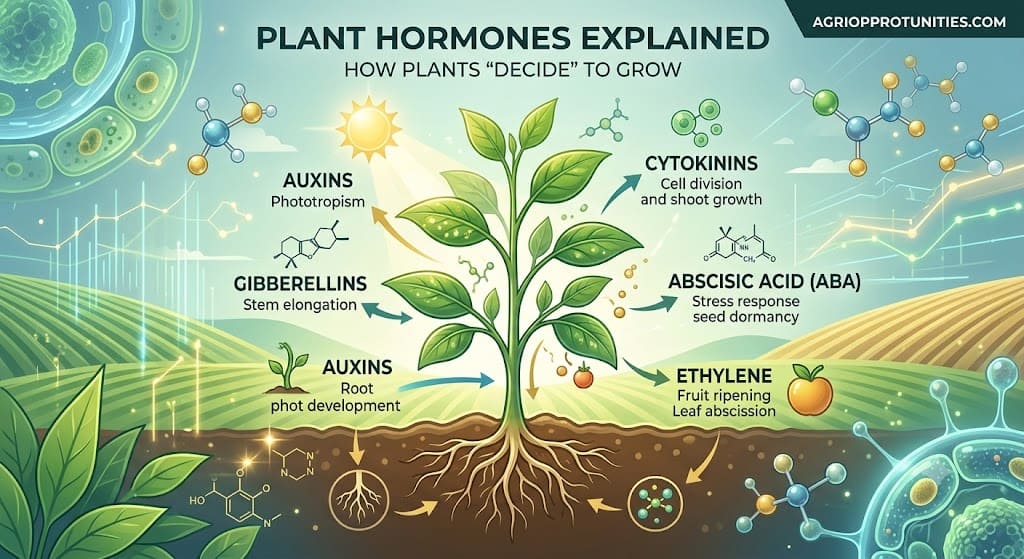
Plant Hormones Explained: How Plants “Decide” to Grow

Plants don’t have a brain or a nervous system, yet they manage to “decide” when to sprout, which direction to grow, when to flower, and when to drop their leaves. All of that coordination happens through a small set of chemical messengers called plant hormones, or phytohormones. I want to walk through what these hormones actually are, what each major one does, and how farmers and researchers actually put this knowledge to practical use in real crop production.

What a Plant Hormone Actually Is
Plant hormones are bioactive chemical compounds that regulate growth, development, and environmental responses, even though they exist in genuinely tiny concentrations within the plant. Despite this small quantity, they produce cascading effects throughout the entire organism, coordinating everything from seed germination to root and shoot development, flowering, fruit ripening, and eventual senescence (aging and death of plant tissue).
The Eight Major Hormone Categories
Research generally groups plant hormones into eight recognized categories: auxins, gibberellins, cytokinins, abscisic acid, ethylene, brassinosteroids, jasmonates, and salicylic acid. Each has a distinct primary role, though as we’ll get to shortly, none of them actually works in isolation.
Auxins
Auxins are central to cell elongation and differentiation, directly influencing how roots and shoots develop and grow. Auxin transport within the plant — physically moving the hormone from cell to cell in specific directions — is what allows a plant to grow toward light or direct root growth downward, making auxin genuinely central to a plant’s basic architectural decisions.
Gibberellins
Gibberellins promote seed germination and stem elongation, essentially controlling how tall and how quickly a plant’s stem grows. This hormone was actually first extracted from a fungus rather than a plant directly, an interesting historical quirk in how it was originally discovered and characterized.
Cytokinins
Cytokinins drive cell division and shoot initiation, working as a kind of counterbalance to auxin in many developmental contexts — the specific ratio between auxin and cytokinin in a given tissue often determines whether that tissue develops into root, shoot, or undifferentiated callus tissue.
Abscisic Acid
Abscisic acid (ABA) regulates a plant’s response to stress and controls seed dormancy, essentially acting as a hormone that tells the plant when to hold back growth in unfavorable conditions rather than pushing forward regardless of circumstances.
Ethylene
Ethylene is critical for fruit ripening and stress responses, and unlike the other hormones on this list, it’s actually a gas rather than a liquid-phase chemical compound. It promotes cell wall degradation, chlorophyll breakdown, and the synthesis of flavor and aroma compounds during ripening — which is exactly why a ripening banana can accelerate the ripening of nearby fruit, since it’s releasing ethylene gas into the surrounding air.
Brassinosteroids
Brassinosteroids promote plant growth and improve tolerance to environmental stress. Scientists recognized them as a distinct hormone family more recently than the others on this list, and their expanding role in crop improvement deserves a closer look later in this article.
Jasmonates
Jasmonates coordinate plant defenses against insect pests and many pathogens, making them essential for activating protective responses under biotic stress.
Salicylic Acid
Salicylic acid strengthens plant immunity, particularly against many disease-causing pathogens, and works alongside jasmonates to coordinate complex defense responses.
The Brassinosteroid Discovery Story
Brassinosteroids have a genuinely interesting origin story worth telling in full. In 1970, researchers reported discovering a new family of plant hormones, which they named “brassins,” isolated specifically from the pollen of rapeseed (Brassica napus). They identified these compounds as genuine hormones based on a specific test: they were translocatable organic compounds isolated from a plant that produced measurable, specific growth control when applied in tiny amounts to a different plant entirely.
What Brassinosteroids Actually Do
Since that original discovery, brassinosteroids have proven to have remarkably wide-ranging effects, playing roles in seed germination, vegetative and reproductive growth, photosynthetic efficiency, vascular tissue differentiation, fruit yield, fruit quality, and resilience to both biotic stress (pests and disease) and abiotic stress (drought, heat, salinity). This breadth of function is genuinely unusual even among plant hormones, and it’s part of why brassinosteroid research has expanded so quickly in recent years.
Why “Hormonal Crosstalk” Is the Real Story
Here’s the concept that matters most for genuinely understanding how plant hormones work, and it’s a theme that should feel familiar if you’ve read the other science-explainer pieces in this series: no single hormone acts in isolation. Plant biologists use the term “hormonal crosstalk” to describe how these different signaling systems constantly interact with, reinforce, or counteract one another.
A Concrete Example: Auxin and Abscisic Acid
Research on root development has found that abscisic acid can induce lateral root growth through a specific receptor pathway, which then interacts directly with auxin’s own signaling pathway. Meanwhile, cytokinin can repress that same pathway, and jasmonate can boost lateral root formation by promoting auxin production through an entirely separate route. Untangling exactly how these different hormonal inputs combine in any given situation remains, in the words of researchers studying this specific area, only just beginning to be understood in its full complexity.
Brassinosteroids Interact With Nearly Everything
Brassinosteroids specifically engage in crosstalk with auxin, cytokinin, ethylene, gibberellins, jasmonic acid, abscisic acid, and salicylic acid, influencing an unusually broad range of physiological and developmental processes as a result. Research on apple trees found that applying brassinosteroid externally actually increased the plant’s own internal levels of auxin and gibberellin too, and upregulated the genes responsible for producing and transporting those other hormones — a clear, concrete demonstration of crosstalk actually happening in a real crop.
How This Crosstalk Helps Plants Handle Environmental Stress
Beyond routine growth and development, hormonal crosstalk plays a genuinely important role in how plants cope with drought, salinity, and temperature extremes — all challenges covered elsewhere in this series, particularly in the dryland farming piece.
A Specific Example From Apple Trees
Research on apples found that a specific transcription factor enhances the plant’s resistance to temperature fluctuations by upregulating both auxin and brassinosteroid signaling pathways simultaneously, showing how these hormone systems work together, rather than independently, to help a plant tolerate environmental stress.
Auxin Transport Changes Under Stress
Environmental stressors are known to alter how auxin moves and distributes within a plant, mediated by specific auxin transporter proteins. Research on watermelon found that abiotic stress changes the expression of specific genes controlling auxin transport, directly affecting how the plant redistributes this hormone in response to difficult growing conditions.
Practical Agricultural Uses: Plant Growth Regulators
Beyond understanding how hormones work naturally, farmers and researchers actively apply synthetic versions of these compounds, commonly called plant growth regulators (PGRs), to achieve specific, deliberate outcomes in commercial crop production.
Boosting Yield and Fruit Size
Auxin and gibberellin, specifically, are used to increase crop grain productivity, boost yield in leafy vegetables, and increase the size of fruits and vegetables — directly improving both the quantity and visual appeal of produce for consumers.
Managing the Full Life Cycle
Plant growth regulators play a role across a plant’s entire life cycle, influencing growth, development, flowering, fruiting, aging, and senescence, and are used to prevent or promote specific outcomes like stem elongation, leafing, and leaf drop, depending on what a specific crop or production system needs.
A Genuine Safety Consideration Worth Knowing
It’s worth being honest about a real caveat here, since it doesn’t get discussed enough in casual coverage of plant growth regulators. Research has flagged that residues of certain PGRs, specifically auxin and gibberellin, have been associated with potential health concerns including hepatotoxicity (liver damage), nephrotoxicity (kidney damage), and genotoxicity (DNA damage) at excessive levels, and these compounds are suspected of potentially disrupting human and animal reproductive system function under certain conditions.
Why This Means Regulation Matters
This is precisely why monitoring PGR residue levels in agricultural products, and enforcing proper application rates and timing, is a genuinely important food safety consideration rather than a minor regulatory formality — a theme that connects to the broader food safety risk assessment piece elsewhere in this science-explainer series.
Why This Matters for Students Considering This Research Area
Plant hormone research sits at a genuinely rich intersection of molecular biology, crop physiology, and practical agronomy. Given how much current research is still actively working out the full complexity of hormonal crosstalk — as one research team studying auxin interactions put it, we are “only beginning to untangle” this complexity — this remains a genuinely active, still-developing field with real room for new discovery, particularly around specific crop species and stress conditions that haven’t yet been studied in depth.
For current research and graduate opportunities in plant physiology and crop hormone signaling, browse live agriculture scholarship listings on Agri Opportunities.
Frequently Asked Questions
How many major types of plant hormones are there?
Researchers commonly group plant hormones into eight major categories: auxins, gibberellins, cytokinins, abscisic acid, ethylene, brassinosteroids, jasmonates, and salicylic acid, each with distinct but often overlapping roles in growth and stress responses.
What is ‘hormonal crosstalk’ in plants?
Hormonal crosstalk describes how different plant hormones interact with and influence one another’s signaling pathways, meaning no single hormone acts in complete isolation, and a change in one hormone’s activity frequently affects how others behave.
Are synthetic plant hormones safe to use on food crops?
When used at approved rates, synthetic plant growth regulators are generally considered safe, but research notes that excessive residues of certain regulators like auxin and gibberellin have been linked to potential health concerns, which is why regulatory limits and proper application practices matter.
When were brassinosteroids discovered as plant hormones?
Brassinosteroids were first identified in 1970 when researchers isolated a new family of growth-promoting compounds, called brassins, from the pollen of rapeseed (Brassica napus), making them one of the more recently recognized additions to the plant hormone family.
- • The Soil and Crop Microbiome Explained
- • What Is Rubisco, and Why Does It Limit How Fast Plants Grow?
- • Plant Hormones: How Plants “Decide” to Grow
- • Understanding Photosynthesis for Better Crop Yields
Add Agri Opportunities as a preferred source on Google to see our latest blogs first.