Dryland Farming and Climate Change: Why Water-Scarce Soils Behave Differently

A soil scientist’s look at why dry soils don’t just emit less — they emit differently, and climate change is changing that further.

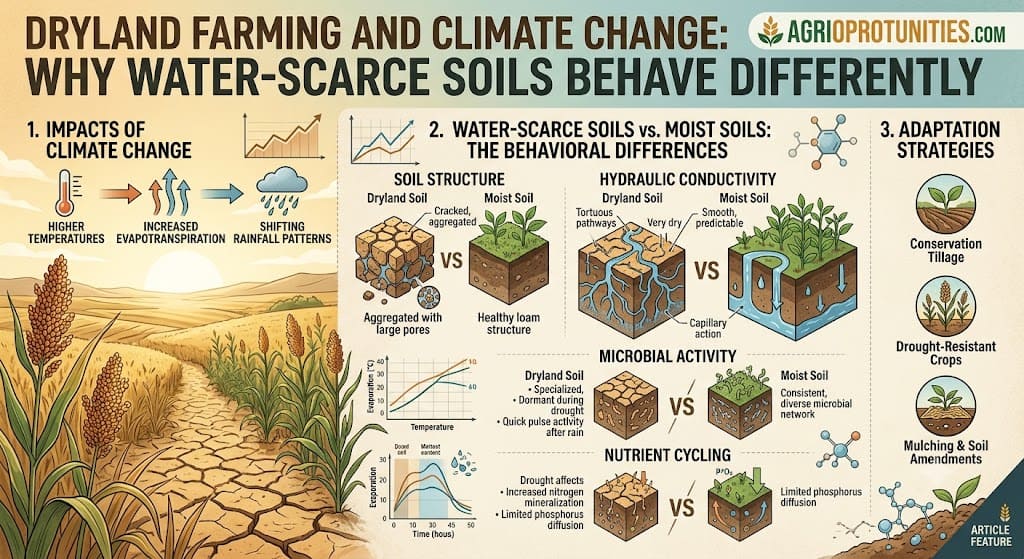
Much of this soil science series so far has focused on soils that get wet — flood-irrigated fields, waterlogged rice paddies, freshly rained-on plots. But a huge share of the world’s cropland, including much of Pakistan’s own agricultural land and a significant part of my own PhD research interest, sits in dryland or semi-arid conditions, where water scarcity is the defining constraint rather than an occasional event. Dry soils don’t just emit less greenhouse gas because there’s less water around. They emit differently, on a different schedule, and in ways that climate change is actively reshaping.

Why Dry Soil Isn’t Simply “Low Emission” Soil
It’s tempting to assume that less water automatically means less microbial activity and, therefore, fewer greenhouse gas emissions. Although that assumption contains some truth, it overlooks an important process: dry soil doesn’t stop nitrogen cycling. Instead, it slows microbial activity and allows nitrogen to accumulate until water returns.
Rainfall or irrigation rapidly reactivates microbial processes. As microbes consume the accumulated nitrogen and carbon, they often trigger a sharp pulse of greenhouse gas emissions instead of the steadier pattern typical of consistently moist soils.
The “Birch Effect”: A Name Worth Knowing
Soil scientists call this phenomenon the Birch effect. It describes the sudden release of carbon dioxide, nitrous oxide, and sometimes methane after dry soil is rewetted. Researchers named the effect after the scientist who first documented it, and decades of research have established it as a defining feature of dryland and seasonally dry ecosystems.
A meta-analysis covering 424 paired observations from 47 studies confirmed that drying and rewetting cycles significantly influence carbon dioxide, methane, and nitrous oxide fluxes. However, the magnitude of those changes depends on the ecosystem and the soil’s physical and chemical properties.
Two Mechanisms Drive the Pulse
Researchers generally attribute the Birch effect to two interacting processes. During drought, microbial activity slows while organic matter and nitrogen compounds accumulate. Once water returns, microbes quickly rebound and process those stored resources, releasing a disproportionate burst of greenhouse gases over a short period.
How This Plays Out Specifically With Nitrogen
Studies of dryland ecosystems show the same pattern for nitrogen. In one experiment that manipulated both summer and winter precipitation, drought caused nitrogen to accumulate in the soil, creating the conditions for a strong emissions pulse after rewetting.
The timing of drought proved just as important as the drought itself. Reduced summer rainfall increased nitric oxide emissions from ammonia-oxidizing bacteria, consistent with greater soil nitrogen availability. By contrast, additional summer rainfall directly stimulated ammonia-oxidizing bacterial activity.
Winter Drought Told a Different Story
Winter drought produced a different response. Although nitrogen continued to accumulate, reduced winter precipitation did not increase nitrifier-derived nitric oxide emissions. Instead, the accumulated nitrate strongly correlated with elevated nitrous oxide emissions after rewetting, indicating that denitrification—not nitrification—became the dominant pathway.
This distinction matters a great deal for climate projections. Since climate change is expected to shift both the amount and seasonal timing of precipitation in many dryland regions, the researchers behind this study concluded that the resulting nitrogen gas emissions will depend heavily on exactly which season sees the biggest rainfall changes, not simply on total annual rainfall alone.
Wet-Dry Cycling Doesn’t Just Happen in Nature — Irrigation Timing Matters Too
This dynamic isn’t limited to naturally dry climates experiencing drought. Controlled research examining wet-dry cycling in agricultural soil, using a potato field as its test system, found that urea fertilizer addition caused a notably stronger “priming effect” on nitrous oxide production specifically under wetter conditions, with urea-derived nitrous oxide showing up more prominently in wetter soil treatments than in consistently moderate moisture.
This connects directly to a practical management point: farmers and irrigation managers working in dryland or semi-arid systems who apply water in occasional, larger events (rather than smaller, steadier ones) may be inadvertently creating exactly the kind of wet-dry cycling that amplifies nitrous oxide pulses, especially if fertilizer application timing overlaps with those irrigation events.
Comparing Dryland and Irrigated Systems Directly
It’s worth putting some numbers on the broader dryland-versus-irrigated comparison. A recent review of greenhouse gas patterns across field cropping systems found irrigation can reduce overall emissions by roughly 20 to 30 percent in carbon dioxide equivalents compared to dryland farming.
That sounds like a straightforward case for irrigation being the lower-emission choice. But the same review flagged an important complication directly relevant to earlier pieces in this series: flood irrigation specifically can increase nitrogen and carbon leaching, which itself drives higher greenhouse gas emissions through the denitrification pathways discussed earlier.
The Real Lesson: It’s About Irrigation Method, Not Just Presence or Absence
Put together, these findings suggest the honest comparison isn’t simply “dryland versus irrigated,” but rather “poorly managed water application versus well-managed water application,” regardless of whether that water comes from rainfall or an irrigation system. Precision-timed, moderate irrigation appears to outperform both continuous flood irrigation and the sharp wet-dry cycling of unmanaged dryland conditions.
Why Soil Texture Changes the Story Again
As covered in the second piece in this series, soil texture shapes how moisture and temperature interact to affect microbial activity, and this holds specifically true in dryland contexts. Coarse, sandy soils drain quickly, limiting water availability for microbes even after a rain event, while fine-textured clay soils retain moisture longer, allowing temperature and moisture to jointly regulate carbon cycling more strongly.
Interestingly, research on soil moisture and carbon dynamics has also found that microbial respiration in many global drylands has adapted somewhat to the local, typically warm thermal regime, which can dampen the expected increase in carbon dioxide emissions under further warming — a reminder that dryland microbial communities aren’t simply “the same microbes as elsewhere, just drier,” but populations that have adjusted over time to their specific water-scarce environment.

Beyond Gas Emissions: Dryland Soils Face a Broader Degradation Risk
Greenhouse gas dynamics are only part of the dryland climate story. Broader assessments note that roughly one-third of the planet’s soils are already degraded through erosion, organic matter loss, and salinization, with this degradation disproportionately concentrated in dryland ecosystems specifically.
Climate change is actively accelerating several of these degradation pathways at once — more frequent droughts, rising temperatures, and, somewhat counterintuitively, more intense heavy rainfall events when rain does occur, all contribute to erosion and nutrient loss in soils that already have comparatively little organic matter buffering capacity to begin with.
A Specific and Concerning Finding: Inorganic Carbon Loss
Recent research has identified a specific and worrying mechanism worth knowing about: drought appears to exacerbate the loss of dryland soil inorganic carbon under warming climate conditions. This matters because dryland soils often store a meaningful share of their total carbon in inorganic forms (such as soil carbonates) rather than purely organic matter, and this pathway has historically received far less research and management attention than organic carbon loss.
What This Means for Farming Practice in Water-Scarce Regions
Given everything above, a few practical implications stand out clearly for dryland and semi-arid farming systems, including much of Pakistan’s own cropping landscape.
Prioritize Moderate, Well-Timed Water Application
Given the wet-dry cycling and Birch effect dynamics discussed throughout this piece, steady, moderate soil moisture — whether from controlled irrigation or fortunate rainfall patterns — appears to produce fewer sharp emissions pulses than a cycle of prolonged drought followed by sudden, intense rewetting.
Separate Fertilizer Timing From Major Wetting Events
Since research specifically found stronger nitrous oxide priming effects when urea was applied under wetter conditions, and given the broader pattern of nitrogen accumulating during dry spells, avoiding fertilizer application immediately before or during a major irrigation or rainfall event may meaningfully reduce the size of the resulting emissions pulse.
Consider Perennial and Deep-Rooted Systems Where Feasible
Research on soil health management in changing climates specifically points to perennial grass systems as a promising strategy in water-limited, semi-arid environments, given their ability to produce economically valuable biomass while helping sequester soil organic carbon and build broader resilience against the degradation pathways discussed above.
A Personal Note on Why This Topic Matters to Me
This is an area I’ve engaged with directly through my own research proposal work on dryland wheat systems, which is precisely why I find the science here so genuinely compelling rather than abstract. Understanding exactly when and why a dryland field is likely to release a nitrous oxide pulse — tied to specific seasonal precipitation patterns rather than simple annual rainfall totals — is the kind of mechanistic detail that separates a genuinely useful field management recommendation from a generic one.
Why This Remains a Rich Area for Future Research
Given how much dryland nitrogen and carbon cycling depends on the specific timing, season, and intensity of moisture changes — rather than simple averages — this is a genuinely active research frontier, particularly as climate change continues to reshape precipitation patterns in ways that don’t uniformly increase or decrease rainfall, but shift its timing and intensity in ways current models are still working to capture accurately.
Where This Series Goes Next
Having now covered nitrogen cycling, nitrous oxide, the ammonia trade-off, biochar, cover crops and organic amendments, and dryland systems, the next piece in this series turns to a genuinely complex, technical concept drawn directly from current soil biogeochemistry research: DOC:NO₃⁻ stoichiometry, and why understanding the ratio between dissolved organic carbon and nitrate matters so much for predicting how a given field will actually behave.
For current research and graduate opportunities in dryland soil science and climate-resilient agriculture, browse live agriculture scholarship listings on Agri Opportunities.
Frequently Asked Questions
What is the ‘Birch effect’ in soil science?
The Birch effect describes the sudden burst of carbon dioxide, nitrous oxide, and sometimes methane released when a dry soil is suddenly rewetted, caused by a rapid spike in microbial activity feeding on nitrogen and carbon that accumulated in the soil during the preceding dry period.
Do dryland soils always emit less greenhouse gas than irrigated soils?
Not necessarily in a simple way. While irrigated systems can show 20 to 30 percent lower overall emissions than dryland systems in some comparisons, dryland soils can release sharp, concentrated pulses of nitrous oxide when a drought period ends and rain finally arrives, since nitrogen accumulates in dry soil and is rapidly processed once the soil rewets.
How does climate change specifically affect dryland nitrogen cycling?
Climate change is altering both the amount and seasonal timing of precipitation in dryland regions, and research shows the effect on nitrogen gas emissions depends heavily on which season sees reduced or increased rainfall, since summer and winter precipitation changes trigger different microbial responses.
Why are dryland soils more vulnerable to degradation under climate change?
Dryland soils already operate with less organic matter and less microbial buffering capacity than more humid regions, and increased drought frequency, salinization, and heavy rainfall events tied to climate change accelerate erosion, nutrient loss, and soil inorganic carbon loss in these already fragile systems.
Add Agri Opportunities as a preferred source on Google to see our latest blogs first.