The Phosphorus Cycle Explained: Why This Nutrient Behaves Nothing Like Nitrogen


A soil scientist’s plain-language explanation of why phosphorus behaves so differently from nitrogen, and why that difference matters for farming and water quality.
If you’ve read my other blog on the nitrogen cycle, phosphorus might seem like it should work the same way — another essential plant nutrient, another set of soil transformations, another loss pathway to water and air. It doesn’t. Phosphorus breaks nearly every pattern nitrogen follows, and understanding exactly how is genuinely useful, both for managing soil fertility and for understanding one of agriculture’s most visible environmental problems: the algae-choked, oxygen-starved lakes sitting downstream of heavily fertilized farmland.

The Single Fact That Explains Almost Everything Else
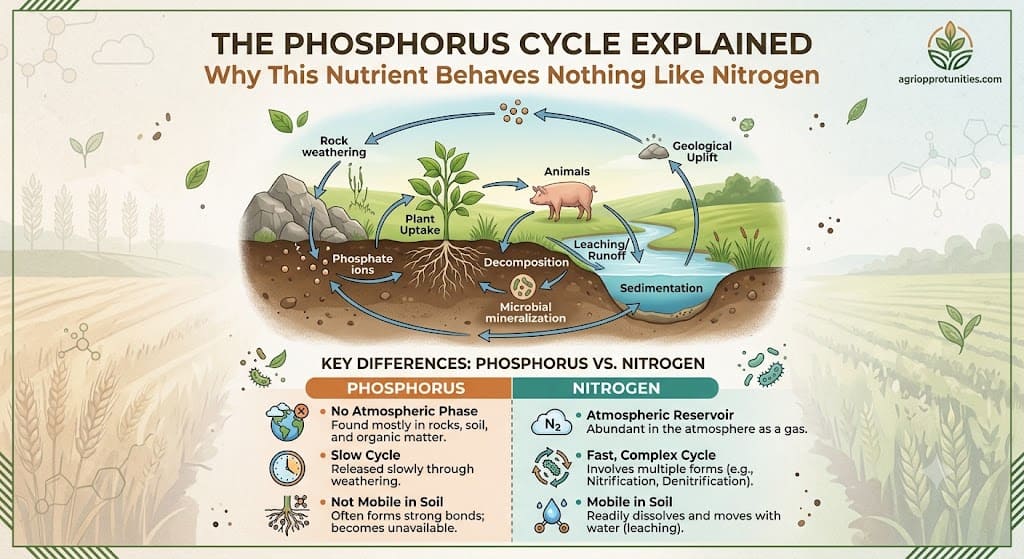
Here’s the one detail worth memorizing above all others: phosphorus has no atmospheric phase. Nitrogen makes up 78 percent of the air around us and cycles constantly between the atmosphere and soil. Phosphorus does neither — it never becomes a gas under normal environmental conditions, and it stays confined to rock, soil, water, and living tissue.
This single difference cascades into nearly every other contrast between the two nutrient cycles, and it’s the reason phosphorus moves so much more slowly through the environment than nitrogen does.
Where Phosphorus Actually Comes From
Phosphorus originates primarily from rocks, particularly a mineral called apatite found in igneous and sedimentary deposits. These geological deposits hold most of Earth’s phosphorus, but plants cannot access most of it directly. Phosphorus enters the soil through slow rock-weathering processes that occur over geological timescales.
Why This Makes Phosphorus a Finite Resource
Unlike elements that circulate through a renewable atmospheric reservoir, phosphorus depends largely on geological processes that replenish available supplies very slowly. As a result, mined phosphate rock is effectively non-renewable on human timescales. Global phosphate rock reserves are concentrated in a limited number of countries, including Morocco and the wider North African region, China, the United States, and other major producing regions. Estimates of how long these reserves will last vary considerably with extraction rates, demand, technological advances, and the distinction between known reserves and broader resources.
How Phosphorus Moves Through Agricultural Soil
When farmers apply phosphate fertilizer or manure to a field, phosphorus enters the soil in two broad forms: inorganic phosphorus, which includes soluble phosphate and phosphorus bound to minerals, and organic phosphorus, which occurs in microbial biomass and organic residues such as crop stubble.
Plants absorb phosphorus primarily as dissolved orthophosphate ions from the soil solution. However, the soil solution usually contains only a small fraction of the soil’s total phosphorus because much of it remains bound to minerals, associated with soil surfaces, or incorporated into organic matter. Soil processes gradually release some of this phosphorus, replenishing the supply available for plant uptake.
Mineralization: Turning Organic Phosphorus Into Plant-Available Form
Soil microbes play a genuinely essential role here, transforming organic phosphorus locked in crop residues and organic amendments into soluble, plant-available orthophosphate through a process called mineralization. This is directly comparable to the microbial transformations covered in the nitrogen cycle piece, though the specific chemistry involved is quite different.
The Problem of Phosphorus “Fixation” in Soil
Unlike nitrate, which moves relatively freely through soil water, phosphorus has notably low mobility. It readily binds to soil minerals — particularly iron, aluminum, and calcium compounds depending on soil pH — in a process often called fixation, which can leave much of a soil’s total phosphorus effectively locked away and unavailable to plants.
Why Soil pH Matters So Much for Phosphorus Availability
In acidic soils, phosphorus tends to bind with iron and aluminum. In alkaline soils, it binds instead with calcium. Both reactions reduce how much phosphorus is actually available for a plant to take up, which is why soil pH management is such a central part of phosphorus fertility planning, and why farmers sometimes use elemental sulfur or microbial inoculants specifically to improve phosphorus solubility in problem soils.
Why Phosphorus Builds Up in Soil Over Time
Because phosphorus doesn’t cycle through the atmosphere and moves slowly through soil, repeated fertilizer or manure applications can cause it to accumulate in soil over years, particularly in fields that regularly receive manure at rates calculated to meet a crop’s nitrogen needs rather than its phosphorus needs.
This is a genuinely common, well-documented pattern: manure application rates are often set based on nitrogen requirements, but manure typically contains proportionally more phosphorus than a crop can use at that same application rate, leading to a steady phosphorus surplus building up in the soil over successive growing seasons.
How Excess Phosphorus Actually Reaches Water
Once soil phosphorus levels exceed what the soil can hold and what crops can use, the excess becomes vulnerable to loss through several pathways: dissolved phosphorus carried in surface runoff, phosphorus attached to eroding soil particles, and, in some soils, downward leaching that eventually reaches groundwater.
Why Sandy Soils Are Especially Vulnerable
Soils with naturally low phosphorus-holding capacity, such as sandy soils, are particularly prone to phosphorus leaching downward through the soil profile rather than being retained near the surface — a genuinely important, region-specific risk factor when planning phosphorus fertilization strategy.
The Eutrophication Chain, Step by Step
This is where phosphorus’s environmental impact becomes most visible, and it follows a well-documented, five-step chain worth understanding in full.

Why Lakes Don’t Recover Immediately, Even After Fertilizer Is Reduced
Here’s a genuinely counterintuitive and important detail: reducing phosphorus inputs to a lake doesn’t immediately fix the problem. A process called internal loading means phosphorus already accumulated in a lake’s bottom sediments continues to leach back into the water column long after external inputs have been reduced.
This means recovery from eutrophication can take years or even decades, even after farmers and land managers have made genuine, effective changes to reduce further phosphorus runoff — a sobering reminder that phosphorus pollution is a genuinely slow-moving problem to both create and reverse.
The Scale of the Problem Globally
Before human intervention, phosphorus flows from land to freshwater systems were estimated at roughly 2.5 teragrams per year. Human agricultural activity, through mined phosphate fertilizer application, has pushed that flow to around 18.2 teragrams per year regionally, with phosphorus reaching the ocean increasing to roughly 4.4 teragrams per year globally.
In economic terms, mitigation costs for eutrophication in the United States alone are estimated at around 2.2 billion dollars annually — a genuinely substantial cost tied directly back to excess phosphorus management on farmland.
Managing Phosphorus Well: What Actually Helps
Soil Testing Before Application
Given how easily phosphorus accumulates and how slowly it moves once excessive, regular soil testing to track phosphorus levels is a foundational management step, allowing farmers to identify fields where phosphorus is already excessive and should receive no further application until levels drop.
Matching Fertilizer and Manure Rates to Crop Removal
Since manure applied to meet nitrogen needs often oversupplies phosphorus, a more precise approach involves calculating application rates based specifically on how much phosphorus a crop will actually remove at harvest, rather than defaulting to nitrogen-based calculations alone.
Soil Conservation Practices
Because a significant share of phosphorus loss travels attached to eroding soil particles, practices that reduce erosion — reduced tillage, grassed waterways, field borders, and improved irrigation and drainage management — directly reduce phosphorus loss alongside their broader soil conservation benefits.
Encouraging Phosphorus-Solubilizing Soil Biology
Phosphate-solubilizing bacteria and mycorrhizal fungi can help release phosphorus from its fixed, unavailable forms in soil, improving a crop’s access to phosphorus that’s already present rather than requiring additional fertilizer input. Practices that support this biology — compost application, cover cropping, and biochar amendments — increasingly form part of a more sustainable phosphorus management strategy.
The Circular Economy Angle: Recovering Phosphorus From Waste
Given the finite nature of phosphate rock, growing research attention is going toward recovering phosphorus from agricultural and food industry waste streams — manure, crop residues, and food processing byproducts — through composting, vermicomposting, and anaerobic digestion. This circular approach offers a genuinely promising complement to mined phosphate fertilizer, simultaneously reducing waste and easing pressure on a non-renewable resource.
Why This Matters for Students Considering This Research Area
Phosphorus management sits at a genuinely important and underappreciated intersection of soil chemistry, water quality science, and long-term resource security. Unlike nitrogen, where the core challenge is largely about efficiency and loss reduction, phosphorus research increasingly grapples with a genuine scarcity question — how to manage a finite resource sustainably while also preventing the water quality damage that excess application causes. That combination of chemistry, ecology, and resource economics makes this a genuinely rich area for future research.
For current research and graduate opportunities in soil fertility and nutrient management, browse live agriculture scholarship listings on Agri Opportunities.
Frequently Asked Questions
Why doesn’t phosphorus have an atmospheric phase like nitrogen?
Phosphorus doesn’t form a stable gas under normal environmental conditions, so unlike nitrogen, which cycles through the atmosphere as N2 gas, phosphorus moves almost entirely through rock, soil, water, and living organisms, making its cycle considerably slower than nitrogen’s.
How long will global phosphate rock reserves last?
Current estimates suggest global phosphate rock reserves could be depleted within roughly 50 to 140 years if current extraction trends continue, since phosphate rock is a finite, non-renewable geological resource unlike atmospheric nitrogen.
Why does phosphorus runoff cause dead zones in lakes?
Phosphorus is typically the limiting nutrient in freshwater ecosystems, so when excess phosphorus runs off farmland into a lake, it triggers rapid algal growth; when that algae dies and decomposes, the decomposition process consumes dissolved oxygen, creating oxygen-depleted conditions that can kill fish and other aquatic life.
Why doesn’t a lake recover immediately after fertilizer runoff is reduced?
Because of a process called internal loading, phosphorus that has already accumulated in a lake’s bottom sediments continues to release back into the water column for years or decades, meaning recovery can take far longer than the time it took for the pollution to occur.
Add Agri Opportunities as a preferred source on Google to see latest blog listings first.