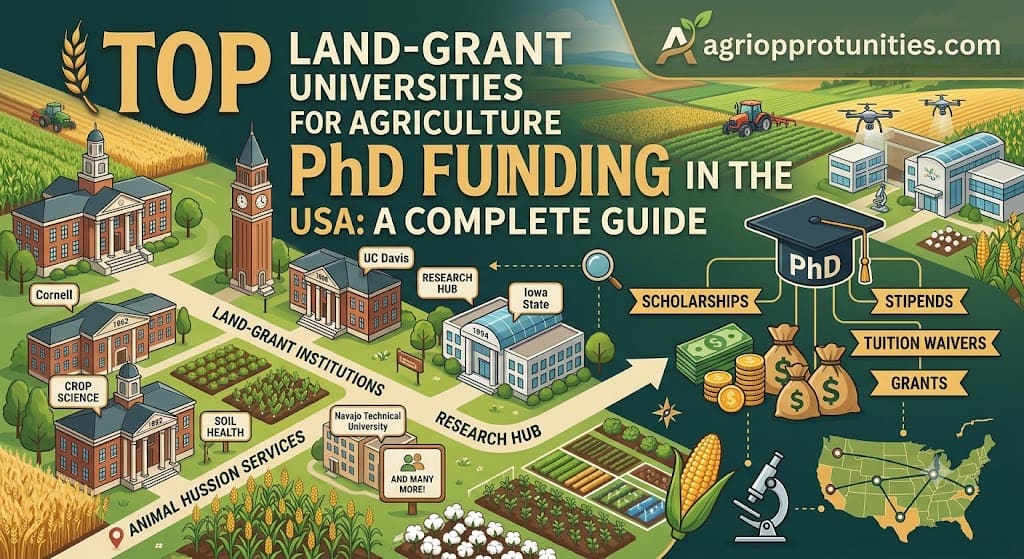
Top Land-Grant Universities for Agriculture PhD Funding in the USA: A Complete Guide


If you’re researching PhD programs in agriculture, soil science, agronomy, or related fields in the United States, you’ve probably run into the term “land-grant university” repeatedly without a clear explanation of why it matters. It matters a great deal, because land-grant status is directly connected to how agriculture PhD funding works in America — and understanding that connection will save you significant time when identifying which programs are genuinely likely to offer full funding.
This guide walks through what land-grant status actually means, how PhD funding is structured and where the money comes from, what stipends and assistantships realistically look like, examples of how funded programs are set up at specific universities, and practical steps for identifying and securing a funded position.
What “Land-Grant University” Actually Means
The land-grant system dates back to the Morrill Act of 1862, which gave states federal land to establish colleges focused on agriculture, science, and engineering — fields that were largely excluded from elite universities of the era. Today, the land-grant system includes three overlapping categories of institutions:
Original land-grant universities — large public research institutions like Kansas State, Michigan State, Iowa State, Texas A&M, and UC Davis/Berkeley.
Historically Black land-grant universities including Tuskegee University, North Carolina A&T, and Alabama A&M.
Tribal Colleges and Universities granted land-grant status, receiving dedicated federal agricultural research and education funding.
Land-grant status ties directly into formula-based federal funding that doesn’t exist for non-land-grant institutions.
The reason this classification matters for PhD funding specifically is that land-grant status ties directly into a formula-based federal funding pipeline that doesn’t exist for non-land-grant institutions in the same way.
Where the Funding Actually Comes From
Understanding the funding pipeline helps explain why some agriculture departments can guarantee funding for essentially every PhD student, while others cannot. There are several key federal mechanisms at play:
Hatch Act
Funds agricultural experiment stations at land-grant universities — foundational research infrastructure that supports faculty research programs.
Smith-Lever Act
Supports Cooperative Extension Services, requiring states to match federal dollars — reflects broader institutional infrastructure.
AFRI
USDA’s flagship competitive research grant program — the single biggest source of “hidden” PhD funding through faculty grants.
National Needs Fellowships
NIFA program funding universities directly to support PhD training in targeted expertise shortage areas.
How PhD Funding Is Structured in Practice
| Funding Type | What It Is | Key Features |
|---|---|---|
| Research Assistantship (RA) | Ties student to faculty grant-funded research project | Stipend + tuition waiver + insurance — most common route |
| Teaching Assistantship (TA) | Teaching/grading responsibilities for undergraduate courses | Similar stipend + tuition benefits — often in later years |
| Departmental Fellowship | Merit-based award with fewer/no work obligations | Often used for recruitment — may stack with RA/TA |
What Stipends and Funding Packages Realistically Look Like
- Annual stipends broadly range between $23,000 and $30,000 for standard research/teaching assistantships in agriculture departments.
- Tuition waivers covering all or most credit hours during fall and spring semesters.
- Health insurance bundled into the assistantship package — typically 12 months of coverage.
- Some departments guarantee funding for a fixed number of years (commonly 4-5) provided the student maintains good academic standing.

Examples of How Funded Programs Are Structured
Rather than presenting a single “best” ranking — which shifts year to year and depends heavily on your specific subfield and target advisor — it’s more useful to understand how funding is actually structured at representative land-grant programs:
- Kansas State University’s Agronomy PhD supports most enrolled students through half-time graduate research assistantships tied to specific faculty research projects.
- Michigan State University’s Department of Agricultural, Food, and Resource Economics explicitly states that both domestic and international students are eligible for assistantships with tuition coverage and health insurance.
- University of California, Davis’s Agricultural and Environmental Chemistry PhD has a departmental policy of fully funding all students for at least five years.
These illustrate a consistent structural pattern: land-grant agriculture departments tend to treat PhD funding as a near-universal expectation for enrolled students.
Practical Steps for Identifying and Securing Funded Positions
- Start with faculty, not admissions pages. Identify a specific professor whose active, currently-funded research aligns with your interests.
- Check whether a professor holds active funding. USDA’s NIFA maintains public award databases — look for AFRI or Hatch-funded projects.
- Email the professor directly before applying. A short, specific email referencing their work is the single most effective step.
- Ask directly about the funding guarantee. Clarify years guaranteed, academic standing requirements, and summer funding separately.
- Confirm assistantship eligibility explicitly if you’re an international applicant — most are open, but some federal fellowships carry citizenship restrictions.
A Note on Realistic Expectations
It’s worth being direct about one thing: a fully funded U.S. agriculture PhD, while genuinely achievable and common, usually requires finding the right supervisor match more than it requires finding the “best” university in the abstract. A strong funded position at a mid-ranked land-grant university, working under an active, well-funded professor in your specific research area, will typically serve your career better than an unfunded or partially funded position at a more prestigious institution.
For currently open PhD and research positions in agriculture and soil science across the USA and internationally, browse live agriculture scholarship and PhD listings on Agri Opportunities.
Frequently Asked Questions
What does “land-grant university” actually mean?
Land-grant universities are institutions established under the Morrill Acts of 1862, along with later 1890 and 1994 institutions, that receive dedicated federal funding for agricultural research, extension, and education, distributed through mechanisms like the Hatch Act and Smith-Lever Act.
Are agriculture PhDs usually fully funded at US land-grant universities?
In most research-focused agriculture PhD programs at land-grant universities, funding through a research or teaching assistantship is standard and expected, covering a stipend, tuition waiver, and health insurance.
What is the difference between a research assistantship and a fellowship?
A research assistantship typically ties a student to a specific faculty member’s grant-funded project and often involves lab or field work duties, while a fellowship is usually a merit-based award with fewer or no work obligations attached.
Do international students qualify for land-grant university agriculture PhD funding?
Yes, in most cases. Research and teaching assistantships funded through faculty grants or departmental funds are typically open to both domestic and international students, unlike some federal fellowship programs which require U.S. citizenship.
Looking for funded agriculture PhD positions? Browse live, currently open PhD and research positions on Agri Opportunities, including land-grant university funded positions in the USA.
Add Agri Opportunities as a preferred source on Google to see our latest career guides and job listings first.