📋 At a Glance
- Erasmus Mundus Master’s
- DAAD & National Scholarships
- Supervisor-Funded PhD
- University-Specific Funding
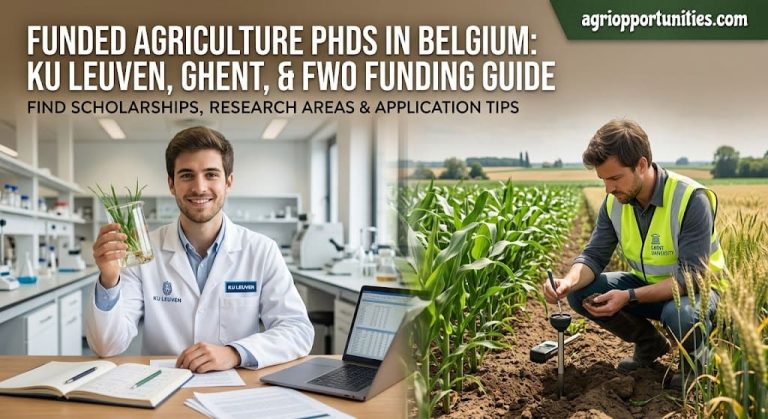
Europe remains one of the most rewarding destinations for agriculture students and researchers seeking funded postgraduate study. Between Erasmus Mundus joint master’s programmes, national government scholarships, and university-specific funding tied to individual research groups, there are more routes into a fully funded European agriculture degree than most applicants realize. The challenge isn’t a shortage of opportunities — it’s knowing where to look and how to build an application that actually gets noticed.
This guide walks through the main funding routes, what makes an application competitive, and the mistakes that quietly sink otherwise strong candidates.
Quick Comparison: Funding Routes at a Glance
| Funding Route | Type | Key Features | Best For |
|---|---|---|---|
| Erasmus Mundus | Master’s | Fully funded • Multi-country study • Monthly stipend • Tuition + travel covered | Students seeking a prestigious, multi-national master’s experience |
| National Government (DAAD, SI, OKP) | Master’s / PhD | Country-specific • Return-to-home requirement • Often prioritizes development impact | Applicants with a clear plan to apply skills back home |
| Supervisor-Funded PhD | PhD | Project-specific • Direct supervisor outreach • Advertised as job vacancies • Salary + benefits | PhD candidates with strong research fit and outreach skills |
| University Scholarships | Master’s / PhD | Institution-specific • Merit-based • Often tied to faculty research priorities | Students targeting a specific university or research group |
Why Europe, and Why Now
European universities have expanded funding specifically for agriculture, food systems, and environmental science over the past several years, driven by EU policy priorities around climate adaptation, soil health, and food security. Countries like the Netherlands, Germany, Denmark, Sweden, and France host some of the world’s leading agricultural research institutions, and many actively recruit international students because their own domestic pipelines can’t fill every funded PhD or master’s position.
For students from Pakistan and similar agricultural economies, this creates a genuine opening: European supervisors are often looking for candidates with real field experience in smallholder systems, dryland cropping, or tropical agronomy — backgrounds that European students frequently lack.
The Three Main Funding Routes
1. Erasmus Mundus Joint Master’s Degrees (EMJMD)
These are fully funded, EU-run master’s programmes delivered jointly by two or more European universities, meaning you study in multiple countries during the same degree. They cover tuition, a monthly stipend, travel, and insurance. Agriculture-relevant EMJMD programmes include tracks in agroecology, food security, plant breeding, and sustainable land management. Applications typically open in October and close between December and January for the following academic year, so timing matters enormously — most applicants who miss this window end up waiting a full year.
2. National Government Scholarships
Several European governments fund scholarships specifically for students from developing countries. Examples include the Dutch Orange Knowledge Programme, the German DAAD scholarships, and Sweden’s SI scholarships. These are usually broader than a single university and often prioritize applicants who can show how their study will benefit agricultural development back home — a genuine advantage for applicants with a clear return-and-apply plan.
3. University or Supervisor-Funded PhD Positions
This is the route most relevant for PhD-level applicants, and the one most people misunderstand. Unlike master’s scholarships, many European PhD positions are not a general application to a university — they’re tied to a specific research project and a specific supervisor’s grant funding. This means the process looks more like a job application than a scholarship application: you identify a professor whose research matches your interests, reach out directly, and propose or respond to a specific project.

Building a Competitive Application
Start with the research fit, not the university ranking. Reviewers can tell within a paragraph whether an applicant actually understands the research group’s work or is sending a generic letter to fifty universities. Read the supervisor’s last two or three papers, understand their current research gaps, and make sure your motivation letter engages with specifics — a named technique, a named gap, a named system they work in.
Lead with field experience, not just grades. European agriculture programmes value hands-on research experience heavily. Greenhouse trials, field sampling, lab technique proficiency — these carry real weight, often more than a marginally higher GPA.
Get your English proficiency sorted early. IELTS or TOEFL scores can take weeks to schedule and receive, and most scholarship deadlines won’t wait for a delayed test date. Book this before you start writing applications, not after.
Secure your recommendation letters months in advance. Professors get flooded with letter requests near deadlines. Reach out at least two months before any submission date, and give your recommenders a clear one-page summary of your background and the specific programme so their letter can be genuinely specific rather than generic.
Common Mistakes That Sink Applications
- Applying too late for Erasmus Mundus programmes. The October–January window is unforgiving; there’s no rolling admission.
- Sending the same motivation letter to every programme. Reviewers read hundreds of these, and generic letters are obvious within the first two sentences.
- Underselling practical experience. Field trial experience, extension work, or farm management experience is genuinely valuable and should be framed explicitly, not buried in a CV line.
- Ignoring supervisor-funded PhD positions entirely. Many applicants only search “scholarships” and miss that a huge share of European PhD funding is advertised as job vacancies on university career pages, not scholarship portals.

Where to Look
Beyond general scholarship databases, check individual university PhD vacancy boards directly — Wageningen University, Copenhagen University, Aarhus University, and Ghent University all post funded agriculture positions on their own HR pages, often before they appear anywhere else. Following specific research groups on institutional pages, rather than relying only on scholarship aggregator sites, consistently surfaces opportunities earlier.
📢 Ready to apply? For live, currently open positions matched to your background, browse current agriculture scholarship listings on Agri Opportunities, updated as new funding is announced.
Switzerland runs the same broad employment-based PhD model as Denmark and Sweden, covered elsewhere on this site, but with a few genuinely distinctive details worth understanding before you apply — including some of the highest doctoral compensation in Europe, paired with famously high living costs. This guide focuses on Switzerland’s two federal institutes of technology, ETH Zurich and EPFL, the two most prominent destinations for agriculture-adjacent PhD research in the country.
PhD as Genuine, Well-Paid Employment
As with the Nordic systems covered elsewhere on this site, Swiss PhD students are not typically “scholarship students” in the traditional sense — they’re full-time university employees, commonly referred to as scientific or doctoral assistants, hired on contracts with salaries defined by national scales.
What This Actually Pays
As of 2026, EPFL’s basic starting salary for a doctoral assistant is 55,225 Swiss francs gross per year. More broadly across ETH and EPFL, doctoral stipends range from roughly 50,000 to 62,000 francs annually — genuinely well above typical European PhD compensation, including comparison points like Germany’s DFG-funded positions, which sit closer to 45,000 to 55,000 euros.
The Living Cost Reality Check
It’s worth being honest that this higher pay reflects genuinely higher costs, not just better funding. Zurich and Geneva rank among the most expensive cities globally for cost of living, placing in the same tier as Hong Kong, Singapore, and New York — meaning the higher salary needs to be weighed against a correspondingly higher cost base rather than treated as pure additional purchasing power.
Tuition Is Almost an Afterthought
Given the employment-based structure, tuition fees are genuinely minimal — often just a few hundred Swiss francs per semester, with ETH Zurich specifically citing fees around 809 CHF per semester. Your salary is effectively your entire funding package, rather than needing to separately cover significant tuition costs on top of living expenses.
How PhD Admission Actually Works
You Generally Need a Doctoral Program Behind You First
At EPFL specifically, you must be admitted by a doctoral program before you can be hired as a doctoral assistant. In some cases, a doctoral program may admit a candidate even without a corresponding funded position immediately available — in that situation, the candidate remains eligible for hiring for up to one year while funding is sought, and can pursue individual scholarships and external funding in parallel.
Finding a Supervisor Is the Real First Step
As with Germany’s traditional PhD model covered elsewhere on this site, Swiss admissions tend to be based on genuine fit and research alignment between you and a specific supervisor, rather than a standardized, purely metrics-based admissions process. Direct outreach to a professor whose research matches your interests — following the same approach recommended in the general research assistantship guide elsewhere on this site — is typically the practical starting point, sometimes taking several months of sustained outreach before securing a supervisor’s commitment.
A Concrete, Currently Open Example: ETH Zurich’s Agricultural Economics PhD
To illustrate these opportunities with a concrete example, consider a recent ETH Zurich vacancy relevant to this site’s focus. ETH Zurich advertised a four-year doctoral position in Agricultural Economics and Policy under Professor Robert Finger in the Agricultural Economics and Policy Group. The position formed part of the ACHIEVE project, which explores pathways to net-zero emissions in hard-to-abate sectors, including agriculture.
What Made This Position Attractive
The position offered a doctoral salary, employee benefits, and the opportunity to contribute directly to a climate policy research project. By connecting agricultural economics research with Switzerland’s net-zero transition planning, the role linked academic investigation with practical policy challenges.
What the Application Actually Required
Applicants had to submit a cover letter, CV, academic transcripts, and contact details for two referees in a single PDF through ETH Zurich’s online application portal. The vacancy welcomed recent master’s graduates and candidates who were still completing a degree in agricultural economics or a related discipline. Applicants should consult the original advertisement to confirm the eligibility criteria and submission requirements.
A Language Detail Worth Noting
Some Swiss positions, including certain policy-facing roles, may favor or require proficiency in one of Switzerland’s major working languages (German or French) alongside English, which can meaningfully narrow the international applicant pool for those specific roles — worth checking carefully on each individual posting rather than assuming English alone is always sufficient, even at internationally-oriented institutions like ETH and EPFL.
Where to Actually Search for Swiss PhD Positions
Direct University Job Portals
ETH Zurich, EPFL, and other Swiss universities including Zurich, Geneva, Lausanne, Bern, Basel, and Fribourg regularly advertise PhD openings directly on their own job portals, alongside general academic job boards like Academic Positions and FindAPhD.
Structured Graduate Schools
Beyond individually advertised positions, structured graduate schools offer another entry route — the Life Science Zurich Graduate School, a joint programme between ETH Zurich and the University of Zurich, offers over 100 fully funded PhD positions across roughly 500 research groups in the life sciences broadly, a genuinely large and relevant pool for agriculture-adjacent research interests.
Swiss Government Excellence Scholarships
Switzerland’s Federal Commission for Scholarships for Foreign Students administers the Swiss Government Excellence Scholarships for eligible international researchers and postgraduate candidates. Depending on the applicant’s country of origin and scholarship category, these awards may support doctoral research or a shorter research stay. Eligibility, funding duration, and application procedures vary by country and award type. Many application routes require applicants to identify a suitable Swiss academic host, and some require formal support from a professor. Applicants should consult the official scholarship guidelines for their country to confirm the requirements.
What Makes ETH and EPFL Genuinely Distinctive as a Career Investment
ETH Zurich and EPFL offer doctoral researchers access to internationally recognized research environments, extensive academic networks, and established industry connections. However, career outcomes vary by discipline, research group, and individual experience, so a doctorate does not guarantee a tenure-track position at a leading university within five years of graduation. Prospective students can evaluate academic career prospects by reviewing graduate placement data, alumni profiles, and the career paths of recent graduates in their field. Both universities also maintain industry partnerships, including connections with companies such as Nestlé, which may interest graduates pursuing careers in agriculture, food science, or related industries.
Practical Tips for a Competitive Application
Start supervisor outreach well in advance, since securing a professor’s genuine commitment can take several months of sustained contact, and treat this relationship-building as the actual gating step in your application timeline rather than an afterthought. Confirm language requirements explicitly for any specific posting rather than assuming English alone suffices, particularly for policy-facing or applied research roles. And budget realistically for Swiss living costs specifically — the higher salary figures covered in this guide need to be weighed honestly against Zurich and Geneva’s position among the most expensive cities in the world, rather than treated as straightforwardly superior to lower-paying positions in more affordable countries.
For currently open PhD positions in Switzerland and across Europe, browse live agriculture scholarship listings on Agri Opportunities.
Frequently Asked Questions
How much does a PhD student at ETH Zurich or EPFL actually earn?
As of 2026, EPFL’s basic starting salary for a doctoral assistant is 55,225 Swiss francs gross per year, while ETH and EPFL doctoral stipends more broadly range from roughly 50,000 to 62,000 francs annually, well above typical European PhD compensation.
Do I need to find a supervisor before applying for a PhD in Switzerland?
Yes, in most cases. At EPFL specifically, you must be admitted by a doctoral program before you can be hired as a doctoral assistant, and finding a professor willing to supervise your specific research area is typically the first practical step.
How much does PhD tuition cost in Switzerland?
Tuition fees are very low, often only a few hundred Swiss francs per semester, since most PhD students are treated as full-time university employees rather than fee-paying students, meaning your salary functions as your primary source of funding.
What is the Swiss Government Excellence Scholarship?
It’s a national-level award, run by the Federal Commission for Scholarships for Foreign Students, available to postgraduate researchers from over 180 countries, funding either a full PhD of usually up to three years or a research stay during a PhD already underway elsewhere.
Add Agri Opportunities as a preferred source on Google to see latest guide listings first.