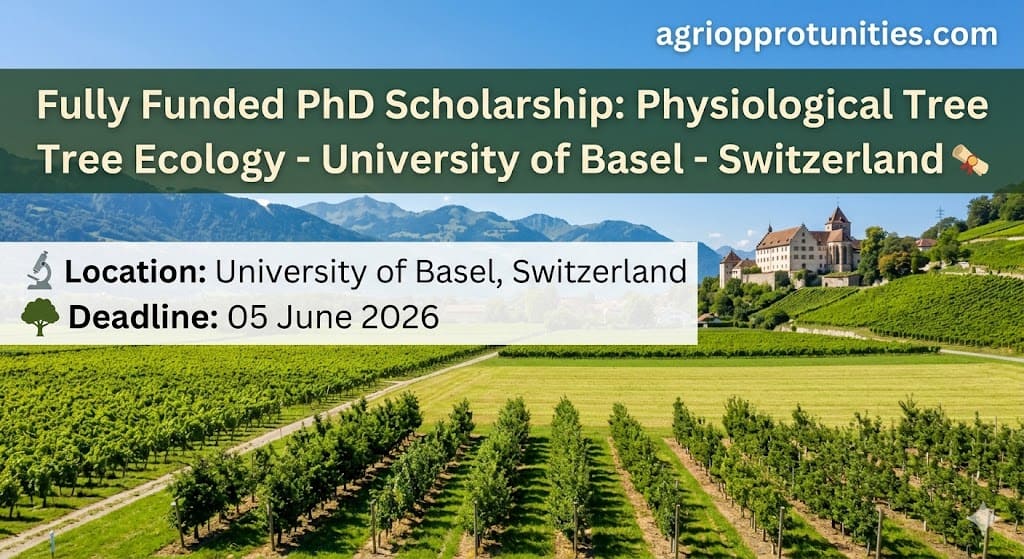
Fully Funded PhD Scholarship: Physiological Tree Ecology – University of Basel – Switzerland

About the University of Basel
Applications are open for a PhD Physiological Tree Ecology Switzerland position at the University of Basel. The project investigates how cold soils limit tree growth using greenhouse experiments, stable isotope labeling, and alpine fieldwork. Founded in 1460, the University of Basel is the oldest university in Switzerland and one of Europe’s most respected research institutions. The Department of Environmental Sciences is internationally recognized for research in ecology, climate science, and sustainability. This four-year doctoral position is funded by the Swiss National Science Foundation (SNSF) and will be carried out in collaboration with researchers at the Swiss Federal Institute for Forest, Snow and Landscape Research.
Scholarship Overview
Project Description
Trees occupy distinct upper elevational and northern latitudinal limits determined by species-specific temperature thresholds. This PhD project focuses on a key hypothesis: low soil temperatures restrict root water uptake, creating hydraulic limitations that suppress tree growth. This mechanism remains insufficiently understood and is poorly represented in current tree hydraulic and vegetation models.
The project combines controlled greenhouse experiments with tree seedlings, stable isotope labeling techniques, continuous sap flow measurements, field observations in Swiss alpine forests, and statistical modeling in R. Together, these approaches will clarify how cold soils influence the physiology and ecology of major European temperate tree species.
Key Research Questions
- How do low root temperatures affect water uptake in different tree species?
- What role do aquaporins play in cold sensitivity?
- Which temperature thresholds define root hydraulic failure?
- How do these thresholds relate to natural treeline conditions in the Swiss Alps?
- How can these findings improve predictive models of forest productivity under climate warming?
Why This Scholarship Stands Out
This PhD is unique because it addresses a fundamental question in plant ecophysiology: how cold soils limit tree growth at high elevations and latitudes. Understanding these hydraulic thresholds is increasingly important as climate change alters forest ecosystems and species distributions. The project combines controlled greenhouse experiments with alpine field studies at the Stillberg treeline research site near Davos, Switzerland. You will use cutting-edge techniques including stable isotope labeling, sap flow measurements, and aquaporin analysis. In the second half of the project, a postdoctoral researcher will join the team, and you will collaborate on mature tree investigations. For a student interested in plant ecophysiology and climate change, this is an opportunity to conduct research with direct relevance to forest modelling and conservation.
Key Responsibilities
- Design and conduct greenhouse experiments on seedlings of multiple European tree species
- Quantify root water uptake under cold conditions using stable isotope tracers
- Measure sap flow continuously to detect hydraulic thresholds
- Investigate aquaporin-mediated transport processes
- Conduct alpine fieldwork across elevational gradients in the Swiss Alps
- Monitor soil and air temperatures at the Stillberg alpine treeline research site
- Collaborate with a postdoctoral researcher on mature tree investigations
- Assist with teaching activities in the Physiological Plant Ecology Group
Candidate Profile and Eligibility
| Requirement | Details |
|---|---|
| Education | MSc degree in Botany, Ecology, Forest Science, Environmental Science or related discipline |
| Knowledge | Basic knowledge of plant physiology |
| Language | Strong written and spoken English |
| Statistical Skills | Experience with statistical analysis in R |
| Personal Qualities | Ability to work independently and collaboratively |
Preferred Qualifications:
- Experience with plant ecophysiological techniques
- Familiarity with sap flow measurements
- Stable isotope methods
- Basic electrical engineering knowledge
- Willingness to conduct long-term fieldwork in subalpine terrain
What They Offer
| Benefit | Details |
|---|---|
| Funding Duration | 4 years (fully funded by SNSF) |
| Start Date | July 2026 or later |
| Location | Basel, Switzerland (fieldwork in Swiss Alps) |
| Salary | Internationally competitive (University of Basel regulations) |
| Benefits | Swiss social benefits |
| Infrastructure | Access to advanced research infrastructure |
| Training | PhD school courses in technical, transferable, and career-development skills |
| Networks | Opportunity to join international research networks |
My Application Strategy
- Highlight your plant ecophysiology experience – Mention any work with plant water relations, gas exchange, or hydraulic measurements
- Emphasize statistical skills – Experience with R for data analysis is required
- Show familiarity with sap flow or isotope methods – These are advantageous
- Demonstrate willingness for alpine fieldwork – The project involves long-term work in subalpine terrain
- Prepare a one-page motivation letter – Keep it concise as specified
Who Should Apply
This PhD is perfect for a student with a background in botany, ecology, or forest science who is fascinated by how cold temperatures limit tree growth at high elevations. If you enjoy both controlled greenhouse experiments and alpine field studies, and want to understand the physiological mechanisms that define treelines, this project offers training across plant ecophysiology, stable isotope techniques, and statistical modeling. Candidates with experience in sap flow measurements or aquaporin research are especially encouraged. The ideal candidate is someone who wants to understand how trees will respond to climate change at their cold limits.
How to Apply
Submit your application through the APPLY NOW link on the University of Basel website.
Required documents:
- Motivation letter (maximum one page)
- Curriculum Vitae (CV)
- Copy of your MSc degree
- Names and contact details of three referees
For academic questions, contact: Prof. Dr. Günter Hoch – guenter.hoch@unibas.ch
Useful Links
Similar Posts
Fully Funded PhD Scholarship: Soil Microbiomes & Soil Health – Ireland
Applications are open for a Fully Funded PhD Soil Microbiomes Ireland position at Teagasc Johnstown Castle, in collaboration with the University of Galway. This PhD will investigate soil microbiomes in pasture-based systems and their role in soil health and grassland productivity, with a focus on nutrient and carbon cycling.
Fully Funded PhD Scholarship: Meiotic Recombination & Barley Breeding – Germany
Applications are open for a PhD Meiotic Recombination Barley Germany position at the Leibniz-Institute for Plant Genetics and Crop Plant Research (IPK) in Gatersleben. The project exploits natural genetic variation in meiotic recombination to overcome breeding barriers in barley.
Fully Funded PhD Scholarship: Plant Pathology – Montana State University USA
Applications are open for a PhD Plant Pathology USA position at Montana State University’s Eastern Agricultural Research Center in Sidney, Montana. The project focuses on dry bean disease management in irrigated production systems.
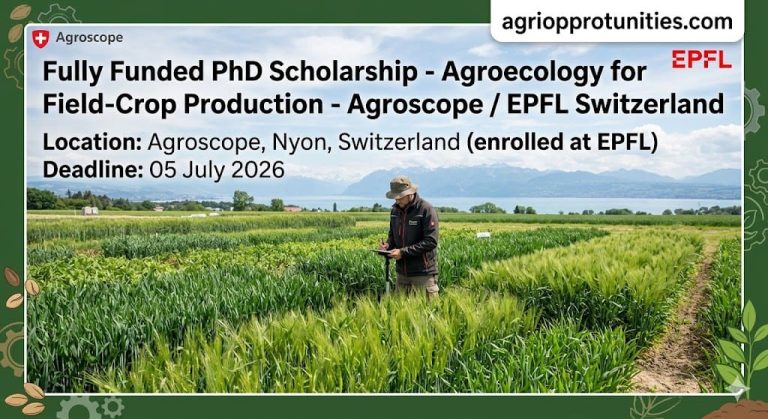
Fully Funded PhD Scholarship – Agroecology for Field-Crop Production – Agroscope / EPFL Switzerland
Applications are open for a PhD Agroecology Field Crop Production Switzerland position at Agroscope in Nyon, in collaboration with EPFL. The SUSTAGRI project investigates the effects of reduced soil tillage and herbicide application on weed diversity, soil microbiome, and soil organic carbon.
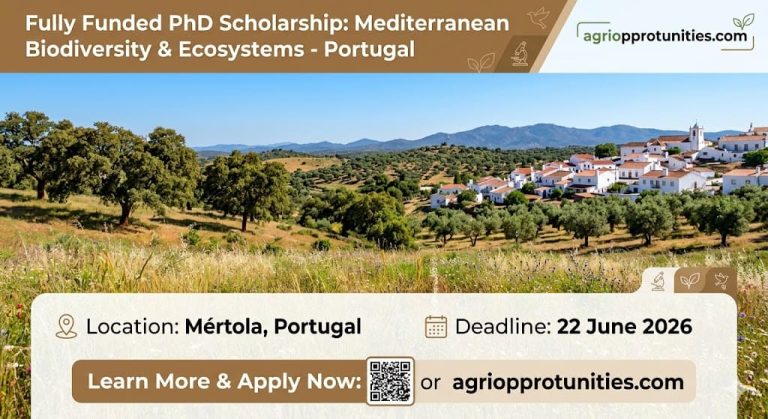
Fully Funded PhD Scholarship: Mediterranean Biodiversity & Ecosystems – Portugal
Applications are open for PhD Mediterranean Biodiversity Portugal positions at the Mértola Biological Station Association (EBM). The call awards 4 (four) PhD studentship grants in the areas of Biological Sciences, Veterinary Sciences, Forest Engineering and Agronomy or related areas.
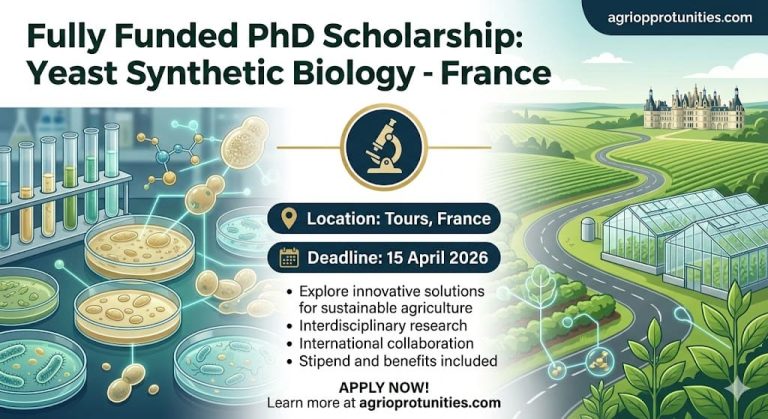
Fully Funded PhD Scholarship: Yeast Synthetic Biology – France
Applications are open for a Fully Funded PhD Yeast Synthetic Biology France position at the University of Tours, Plant Biomolecules and Biotechnologies (BBV) laboratory in Tours, France. This PhD project focuses on using synthetic biology to enable de novo production of complex monoterpene indole alkaloids (MIAs) in heterologous hosts.
I am interested