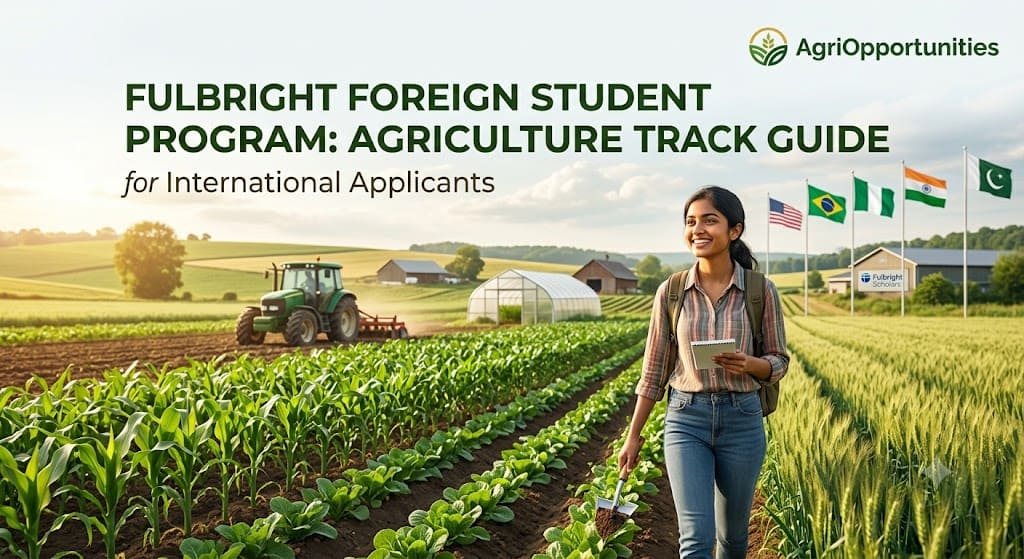
Fulbright Foreign Student Program: Agriculture Track Guide for International Applicants


The Fulbright Foreign Student Program is one of the most recognizable routes into a fully funded U.S. master’s or PhD, awarding roughly 4,000 grants annually to students from more than 160 countries. For agriculture applicants specifically, it’s also one of the more genuinely accessible fully funded options — several country programs, including Pakistan’s, explicitly list agriculture as a priority field. But the application process has real quirks that catch first-time applicants off guard, particularly around how the program is actually administered.
Quick Facts
160+ Countries
Fulbright awards grants to students from more than 160 countries annually.
4,000 Grants Yearly
Approximately 4,000 Fulbright Foreign Student grants are awarded each year.
Agriculture Priority
Pakistan and several other countries list agriculture as a priority field.
Country-Specific
Applications are processed through binational commissions, not a single U.S. office.
How the Program Actually Works
Unlike a single centralized U.S. scholarship office, the Fulbright Foreign Student Program is administered through binational Fulbright Commissions or Foundations, or through U.S. Embassies, in each applicant’s home country. This means eligibility details, required test scores, deadlines, and even the specific university placement process differ meaningfully from country to country. In Pakistan, the program is run by USEFP, the United States Educational Foundation in Pakistan, which manages everything from application review to the eventual visa process.
In the U.S., two organizations handle placement on Fulbright’s behalf: the Institute of International Education (IIE) and AMIDEAST, depending on region. Applicants are placed into U.S. universities either through IIE’s Placement service, where the Fulbright team applies to institutions on the candidate’s behalf, or through Self-Placement, where the candidate secures their own admission.
🇵🇰 Pakistan Fulbright Timeline (Example)
Eligibility Basics
Core requirements across most country programs include:
- Residency in the country of nomination throughout the application process.
- The equivalent of a U.S. bachelor’s degree with a strong academic record by the program start date.
- English fluency, typically demonstrated through a recent TOEFL score of at least 79-80 (Internet-Based Test) or an IELTS score around 6.5.
For Pakistani applicants specifically, eligibility requires Pakistani citizenship, a four-year bachelor’s degree (or a bachelor’s plus master’s totaling 16 years of formal education) for master’s applicants, and an 18-year equivalent for PhD applicants. A GRE score is mandatory, and TOEFL is required for shortlisted candidates. Applicants must also commit to returning to Pakistan after their program.

Why Agriculture Applicants Have an Advantage
🌾 Agriculture is a Priority Field
Several country-specific Fulbright programs explicitly encourage applicants with backgrounds in agriculture. In Pakistan, USEFP specifically names agriculture alongside energy, water, health, education, environment, and climate change as priority fields — meaning agriculture applicants aren’t competing in a generic pool but are being actively sought out for their subject expertise. If your research or professional background touches on food security, climate adaptation, or resource management, your application narrative should lean into that connection explicitly, since it aligns directly with what reviewers are told to prioritize.
What the Scholarship Covers
Fulbright awards are generally comprehensive, covering:
Coverage details and any return-service obligations vary by country, so applicants should confirm specifics with their own Fulbright commission rather than assuming coverage is identical worldwide.
A Commitment Worth Understanding Upfront
Many country programs, including Pakistan’s, require successful candidates to sign a contract or bond committing to return home after the program and serve for a period tied to the length of the scholarship. This is a genuine long-term commitment and worth weighing carefully before applying, not something to discover after acceptance.
Practical Tips for a Competitive Application
- Start GRE and English proficiency testing at least a year in advance, since scheduling and score delivery take time and most commissions won’t extend deadlines for a pending test date.
- Write your personal statement around a specific development need in your home country, connected explicitly to your proposed field of study. Reviewers are assessing not just academic strength but leadership potential and a credible plan for applying your degree back home.
- Confirm your country’s specific requirements directly with your national Fulbright Commission or Foundation website, since generic guidance found online often reflects outdated deadlines or details from a different country’s program.
For related funding routes and university-specific agriculture positions in the U.S. and beyond, browse current agriculture scholarship listings on Agri Opportunities.
Frequently Asked Questions
Does the Fulbright Foreign Student Program fund agriculture degrees?
Yes. Agriculture is an eligible field, and in several countries including Pakistan, agriculture is explicitly listed as a priority area alongside energy, water, health, and environmental studies.
Who administers the Fulbright Foreign Student Program application?
Applications are processed through binational Fulbright Commissions or Foundations, or U.S. Embassies, in the applicant’s home country, not through a single centralized U.S. office. In Pakistan, this is USEFP, the United States Educational Foundation in Pakistan.
What test scores are required for a Fulbright agriculture application?
Most programs require GRE General Test scores and English proficiency demonstrated through TOEFL or IELTS, though exact requirements vary by country and specific Fulbright commission.
Is there a service commitment after completing a Fulbright degree?
In many countries, including Pakistan, PhD recipients sign a bond committing to return home after their program and serve for a period equivalent to the length of their scholarship.
Ready to explore funded agriculture opportunities? Browse live, currently open PhD and master’s funding listings on Agri Opportunities, including Fulbright-aligned university positions in the USA and beyond.
Add Agri Opportunities as a preferred source on Google to see our latest career guides and job listings first.