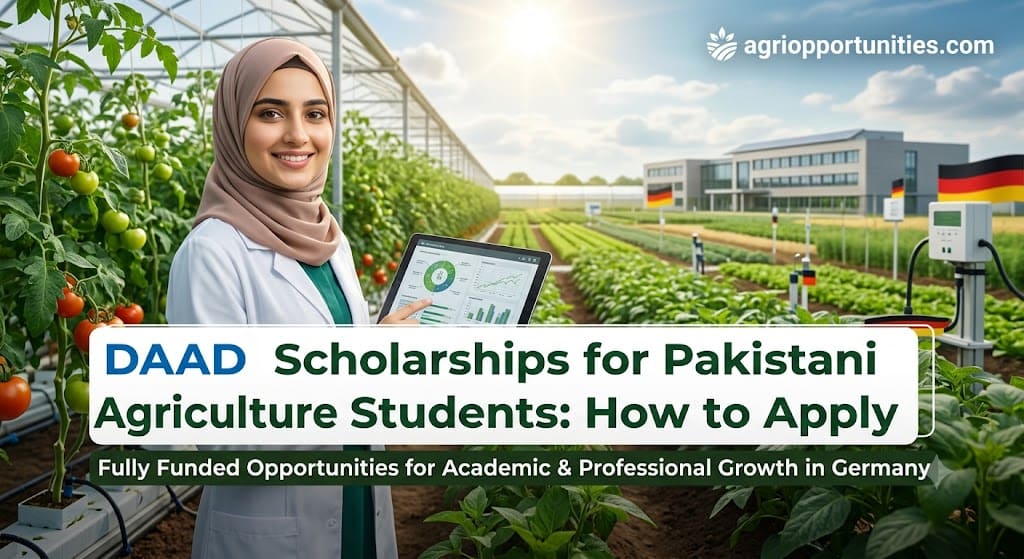
DAAD Scholarships for Pakistani Agriculture Students: How to Apply

DAAD Scholarships for Pakistani Agriculture Students
EPOS, research grants, sandwich PhDs, and study scholarships — every DAAD route relevant to Pakistani agriculture students.

DAAD — the Deutscher Akademischer Austauschdienst, or German Academic Exchange Service — is the world’s largest funding organization for international academic exchange, having supported over two million scholars since 1925. For Pakistani agriculture students, this matters because Germany funds a genuinely wide range of agriculture-relevant study through DAAD, spanning natural sciences, environmental management, sustainable development, and agricultural research specifically. What trips up most first-time applicants, though, is a misconception baked into the very phrase “DAAD scholarship” — there isn’t one. DAAD runs dozens of distinct programmes, each with its own eligibility rules, application process, and deadline, and picking the wrong one, or misunderstanding how to apply to the right one, wastes months of effort. This guide walks through every DAAD route genuinely relevant to Pakistani agriculture students, in detail.
DAAD Programmes at a Glance
EPOS (Development Courses)
Master’s in development-related fields. Requires 2 years work experience. Apply to university first.
Most CommonSTEM Study Scholarships
Master’s in engineering, natural sciences, technology. No work experience required. Apply to DAAD directly.
STEM FocusResearch Grants (PhD/Postdoc)
Doctoral and postdoctoral research stays in Germany. Research proposal required. Competitive.
ResearchSandwich PhD
Enrolled in Pakistan PhD + research stay in Germany (up to 1 year). Joint supervision. Access to German facilities.
FlexibleDevelopment-Related Postgraduate Courses (EPOS)
EPOS is the single most relevant DAAD stream for most Pakistani agriculture applicants, and also the most commonly misunderstood. Launched in 1987, the programme has awarded more than 7,000 scholarships to date, with roughly half going to women, and a completion rate above 90 percent among admitted scholars. EPOS specifically funds master’s-level study in development-related fields at designated German universities, and the eligible subject list explicitly includes agriculture, alongside renewable energy, sustainable development, public health, civil engineering, and environmental management.
Eligibility
You’ll need a bachelor’s degree (normally a four-year programme) in a relevant subject, completed with results in the upper third of your cohort, and — this is the requirement that catches people off guard — at least two years of professional work experience in a relevant field after your first degree, at the time of application. Internships and voluntary work generally don’t count toward this requirement; DAAD wants documented, salaried professional experience, verified through an employer letter stating exact employment dates on official letterhead. Your degree also normally shouldn’t be more than six years old at the time of application.
How You Actually Apply
This is the detail that trips up the most applicants: EPOS is a university-first programme. You do not apply to DAAD directly. Instead, you apply to the specific German university offering the EPOS programme you’re interested in, and if your application is strong, that university nominates you for DAAD funding — DAAD then processes the nomination rather than reviewing your original application from scratch. You’re generally allowed to apply to up to three EPOS courses, listed in priority order, and if you’re applying to more than one, you’ll typically need to write a second motivation letter explaining your specific priority ordering across programmes.
What It Covers
As of 2026, EPOS scholars typically receive 992 euros per month at the graduate level, rising to 1,300 euros monthly for doctoral candidates (increasing further to 1,400 euros from February 2026), plus health, accident, and personal liability insurance, and a travel allowance where not otherwise covered. EPOS scholarship recipients are also generally exempted from the per-semester study fees that non-EU students would otherwise pay at many German institutions.

DAAD Study Scholarships for STEM Disciplines
A separate stream, distinct from EPOS, targets Pakistani graduates specifically in engineering, natural sciences, mathematics, and technology — a category that agricultural science and related technical fields can fall under depending on the specific degree classification. Unlike EPOS, this programme isn’t restricted to a fixed list of designated courses; you can generally apply to any German university’s master’s programme within an eligible STEM field. Eligibility typically requires a bachelor’s degree completed within the last six years, without the two-year work experience requirement attached to EPOS.
Research Grants for PhD and Postdoctoral Candidates
For agriculture students pursuing doctoral research, DAAD offers research grants supporting both short-term and long-term research stays at the doctoral and postdoctoral level. These are generally more research-specific and competitive than the master’s-level programmes, and typically expect a stronger existing academic track record, including publications where applicable. A submitted research proposal is a standard requirement for doctoral-level applications under this stream.
Sandwich PhD Programmes
A distinct and often overlooked option for Pakistani agriculture PhD students: rather than relocating to Germany for a full doctorate, a sandwich PhD lets you remain enrolled in your PhD programme in Pakistan while conducting part of your doctoral research in Germany, under joint supervision. This is a genuinely practical option for candidates who are already enrolled in a Pakistani PhD programme (at institutions like your own university’s soil science or agriculture departments) and need access to specific German laboratory facilities, instrumentation, or expertise not available at home.

The Application Process, Step by Step
- Identify the right programme — Use the official DAAD scholarship database directly, filtering by country, field, and academic level.
- Confirm eligibility carefully — Check specific requirements rather than assuming a general DAAD standard applies uniformly.
- Prepare documents in advance — CV, motivation letter, transcripts, English certificate (TOEFL ~95 or IELTS 7), research proposal for PhD.
- Apply through the correct channel — EPOS = apply to university first. Most others = apply to DAAD directly.
- Plan for a long timeline — Total processing ~6-7 months. Start preparation at least a year in advance.
Common Mistakes Pakistani Applicants Make
- Assuming all DAAD programmes require two years of work experience — this applies specifically to EPOS, not all DAAD scholarships.
- Assuming you always apply to DAAD directly — EPOS requires applying to the university first.
- Delaying language testing — TOEFL/IELTS scheduling and score delivery take weeks.
- Sending reference letters yourself — referees must submit them directly to the university or DAAD.
- Underestimating the German student visa requirement — you need to demonstrate at least 11,904 euros annually.
🌟 What Makes an Agriculture Application Genuinely Competitive
Since EPOS and similar development-oriented DAAD programmes explicitly prioritize candidates who plan to return home and apply their training to real development challenges, agriculture applicants from Pakistan are naturally well-positioned to build a compelling motivation narrative — food security, sustainable nutrient management, and climate-resilient farming systems are exactly the kind of development-relevant framing DAAD reviewers are looking for. Lean into that connection explicitly in your motivation letter rather than writing generically about wanting to “study in Germany” for its own sake.
For related funded PhD and master’s positions across Germany and other European destinations, browse live agriculture scholarship listings on Agri Opportunities.
Frequently Asked Questions
Do all DAAD scholarships require two years of work experience?
No. The two-year professional experience requirement applies specifically to the EPOS programme and similar development-related postgraduate courses. Many DAAD Master’s and PhD research grant programmes do not require prior work experience.
Do I apply to DAAD directly or to the German university first?
It depends on the programme. For EPOS, you apply directly to the specific German university offering the programme, and the university nominates you for DAAD funding. For most other DAAD Master’s and PhD scholarships, you apply for the funding directly through the DAAD portal before securing university admission.
How much does a DAAD scholarship pay per month?
As of 2026, DAAD graduate and Master’s scholarships typically pay 992 euros per month, while doctoral candidates receive 1,300 euros per month, rising to 1,400 euros per month starting February 2026, alongside health insurance and a travel allowance.
How far in advance should I start a DAAD application?
At least a year before your intended start date. Given a total processing timeline of roughly six to seven months plus preparation time for language tests and documents, most successful Pakistani applicants begin preparing at least twelve months ahead of their target intake.
Browse live, currently open DAAD scholarships, PhD positions, and research grants for agriculture students in Germany and across Europe.