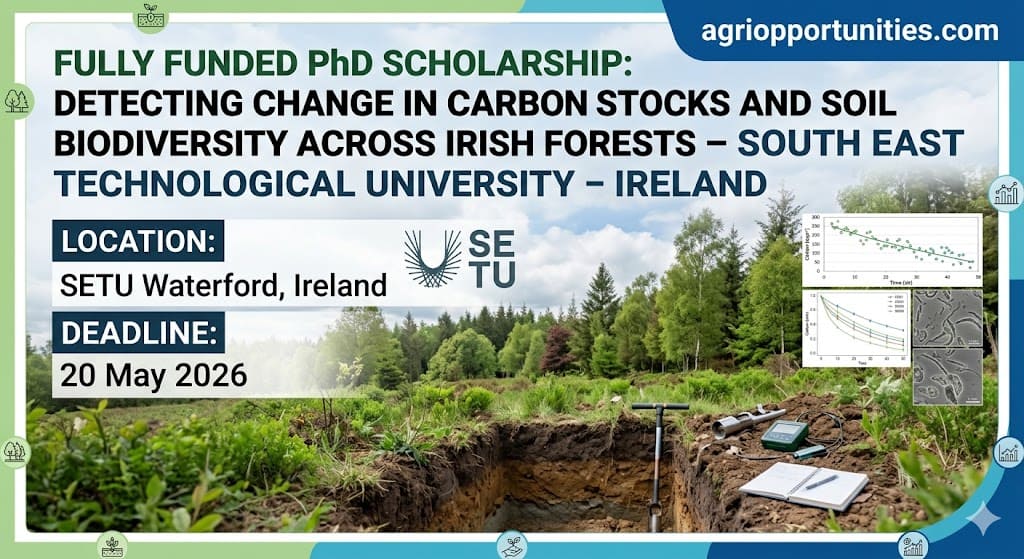
Fully Funded PhD Scholarship: Detecting Change in Carbon Stocks and Soil Biodiversity Across Irish Forests – South East Technological University – Ireland

About South East Technological University (SETU)
Applications are open for a PhD Forest Soil Biodiversity Ireland position at South East Technological University in Waterford. The C-BioStock project investigates how clear-felling affects soil biodiversity and carbon stocks in native and commercial Irish forests. SETU is a technological university in Ireland. This PhD project is part of the main project “C-BioStock – 3D laser scanning for detecting change in carbon stocks and soil biodiversity across native and commercial Irish forests”. There are two other PhD students based in UCC and UCD working on this project.
Scholarship Overview
Project Description
Forests in Ireland are important for biodiversity conservation, climate change mitigation and timber production. Soils, vegetation, and birds are among the key aspects of forest biodiversity which are affected by management operations such as clear-felling. Both coniferous plantations and native woodlands hold great potential for improving landscape-level biodiversity and carbon storage, but considerable uncertainty surrounds the management approaches best suited to achieve these goals.
C-BioStock will classify site ecological changes in two contrasting management systems at a series of developmental stages to accurately evaluate how biodiversity changes in second and subsequent rotation coniferous forests and native woodlands. Specifically, the response of soil biodiversity (using metabarcoding methods and hill series calculations) to clear-felling will be investigated by comparing a mature stand prior to harvesting with a chronosequence of developing reforestation sites and native woodlands at different developmental stages.
The research will use two methods of terrestrial LiDAR and traditional field sampling methods.
Why This Scholarship Stands Out
This PhD is unique because it combines cutting-edge remote sensing technology (terrestrial LiDAR) with traditional field sampling and molecular methods (metabarcoding) to assess forest biodiversity and carbon stocks. The project addresses a critical knowledge gap: how do forest management practices affect soil biodiversity and carbon storage across different forest types (coniferous plantations vs. native woodlands)? You will work within a team of three PhD students across SETU, UCC, and UCD, providing a collaborative research environment. The €25,000 stipend plus tuition coverage is competitive for Irish PhD positions. For a student interested in forest ecology, soil science, or biodiversity monitoring, this is an opportunity to contribute to evidence-based forest management in Ireland.
Key Responsibilities
- Investigate the response of soil biodiversity to clear-felling using metabarcoding methods
- Compare mature stands prior to harvesting with chronosequences of developing reforestation sites
- Study native woodlands at different developmental stages
- Use terrestrial LiDAR and traditional field sampling methods
- Collaborate with two other PhD students at UCC and UCD
Candidate Profile and Eligibility
| Requirement | Details |
|---|---|
| Education | Good primary degree (First- or Second-class Honours) or M.Sc. in Ecology, Soil Science, Botany, Environmental Science or related discipline |
| Driving Licence | EU driving licence required (to facilitate field data collection) |
| Forestry Knowledge | Essential |
| Ecology Knowledge | Essential |
| English Language | Must meet SETU’s English language requirements |
Desirable:
- Good primary degree in forestry
- Experience in soil sampling
- Experience working in forestry
- Experience in environmental consultancy or surveying sectors
- Experience in microbiology
- Experience in forest ecology
What They Offer
| Benefit | Details |
|---|---|
| Stipend | €25,000 per annum |
| Tuition Fees | €5,750 per annum covered |
| Duration | 4 years (48 months) |
| Hours | 40 hours per week |
| Research Team | Collaboration with PhD students at UCC and UCD |
| Methods | Terrestrial LiDAR, metabarcoding, traditional field sampling |
My Application Strategy
- Highlight your forestry and ecology knowledge – This is essential for the position
- Emphasize any soil sampling experience – Soil biodiversity assessment is a core component
- Show experience with microbiology or metabarcoding – Molecular methods are used for soil biodiversity
- Demonstrate field sampling skills – The role requires extensive fieldwork
- Mention your EU driving licence – This is a requirement
- Ensure English language requirements are met – Provide evidence in your application
Who Should Apply
This PhD is perfect for a student with a background in ecology, soil science, or forestry who is interested in how forest management affects biodiversity and carbon storage. If you enjoy field sampling, are excited by new technologies like LiDAR, and want to understand the trade-offs between commercial forestry and conservation, this project offers training across soil science, molecular ecology, and remote sensing. Candidates with a forestry degree are especially encouraged. The ideal candidate is someone who wants to contribute to evidence-based forest management in Ireland.
How to Apply
Complete the online application form from the SETU website quoting the advert reference code WD_2025_10_SPONS.
For informal queries, contact: Maryam Fazlollahi Mohammadi – Maryam.fazlollahimohammadi@setu.ie
For application queries: Postgraduate Admissions Office – researchadmissions@setu.ie or +353 (0)51 302883
Application Deadline: May 20, 2026 – 4:00 PM Irish Time
Useful Links
Similar Posts
Fully Funded PhD Scholarship: Grain Science & Food Structure – University of Guelph – Canada
Applications are open for a PhD Grain Science Food Structure Canada position at the University of Guelph. The NSERC CREATE program investigates how grain architecture influences food quality using data science and AI.
Fully Funded PhD: From Ocean to Soil – Seaweed-Derived Bioplastic Mulches, Ireland
A Fully Funded PhD Scholarship South East Technological University. This PhD Seaweed Bioplastic Mulch project will investigate a novel solution by developing biodegradable mulch films derived from seaweed biomass.
Fully Funded PhD Scholarship: Forest Tree Genomics – Swedish University of Agricultural Sciences
Applications are open for a PhD Forest Tree Genomics Sweden position at the Swedish University of Agricultural Sciences, Umeå Plant Science Centre. The project focuses on forest tree evolution, adaptation, and genetic diversity.
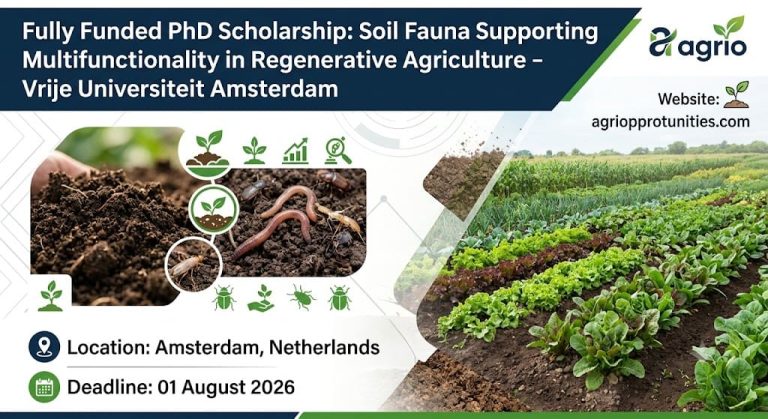
Fully Funded PhD Scholarship: Soil Fauna Supporting Multifunctionality in Regenerative Agriculture – Vrije Universiteit Amsterdam
Apply for PhD in Soil Fauna Research at Vrije Universiteit Amsterdam. Study soil invertebrate diversity across 40+ regenerative farms. Part of the ReGeNL project. €3,059-€3,881/month. Deadline August 1, 2026.
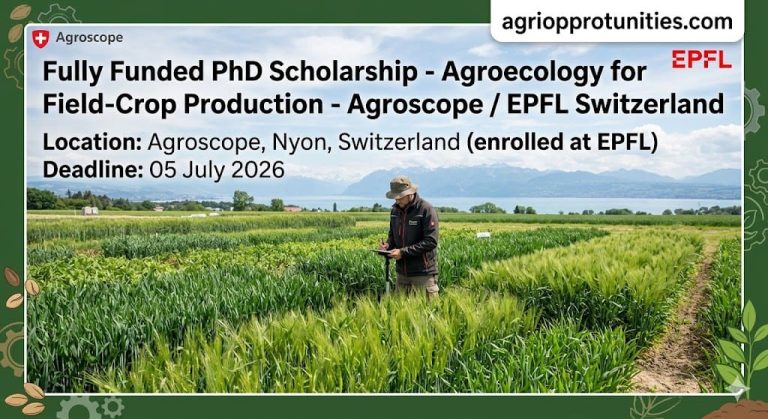
Fully Funded PhD Scholarship – Agroecology for Field-Crop Production – Agroscope / EPFL Switzerland
Applications are open for a PhD Agroecology Field Crop Production Switzerland position at Agroscope in Nyon, in collaboration with EPFL. The SUSTAGRI project investigates the effects of reduced soil tillage and herbicide application on weed diversity, soil microbiome, and soil organic carbon.
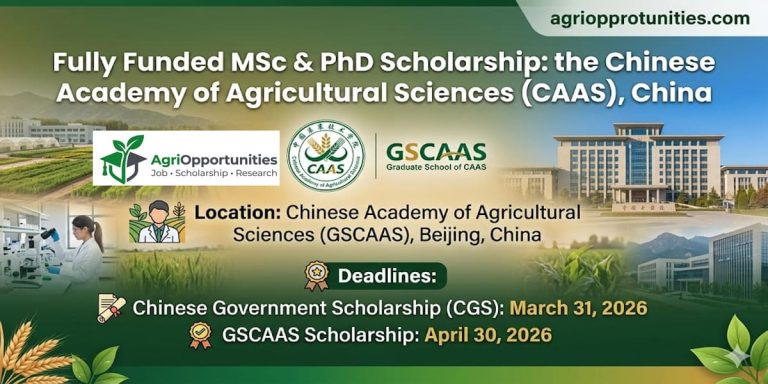
Fully Funded MSc & PhD Scholarship: the Chinese Academy of Agricultural Sciences (CAAS), China
Fully funded 51 Master’s & 47 Doctoral scholarships are open in the Chinese Academy of Agricultural Sciences (CAAS)
Dear Professor
I hope this message finds you well. I am writing to inquire about potential postdoctoral opportunities in Environmental Science/ Plant Science.
I am currently in the final year of my PhD at Jilin University, China, and I expect to graduate in July 2026. My doctoral research focuses on plant physiology and ecology under stress, the freeze-thaw cycle, heavy metals, environmental contaminants, exogenous organic regulators, organic pollutants, agricultural sustainability, ecotoxicology, abiotic stress, antioxidant defense mechanisms in plants, antioxidant enzymes, and climate change. I have published and submitted several peer-reviewed articles, as detailed in my resume.
I would be grateful to know whether there are any postdoctoral positions, funded projects, or upcoming openings in your department for the next academic year. I would also appreciate any guidance regarding application procedures or potential research alignment.
Thank you very much for your time and consideration.
Kind regards,
Shoujat Ali
PhD Candidate, Environmental Science
JILIN UNIVERSITY