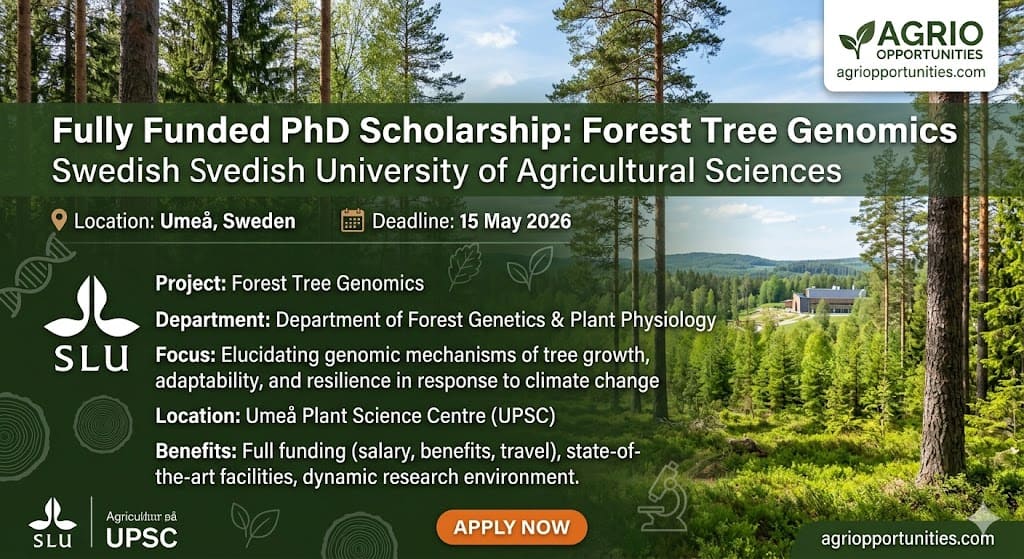
Fully Funded PhD Scholarship: Forest Tree Genomics – Swedish University of Agricultural Sciences

About the Swedish University of Agricultural Sciences (SLU) & Umeå Plant Science Centre (UPSC)
Applications are open for a PhD Forest Tree Genomics Sweden position at the Swedish University of Agricultural Sciences, Umeå Plant Science Centre. The project focuses on forest tree evolution, adaptation, and genetic diversity. The Department of Forest Genetics and Plant Physiology is part of Umeå Plant Science Centre (UPSC), which is a centre of excellence for experimental plant research and forest biotechnology in Northern Sweden. UPSC is one of Europe’s strongest research environments for basic plant research, covering a wide range of disciplines from cell biology to ecophysiology and from basic research to industrial applications. The common goal is to understand plants’ ability to grow, adapt and acclimate to a changing world and how we can breed better plants.
Scholarship Overview
Project Description
As forests increasingly face challenges brought on by a rapidly changing environment, it is important to address these problems from multiple angles. There is growing awareness of the potential usefulness of genetic data in forest management, but much is unknown about the genomics of non-model plant species like many forest trees.
The McEvoy Lab draws from a variety of new approaches to develop a better understanding of how genomic diversity is distributed in forest tree species, how it has evolved, and implications for the future. Methods range from studying genomic characteristics that drive genome evolution, examining variation critical for survival and fitness such as enhanced disease resistance, assessing and characterizing genetic diversity and population dynamics, and demonstrating how this information can be used to help inform conservation or breeding programs.
Why This Scholarship Stands Out
This PhD is unique because it focuses on the genomics of non-model forest tree species – a field with significant knowledge gaps but growing practical applications for forest management and conservation. The work is primarily computational, requiring development of skills in bioinformatics, population genetics, and large dataset analysis. UPSC is one of Europe’s leading plant research centres, providing access to high-performance computing resources and an international research environment. For a student interested in evolutionary genomics and conservation, this is an opportunity to generate knowledge that can directly inform forest management and breeding programs in Sweden and beyond. The project offers flexibility to explore various questions within forest tree genomics, from genome evolution to disease resistance to population dynamics.
Candidate Profile and Eligibility
| Requirement | Details |
|---|---|
| Education | Master’s degree in Evolution and Ecology, Genomics, Population Genetics, Plant or Forest Sciences, or closely related field |
| Credits | 90 HEC in biology-related subjects; 30 at second-cycle level |
| Language | English (equivalent to Swedish upper-secondary Engelska B/6) |
| Experience | Experience with genomic or transcriptomic data analysis (desirable) |
| Technical Skills | Writing code, using git, HPC experience (desirable) |
| Statistical Knowledge | Understanding of basic statistical methods (desirable) |
| Personal Qualities | Detail-oriented, structured, quality-conscious, able to work independently and collaboratively, eager to learn new methods |
My Application Strategy
- Highlight your computational biology experience – Mention any work with genomic data, bioinformatics pipelines, or programming (Python, R, bash)
- Emphasize population genetics or evolution coursework – Theory of population genetics, molecular evolution, or phylogenetics
- Show technical skills – Experience with git, HPC clusters, or workflow management (Snakemake, Nextflow) is valuable
- Demonstrate ability to synthesize literature – The project requires reviewing and synthesizing scientific concepts
- Read Dr. McEvoy’s recent publications – Cite their work in your application to show genuine interest
What They Offer
| Benefit | Details |
|---|---|
| Duration | 4 years (doctoral student employment) |
| Location | Umeå, Sweden |
| Research Environment | UPSC – centre of excellence for plant research |
| Salary | Fixed progression under local collective agreement |
Who Should Apply
This PhD is perfect for a student with a background in evolution, ecology, or plant sciences who wants to develop computational genomics skills. If you are interested in how genomic diversity is distributed across forest tree populations, how it evolves, and how genetic data can inform conservation and breeding, this project offers training in bioinformatics, population genetics, and large-scale data analysis. Candidates with experience in genomic data analysis are especially encouraged. The ideal candidate is someone who enjoys coding, working with large datasets, and applying computational methods to answer biological questions.
How to Apply
Submit your application using the link below.
Useful Links
Similar Posts
Fully Funded PhD Scholarship: Yeast Synthetic Biology – France
Applications are open for a Fully Funded PhD Yeast Synthetic Biology France position at the University of Tours, Plant Biomolecules and Biotechnologies (BBV) laboratory in Tours, France. This PhD project focuses on using synthetic biology to enable de novo production of complex monoterpene indole alkaloids (MIAs) in heterologous hosts.
Fully Funded PhD Scholarship: VIRTUE – Phytoremediation, Pyrolysis and Biochar for PFAS removal – Norway
Applications are open for a Fully Funded PhD PFAS Environmental Sciences Norway position at the Faculty of Environmental Sciences and Natural Resource Management (MINA), Norwegian University of Life Sciences (NMBU). This 3-year PhD position is connected to the project VIRTUE.
Fully Funded PhD Scholarship – Characterization of Boreal Soil Proteins and Their Role in Soil Nitrogen Turnover – Swedish University of Agricultural Sciences
Applications are open for a PhD Soil Proteins Nitrogen Turnover Sweden position at SLU’s Department of Forest Ecology and Management in Umeå. The project characterizes boreal soil proteins and their role in nitrogen cycling.
Fully Funded PhD Scholarship: Precision Livestock Farming for Calf Welfare – France/Spain
Applications are open for a PhD Precision Livestock Farming Calf Welfare Europe position at INRAE’s UMR IHAP in Toulouse, France, with fieldwork in Lleida, Spain. The project uses AI-driven acoustic analysis, accelerometers, and ruminal boluses to assess calf health and welfare.
Fully Funded PhD Scholarship: CRISPR Library Screening for AAV Production – Ireland
Applications are open for a PhD CRISPR AAV Production Ireland position at the National Institute for Bioprocessing Research and Training (NIBRT) in collaboration with University College Dublin (UCD). This position is part of the TRANS-AM research program focused on transforming advanced medicines manufacture.
Fully Funded PhD Scholarship: Microbial Inoculants for Agriculture – DTU Denmark
Applications are open for a PhD Microbial Inoculants Agriculture Denmark position at DTU Bioengineering. The Lab2Field project investigates why promising microbial bioinoculants fail in the field and how to develop more robust, climate-resilient plant biologicals.