Fully Funded PhD: Biogenic Carbon Cycle – University of Sydney, Australia

Quick Overview
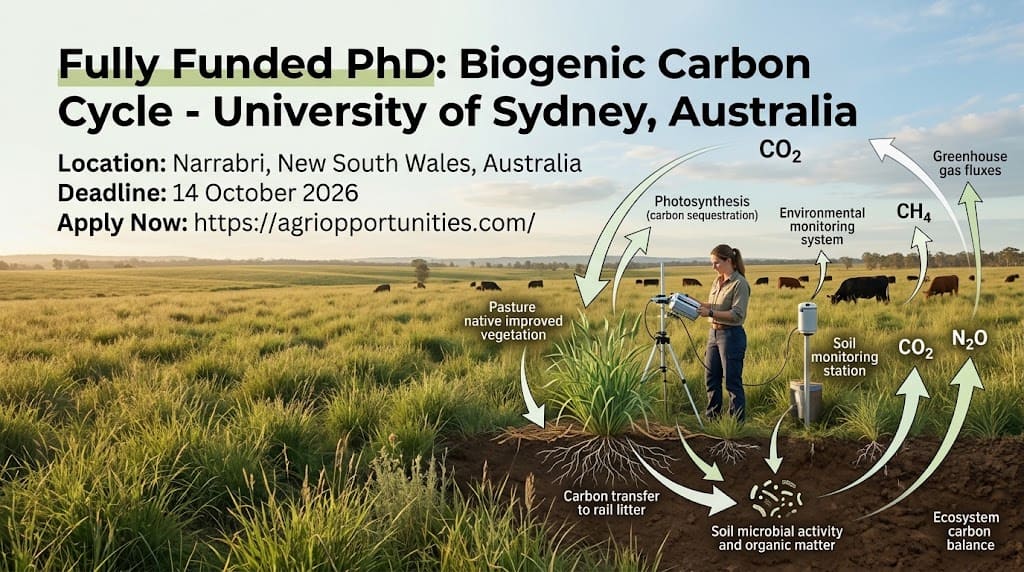
The University of Sydney is offering a Postgraduate Research Stipend Scholarship in the Biogenic Carbon Cycle, providing financial assistance to a higher degree research (HDR) student undertaking research in biogenic carbon cycles and the role of plant physiology in predicting pasture production. This fully funded scholarship is available within the School of Life and Environmental Science, Faculty of Science, and offers a stipend of $42,754 per annum for up to 14 research periods for PhD candidates. The scholarship is funded by Meat & Livestock Australia (MLA) through the Biogenic Carbon Project led by Professor Luciano Gonzalez.
The successful candidate will conduct research into pasture production, ecosystem carbon balance, and greenhouse gas (GHG) fluxes, working under the supervision of Dr. William Salter and Dr. Sabrina Lomax. The position is based at the University of Sydney’s Narrabri facilities, providing access to world-class research infrastructure and field sites. This is an exceptional opportunity for a highly motivated candidate with an Honours degree (First Class) or Master’s degree in agricultural science who is passionate about sustainable livestock production and environmental research.
Key Details
| Scholarship | Postgraduate Research Scholarship in Biogenic Carbon Cycle |
| Organization | University of Sydney |
| Location | Narrabri facilities, New South Wales, Australia |
| Faculty | Faculty of Science – School of Life and Environmental Science |
| Program | PhD (or Master’s by Research with intent to transfer to PhD) |
| Qualification | MSc in agricultural science or related field |
| Stipend | $42,754 per annum (University of Sydney RTP Stipend rate, indexed annually) |
| Duration | Up to 14 research periods (PhD); up to 4 research periods (Master’s by Research) |
| Supervisors | Dr. William Salter and Dr. Sabrina Lomax |
| Application Opens | 30 September 2026 |
| Application Closes | 14 October 2026 |
About the Scholarship and Project
This scholarship provides financial assistance to a higher degree research (HDR) student undertaking research on biogenic carbon cycles and the role of plant physiology in predicting pasture production. Meat & Livestock Australia (MLA) funds the research through the Biogenic Carbon Project, led by Professor Luciano Gonzalez. The project addresses important questions about how pasture systems influence ecosystem carbon balance and greenhouse gas (GHG) fluxes, with implications for sustainable livestock production and climate change mitigation.
The successful candidate will conduct the research at the University of Sydney’s Narrabri facilities, one of Australia’s leading agricultural research precincts. The Narrabri campus provides access to extensive field sites, laboratories, and research instrumentation for studying pasture production, carbon dynamics, and GHG fluxes. This research environment gives the candidate the resources and support needed to conduct high-quality research with practical implications for sustainable agriculture and climate change mitigation.
The scholarship is offered within the School of Life and Environmental Science, Faculty of Science at the University of Sydney. The school is renowned for its research in agricultural science, plant physiology, and environmental sustainability. The successful candidate will work under the supervision of Dr. William Salter and Dr. Sabrina Lomax, both of whom bring expertise in pasture systems, carbon cycling, and plant physiology. This supervisory team, combined with the broader research environment at the University of Sydney, provides an excellent foundation for a research career in agricultural science and environmental sustainability.
Key Responsibilities
Research Activities
- Conduct research into pasture production, ecosystem carbon balance, and GHG fluxes.
- Investigate biogenic carbon cycles and the role of plant physiology in predicting pasture production.
- Design and implement field and laboratory experiments.
- Collect and analyse data on pasture production, carbon dynamics, and GHG emissions.
Academic and Professional Development
- Complete coursework and doctoral requirements.
- Publish research findings in peer-reviewed journals.
- Present research at scientific conferences and seminars.
- Engage in professional development activities relevant to career goals.
Collaboration and Supervision
- Work under the supervision of Dr. William Salter and Dr. Sabrina Lomax.
- Collaborate with researchers within the School of Life and Environmental Science and the broader university.
- Contribute to the Biogenic Carbon Project and related research initiatives.
- Participate in regular meetings with supervisors and research group.
Candidate Profile
Required:
- An unconditional offer of admission or current enrolment in a full-time PhD within the School of Life and Environmental Science, Faculty of Science at the University of Sydney. Master’s by Research applicants are also eligible if they intend to transfer to PhD after satisfactory completion of the first annual progress evaluation.
- Willingness to conduct research into pasture production, ecosystem carbon balance, and GHG fluxes.
- An Honours degree (First Class) or equivalent, or a Master’s degree in a related field of agricultural science.
- Willingness to be based at the University of Sydney Narrabri facilities.
- Willingness to be supervised by Dr. William Salter and Dr. Sabrina Lomax.
Note: Applicants without an unconditional offer of admission may apply and be selected; however, no scholarship offer will be sent until the applicant has an unconditional offer of admission.
Preferred:
- Strong academic record and research potential.
- Experience with field or laboratory research in agricultural science.
- Knowledge of pasture systems, carbon cycling, or plant physiology.
- Strong communication and analytical skills.
- Previous research experience demonstrated via publications.
What They Offer
| Benefit | Details |
|---|---|
| Scholarship | Postgraduate Research Stipend Scholarship in Biogenic Carbon Cycle |
| Stipend | $42,754 per annum (University of Sydney RTP Stipend rate, indexed annually) |
| PhD Duration | Up to 14 research periods |
| Master’s Duration | Up to 4 research periods |
| Supervisors | Dr. William Salter and Dr. Sabrina Lomax |
| Location | University of Sydney Narrabri facilities |
| Funding Body | Meat & Livestock Australia (MLA) |
| Project | Biogenic Carbon Project led by Professor Luciano Gonzalez |
| Leave | Up to 20 working days recreation leave per year; up to 10 working days sick leave per year |
| Research Overseas | Up to 4 research periods outside Australia (with approval) |
| Suspension | Up to 4 research periods suspension (with approval) |
Application Tips
- Check your eligibility first – Ensure you meet the qualifications requirement (Honours First Class or Master’s degree in agricultural science) and are willing to conduct research into pasture production, ecosystem carbon balance, and GHG fluxes.
- Secure an unconditional offer of admission – While you may apply and be selected without an unconditional offer, no scholarship offer will be sent until you have one. Start your admission application early.
- Prepare a strong research proposal – The selection criteria include academic merit, area of study and research proposal, curriculum vitae, and previous research experience demonstrated via publications.
- Highlight relevant experience – Emphasize any experience with pasture systems, carbon cycling, plant physiology, or GHG flux research.
- Demonstrate your motivation – Show genuine interest in biogenic carbon cycles, sustainable livestock production, and environmental research.
- Contact the supervisors – Reach out to Dr. William Salter and Dr. Sabrina Lomax to discuss the project and express your interest.
- Apply between 30 September and 14 October 2026 – The application window is relatively short, so prepare your materials in advance.
- Note the Narrabri base – The position requires you to be based at the University of Sydney Narrabri facilities, so consider this when applying.
Why This Scholarship Matters (My Analysis)
The livestock sector is a significant contributor to global greenhouse gas emissions, and understanding the biogenic carbon cycle in pasture systems is essential for developing sustainable production practices. This scholarship addresses a critical research gap by investigating how plant physiology influences pasture production and how pasture systems contribute to ecosystem carbon balance and GHG fluxes. The findings from this research could inform management practices that reduce emissions, enhance carbon sequestration, and improve the sustainability of Australia’s livestock industry.
For the successful candidate, this scholarship offers an exceptional opportunity to contribute to cutting-edge research in agricultural science and environmental sustainability. The University of Sydney is one of Australia’s leading research universities, and the Narrabri facilities provide access to world-class field sites and instrumentation for studying pasture systems and carbon dynamics.
The scholarship’s funding by Meat & Livestock Australia (MLA) through the Biogenic Carbon Project underscores the practical relevance of the research. MLA is a major investor in research and development for the Australian red meat industry, and the Biogenic Carbon Project is a key initiative addressing carbon dynamics in livestock production. The stipend of $42,754 per annum is competitive, and the scholarship includes provisions for recreation leave, sick leave, overseas research, and suspension. With a duration of up to 14 research periods for PhD candidates, the scholarship provides long-term financial security for the successful candidate.
For candidates with a strong academic background in agricultural science, a passion for sustainability, and an interest in biogenic carbon cycles, this scholarship represents an outstanding opportunity to pursue a PhD at one of Australia’s premier research institutions. The research has the potential to make a meaningful contribution to climate change mitigation and sustainable livestock production, aligning with broader societal goals for environmental sustainability.
Apply Now
Application Portal:
- Application Opens: 30 September 2026
- Application Closes: 14 October 2026
- Location: Narrabri facilities, New South Wales, Australia
- Organization: University of Sydney (School of Life and Environmental Science, Faculty of Science)
- Scholarship: Postgraduate Research Scholarship in Biogenic Carbon Cycle
- Stipend: $42,754 per annum
- Supervisors: Dr. William Salter and Dr. Sabrina Lomax
- Funding Body: Meat & Livestock Australia (MLA) through the Biogenic Carbon Project led by Professor Luciano Gonzalez
Frequently Asked Questions
- What is the scholarship? A Postgraduate Research Stipend Scholarship in the Biogenic Carbon Cycle at the University of Sydney.
- Where is the scholarship located? The University of Sydney Narrabri facilities, New South Wales, Australia.
- What is the qualification requirement? An Honours degree (First Class) or equivalent, or a Master’s degree in agricultural science or a related field.
- What is the stipend? $42,754 per annum (University of Sydney RTP Stipend rate, indexed annually).
- How long is the scholarship? Up to 14 research periods for PhD candidates; up to 4 research periods for Master’s by Research recipients.
- What is the research focus? Biogenic carbon cycles, pasture production, ecosystem carbon balance, and GHG fluxes, with a focus on the role of plant physiology.
- Who are the supervisors? Dr. William Salter and Dr. Sabrina Lomax.
- When does the application open and close? Opens 30 September 2026; closes 14 October 2026.
- Do I need an unconditional offer of admission? You may apply and be selected without one, but no scholarship offer will be sent until you have an unconditional offer of admission.
- What is the funding body? Meat & Livestock Australia (MLA) through the Biogenic Carbon Project led by Professor Luciano Gonzalez.
- What leave arrangements are available? Up to 20 working days recreation leave per year and up to 10 working days sick leave per year.
- Can I conduct research overseas? Yes, up to 4 research periods outside Australia, subject to approval.
- Can I suspend the scholarship? Yes, up to 4 research periods suspension, subject to approval.
Related Opportunities
- Funded PhD & MS Positions in Soil Biogeochemistry | University of Wyoming
- PhD Student in Resilient Forage Production Systems | SLU Sweden
- PhD Position: Symbiotic Nitrogen Fixation in Legumes | University of Seville
Add Agri Opportunities as a preferred source on Google to see latest agricultural Scholarship listings first.