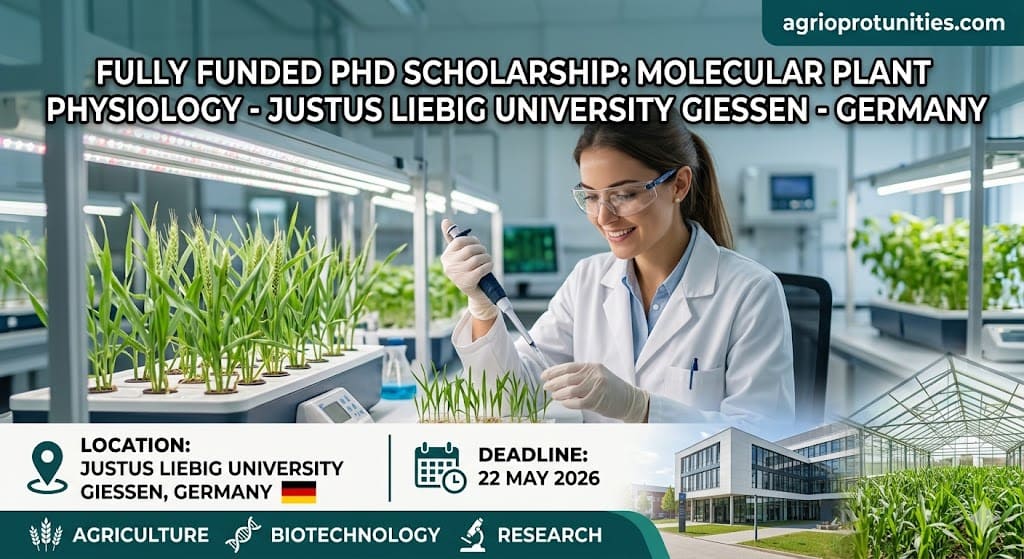
Fully Funded PhD Scholarship: Molecular Plant Physiology – Justus Liebig University Giessen – Germany

About Justus Liebig University Giessen
Applications are open for a PhD Molecular Plant Physiology Germany position at Justus Liebig University Giessen. The project investigates phytochrome signal transduction in higher plants, focusing on nuclear transport of phytochrome A. Founded in 1607, Justus Liebig University Giessen (JLU) is one of Germany’s oldest research universities. Today, it serves around 25,000 students and employs approximately 5,800 staff members. JLU combines a long academic tradition with a strong commitment to innovative, interdisciplinary research. The university is particularly well known for its contributions to life sciences, agriculture, and environmental research.
Scholarship Overview
Project Description
The project focuses on the function of phytochromes, a family of red and far-red light receptors that regulate key aspects of plant development. A major objective is to clarify how activated phytochrome A is transported into the nucleus of Arabidopsis thaliana cells. The research combines several complementary approaches, including molecular biology, cell biology, protein biochemistry, biophysical methods, and structural biology. Understanding these signaling pathways is fundamental to plant photobiology and has broader implications for agriculture and crop improvement.
Why This Scholarship Stands Out
This PhD is unique because it focuses on a fundamental question in plant photobiology: how phytochrome A is transported into the nucleus. Phytochromes are master regulators of plant development, controlling seed germination, seedling establishment, flowering, and shade avoidance. Understanding their signaling mechanisms has implications for crop improvement. The position offers broad technical training across molecular biology, protein biochemistry, fluorescence/confocal imaging, and structural approaches. JLU is one of Germany’s oldest research universities, and the position includes teaching responsibilities at BSc, MSc, and teacher training levels – valuable academic experience. The TV-H E13 salary with 65% employment provides stable funding. For a student interested in plant development and light signaling, this is an opportunity to do fundamental research with strong technical training.
Key Responsibilities
Research Activities:
- Investigate the molecular mechanisms of phytochrome signaling
- Perform cloning, protein expression, and biochemical analyses
- Conduct microscopy-based experiments
- Collaborate with experts in single-molecule microscopy, mass spectrometry, and structural biochemistry
- Present findings at scientific conferences and meetings
Teaching Duties:
- Contribute to BSc, MSc, and teacher training courses
- Support student projects and written assignments
Doctoral Qualification:
- Work toward your PhD as part of your employment
Candidate Profile and Eligibility
| Requirement | Details |
|---|---|
| Education | Master’s degree (or equivalent) in Biology, Biochemistry, Molecular Biology, Plant Sciences or related field |
| Specialization | Molecular plant physiology or plant genetics is particularly advantageous |
| Knowledge | Strong knowledge of molecular cell biology |
| Language | Excellent written and spoken English |
| Teamwork | Ability to work collaboratively in a research team |
Preferred Experience:
- Protein biochemistry
- Fluorescence or confocal imaging
- Scientific publications
- Conference presentations
- Interdisciplinary research
Employee Benefits at JLU
| Benefit | Details |
|---|---|
| Working Hours | Flexible working hours |
| Transport | Free public transport across Hesse (LandesTicket Hessen) |
| Training | More than 100 annual seminars and workshops |
| Health | Health promotion and university sports |
| Pension | Occupational pension scheme |
| Family Support | Child allowance, family-friendly policies |
| Other | Special payments |
What They Offer
| Benefit | Details |
|---|---|
| Salary | TV-H E13 (65% part-time) |
| Initial Contract | 3 years |
| Extension | Up to 2 additional years |
| Start Date | September 1, 2026 |
| Location | Giessen, Germany |
| Research Environment | Interdisciplinary collaboration across multiple techniques |
My Application Tips
- Highlight your molecular biology experience – Cloning, protein expression, and biochemical analyses are core techniques
- Emphasize any imaging experience – Fluorescence or confocal microscopy is highly relevant
- Show interest in plant photobiology – Understanding of phytochrome signaling and light-regulated development
- Mention teaching or mentoring experience – Teaching duties are part of the role
- Include reference number 199/08 in your application
Who Should Apply
This PhD is perfect for a student with a background in molecular biology, biochemistry, or plant sciences who is fascinated by how plants sense and respond to light. If you enjoy working at the bench – cloning, protein expression, imaging – and want to understand fundamental signaling mechanisms, this project offers training across multiple techniques. Candidates with experience in protein biochemistry or confocal imaging are especially encouraged. The ideal candidate is someone who wants to combine molecular biology, cell biology, and structural approaches to answer fundamental questions in plant development.
How to Apply
Submit your application through the APPLY NOW link on the university website.
Required documents:
- Curriculum vitae (CV)
- Cover letter outlining your motivation
- Bachelor’s and Master’s certificates
- List of publications (if available)
- Summary of your Master’s or diploma thesis
- Up to two references
Application Deadline: May 22, 2026
Reference Number: 199/08 (must be included in your application)
Useful Links
Similar Posts
Fully Funded PhD Position: Insect Ecology – University of Würzburg, Germany
Apply for PhD Position in Insect Ecology at University of Würzburg. Research heatwave impacts on pollinators. 3-year position, TV-L E13 (65%). Deadline October 15, 2026.
Fully Funded MSc & PhD Scholarship: the Chinese Academy of Agricultural Sciences (CAAS), China
Fully funded 51 Master’s & 47 Doctoral scholarships are open in the Chinese Academy of Agricultural Sciences (CAAS)
Fully Funded PhD – Soil Pesticide Impacts on Bees – University of Guelph – Canada
Apply for Fully Funded PhD in Soil Pesticide Impacts on Bees at University of Guelph. 4-year position. Horizon Europe ProPollSoil project. Deadline August 21, 2026.
Fully Funded PhD Scholarship: AI-Driven Soil Insight and Precision Management Using Weed Indicators – Leiden University & Wetsus, Netherlands
Apply for Fully Funded PhD in AI-Driven Soil Insight Using Weed Indicators at Leiden University & Wetsus. Research precision agriculture and soil characterization.
Fully Funded PhD Scholarship: Impacts of Agrivoltaics on Biodiversity and Soil Physical Properties – Teagasc / Dublin City University – Ireland
Apply for PhD in Agrivoltaics Impacts on Biodiversity at Teagasc Ireland. Research solar farms and sheep grazing. €25,000 stipend + fees. Deadline August 19, 2026.
Fully Funded PhD Position: Legumes and Nitrogen Cycling in Regenerative Arable Rotations – Cranfield University, UK
Fully funded PhD at Cranfield University on legumes and nitrogen cycling in regenerative arable rotations. £24,500 tax free stipend, Home fees covered, three years. Deadline 11 November 2026, reference CRAN-0108.