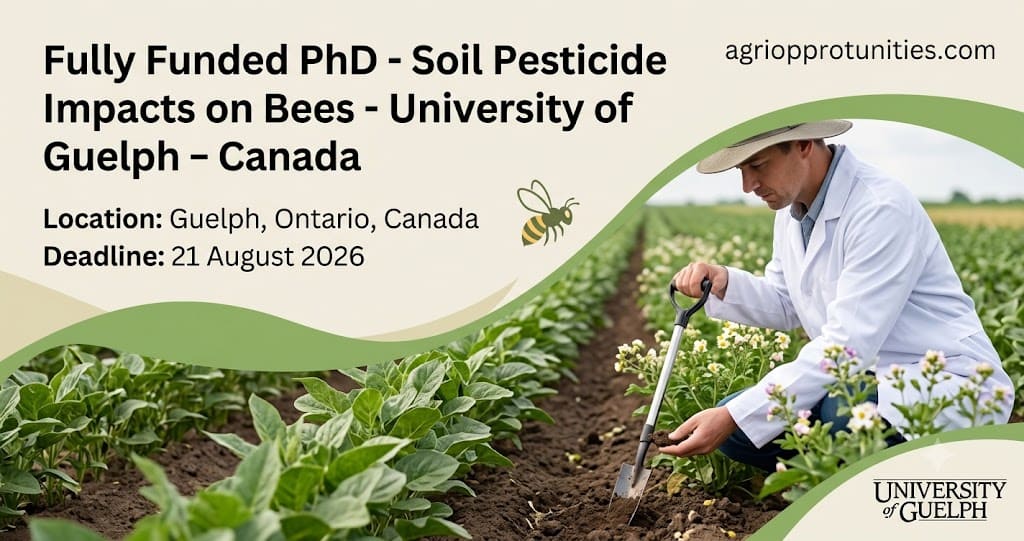
Fully Funded PhD – Soil Pesticide Impacts on Bees – University of Guelph – Canada

Quick Overview
The University of Guelph is seeking a highly motivated PhD student for a 4-year funded position investigating the risks and impacts of pesticide residues in soil on soil-dependent bees. As approximately 70% of all bee species depend on soil for at least some stages of their lifecycle, this research addresses a critical knowledge gap. The project is part of the Horizon Europe funded ProPollSoil project.
Experience Level: Master’s degree in relevant field
Best Fit: Candidates with background in behavioural ecology, entomology, ecotoxicology, or related disciplines
Deadline: August 21, 2026
Key Details
| Position | PhD Researcher |
| Project | Impacts of exposure to soil pesticide residues on soil-dependent bees |
| University | University of Guelph |
| Location | Guelph, Ontario, Canada |
| Qualification | MSc in agricultural sciences, environmental sciences, behavioural ecology, ecology, conservation, entomology, zoology, ecotoxicology or related disciplines |
| Duration | 4 years |
| Start Date | September 2026 |
| Deadline | August 21, 2026 |
| Apply Via | nraine@uoguelph.ca |
| Supervisor | Prof. Nigel Raine |
Project Description
Pesticide usage is an integral part of modern farming, but there are concerns about environmental impacts on insect pollinators. While most research has focused on above-ground exposure routes (e.g., contaminated nectar/pollen, spray drift), the implications of exposure to pesticide residues in soil for wild bee pollinators are currently not well understood.
This project will investigate implications of pesticide residue exposure for a variety of bees, including:
- Solitary ground-nesting bees (e.g., hoary squash bee Xenoglossa pruinosa)
- Bumble bee queens
The PhD will involve a range of experimental work in both lab and semi-field conditions. This position is part of the Horizon Europe funded ProPollSoil project.
Why This Scholarship Stands Out
This PhD is unique because it addresses a critical knowledge gap in pollinator conservation: the impacts of soil pesticide residues on the 70% of bee species that depend on soil for part of their lifecycle. The project is part of a larger Horizon Europe network, providing international collaboration opportunities. You’ll work closely with Dr. Dara Stanley and colleagues at University College Dublin, Ireland.
Who Should Apply
This position is suited to applicants with a strong background in behavioural ecology, ecology, conservation, entomology, zoology, environmental sciences, agricultural sciences, ecotoxicology or related disciplines.
Strong candidates will have:
- A Masters degree (e.g., MSc) in a suitable research field
- Prior research experience, particularly working with insects in the laboratory or field (desirable)
- Strong interest in pollinator conservation and ecotoxicology
Skills That Will Help You Stand Out
| Skill | Why It Matters |
|---|---|
| Behavioural ecology | Understanding bee behaviour |
| Entomology | Working with insects |
| Ecotoxicology | Pesticide impacts |
| Lab/field experience | Experimental work |
| Data analysis | Research skills |
What They Offer
| Benefit | Details |
|---|---|
| Duration | 4 years (fully funded) |
| Location | University of Guelph, Canada |
| Supervision | Prof. Nigel Raine (Raine Lab) |
| International Collaboration | Horizon Europe ProPollSoil project |
| Partner Institution | University College Dublin, Ireland |
Application Tips
- Highlight relevant experience – Insect work in lab or field is desirable.
- Demonstrate research skills – Show ability to conduct experimental research.
- Show interest in pollinator conservation – Key focus area.
- Include scientific writing sample – Essay, manuscript, lab report, or publication.
- Submit before deadline – August 21, 2026.
How to Apply
Email the following to Prof. Nigel Raine (nraine@uoguelph.ca) with subject line “Soil pesticide PhD application“:
- Covering letter detailing interest and motivations (max 2 pages)
- CV with contact details of two academic/scientific references
- Copies of unofficial University transcripts
- An example of scientific writing (essay, manuscript, lab report, or publication)
Review of applications will begin immediately and continue until the position is filled.
Anticipated start date: September 2026
Frequently Asked Questions
- What is the qualification requirement? Masters degree in a relevant field.
- What is the project about? Investigating impacts of soil pesticide residues on soil-dependent bees.
- What species will I work with? Solitary ground-nesting bees and bumble bee queens.
- Is there international collaboration? Yes, part of Horizon Europe ProPollSoil project.
- What is the deadline? August 21, 2026.
Related Opportunities
- Fully Funded PhD Remote Sensing AI Agriculture | Montana State University
- Australian Government Scholarship | University of Sydney
- More PhD Positions
Add Agri Opportunities as a preferred source on Google to see latest agriculture Scholarship listings first.