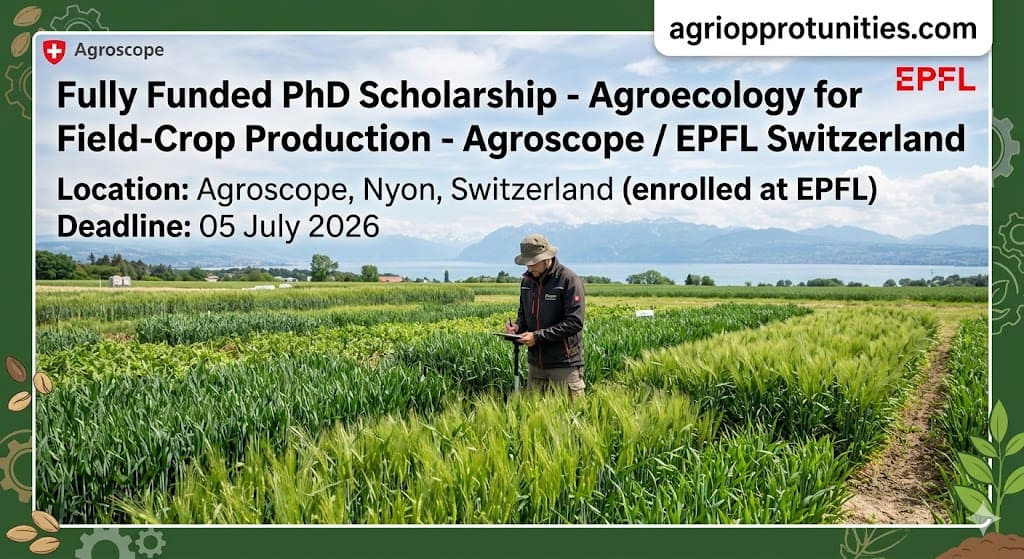
Fully Funded PhD Scholarship – Agroecology for Field-Crop Production – Agroscope / EPFL Switzerland

About Agroscope & EPFL
Applications are open for a PhD position in Agroecology for Field-Crop Production at Agroscope in Nyon, Switzerland. Agroscope is the Swiss federal centre of excellence for research in the agriculture and food sector. The project (SUSTAGRI) is funded by the Swiss National Science Foundation and involves collaboration between multiple institutions including Agroscope, EPFL, University of Lausanne, University of Zurich, Nestlé Institute of Agricultural Sciences, University of Basilicata (Italy), and INRAE (France). The PhD student will be enrolled in the EDCE doctoral program at EPFL.
Scholarship Overview
Research Project
Based on the principles of agroecology, the ‘Field-Crop Systems and Plant Nutrition’ Research Group aims to develop the scientific foundations to increase the efficiency of use of field-crop nutrients, encourage the use of recyclable products such as fertiliser, and develop resilient systems for soil conservation practices, crop-rotation diversification, and agroforestry systems.
Key Responsibilities
- Conduct field samplings, laboratory analyses, and data treatment in a 6-year old field trial
- Assess the diversity and functional composition of weeds based on a dataset from a 6-year long rotation
- Analyse the composition and functioning of soil microbiome in response to soil tillage and herbicide reduction
- Characterize the quantity and quality of soil organic carbon after 6-years of reduced soil tillage and herbicide application
- Disseminate results through scientific publications, technical reports, and conference participation
Why This Scholarship Stands Out
This PhD is unique because it is embedded in a long-term field trial (6 years) and a major international collaboration involving six research institutions across Switzerland, France, and Italy. You will study the effects of reduced soil tillage and herbicide reduction on weed diversity, soil microbiome, and soil organic carbon – all key components of agroecological transitions. The project combines fieldwork, laboratory analysis, and data treatment. For a student interested in sustainable agriculture, soil science, and agroecology, this is an opportunity to conduct research with direct implications for field-crop production systems.
Candidate Profile and Eligibility
| Requirement | Details |
|---|---|
| Education | Master’s degree in Environmental Sciences, Agricultural Science, Biology, or related discipline |
| Interest | Strong interest in agroecology, sustainable agriculture, soil science, plant ecology |
| Experience | Data analysis and laboratory experience is an advantage |
| Skills | Ability to work independently while collaborating in a multidisciplinary and international research team, good organisational and communication skills |
| Language | Knowledge of two official Swiss languages and English |
What They Offer
| Benefit | Details |
|---|---|
| Position | PhD Researcher |
| Duration | 4 years (01.10.2026 – 30.09.2030) |
| Location | Nyon, Switzerland |
| Employment | 100% |
| Research Network | Collaboration with EPFL, University of Lausanne, University of Zurich, Nestlé Institute, University of Basilicata, INRAE |
| Doctoral Program | EDCE (Civil and Environmental Engineering) at EPFL |
My Application Tips
- Highlight your interest in agroecology and sustainable agriculture – The project is grounded in agroecological principles
- Emphasize field and laboratory experience – Field samplings and lab analyses are core activities
- Show data analysis skills – Working with datasets from a 6-year trial
- Demonstrate language proficiency – Knowledge of two Swiss languages and English is required
- Ensure EPFL doctoral program admission – The EDCE program has specific admission criteria
Who Should Apply
They seek PhD candidates with backgrounds in environmental sciences, agricultural science, or biology who want to conduct research in agroecology and sustainable field-crop production. The project focuses on understanding how reduced soil tillage and herbicide application affect weed diversity, the soil microbiome, and soil organic carbon. It provides training in field research, laboratory analysis, and data processing and interpretation.
How to Apply
Apply now through the Agroscope application portal.
For questions about the position: Luca Bragazza (Group leader) – +41 58 48 18586
Starting Date: October 1, 2026
Place of Work: Route de Duillier 60, 1260 Nyon, Switzerland