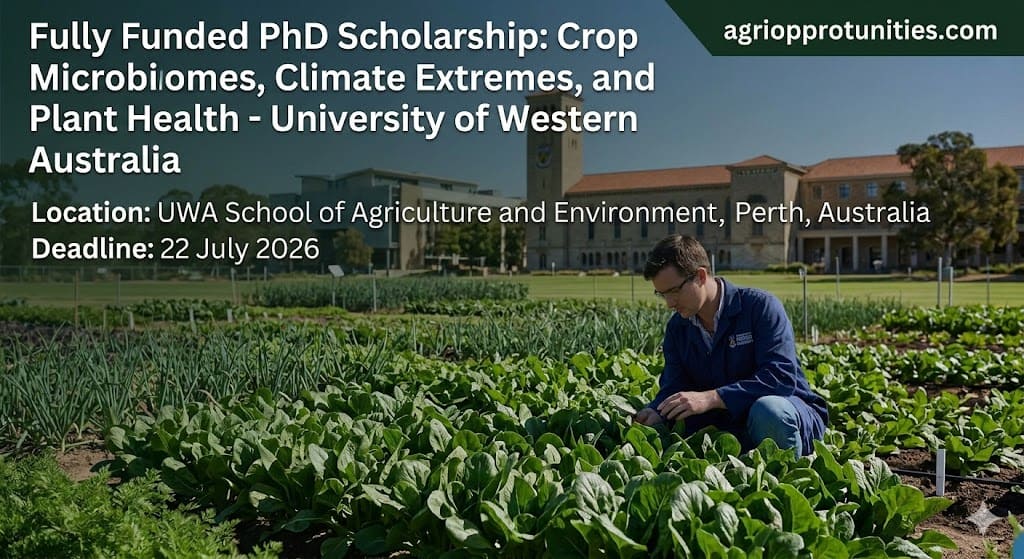
Fully Funded PhD Scholarship: Crop Microbiomes, Climate Extremes, and Plant Health – University of Western Australia

About the University of Western Australia (UWA)
Applications are open for a PhD scholarship in crop microbiomes, climate extremes, and plant health at the UWA School of Agriculture and Environment. The project will investigate how extreme climate events impact the structure and functions of crop-associated microorganisms and develop novel microbial applications and bio-products to boost plant resilience to climate change and pathogen threats. The candidate will be embedded in a multidisciplinary research network with strong national and international connections.
Scholarship Overview
Project Description
This project will investigate how extreme climate events impact the structure and functions of crop-associated microorganisms and develop novel microbial applications and bio-products to boost plant resilience to climate change and pathogen threats, offering significant benefits for sustainable agriculture. Combining field surveys and sampling, greenhouse experiments, and state-of-the-art tools, including metagenomics, metatranscriptomics, proteomics, metabolomics, microbial culturomics, and artificial intelligence-based microbiome analysis, this project will generate new knowledge on the mechanisms by which climate extremes shape the diversity, functions, and interactions of crop-associated microbiomes, and how these changes influence pathogen invasion and overall plant health. The project will develop a Smart Microbiome Training workflow based on microbiome adaptive eco-evolutionary response theory that can be used to harness beneficial microbial traits and metabolites against climate-change impacts.
Why This Scholarship Stands Out
This PhD is unique because it combines cutting-edge multi-omics technologies (metagenomics, metatranscriptomics, proteomics, metabolomics) with AI-based microbiome analysis to address a critical challenge: how climate extremes affect crop microbiomes and plant health. The project integrates field surveys, greenhouse experiments, and microbial culturomics. The Smart Microbiome Training workflow based on eco-evolutionary theory is an innovative approach to harnessing beneficial microbial traits. The scholarship value of AUD $38,110 per year is competitive for Australian PhD positions. For a student interested in microbiome science, plant pathology, and climate change, this is an opportunity to do interdisciplinary research with strong national and international connections.
Key Responsibilities
- Conduct field surveys and sampling of crop-associated microbiomes
- Perform greenhouse experiments
- Apply multi-omics tools (metagenomics, metatranscriptomics, proteomics, metabolomics)
- Use AI-based microbiome analysis
- Develop a Smart Microbiome Training workflow based on eco-evolutionary theory
Candidate Profile and Eligibility
| Requirement | Details |
|---|---|
| Eligibility | Must meet UWA admission requirements for Higher Degrees by Research (HDR) |
| Citizenship | Domestic and International students welcome |
| Enrolment Status | Future student |
| Specific Requirement | Previous research experience in the discipline |
| Skills | Experimental, bioinformatics, and data-analysis skills |
What They Offer
| Benefit | Details |
|---|---|
| Scholarship Type | Stipend scholarship |
| Scholarship Value | AUD $38,110 per year |
| Duration | Standard PhD duration |
| Location | Perth, Western Australia |
| Research Environment | Vibrant, welcoming, and supportive environment with guidance from soil scientists, plant scientists, and bioinformaticians |
My Application Tips
- Highlight your research experience
- Emphasize multi-omics or bioinformatics skills – Experience with metagenomics, transcriptomics, or AI-based analysis is highly relevant
- Show interest in plant-microbe interactions – Understanding of crop microbiomes and plant health
- Demonstrate field and greenhouse experience – The project combines both
- Prepare a short research statement – One page outlining background, skills, and fit for the project
Who Should Apply
This PhD is perfect for a student with a background in microbiology, plant science, bioinformatics, or environmental science who wants to work at the intersection of climate change and plant health. If you are interested in how extreme climate events affect crop-associated microbiomes, and want to use multi-omics and AI to develop solutions for sustainable agriculture, this project offers training across field sampling, greenhouse experiments, and computational analysis.
How to Apply
Prospective applicants should first contact Dr Chao Xiong (chao.xiong@uwa.edu.au) to discuss suitability for the project and obtain supervisory support before submitting a formal scholarship application.
Required documents email to Dr Chao Xiong:
- CV (maximum two pages)
- Academic transcripts
- Short research statement (maximum one page) outlining research background, relevant experimental, bioinformatics and data-analysis skills, future research interests, and fit for the project
Selection process: Only shortlisted candidates will be contacted. The selection process may conclude early if appropriate applicants are secured.