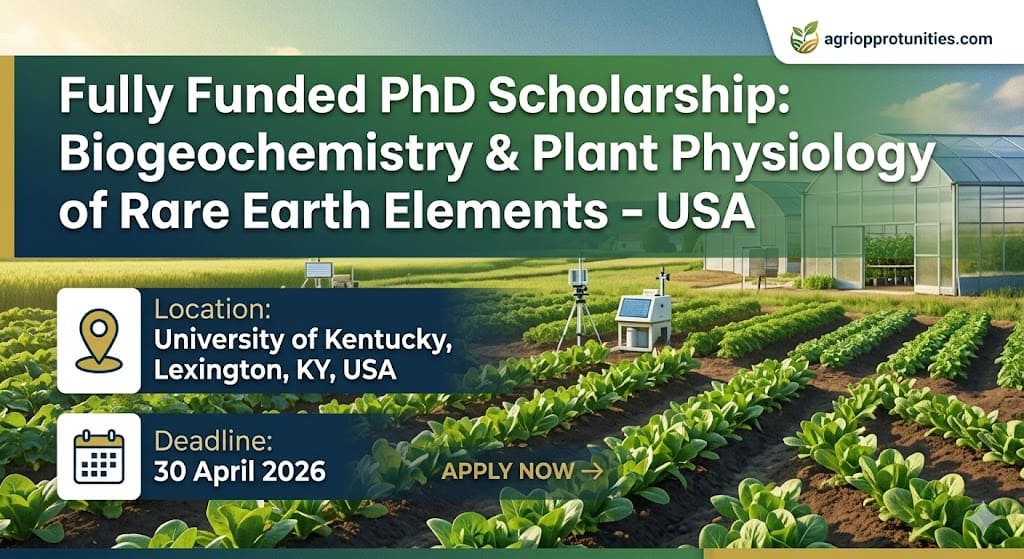
Fully Funded PhD Scholarship: Biogeochemistry & Plant Physiology of Rare Earth Elements – USA

🏛️ About University of Kentucky & Department of Plant and Soil Sciences
Applications are open for a Fully Funded PhD Biogeochemistry Rare Earth Elements USA position at the University of Kentucky’s Department of Plant and Soil Sciences. The project investigates the mechanisms by which plants take up and process rare earth elements from soil. The University of Kentucky’s Department of Plant and Soil Sciences is one of 14 academic departments in the Martin-Gatton College of Agriculture, Food and Environment (CAFE). The department has over 40 faculty members and 60+ staff members, as well as post-doctoral scholars, graduate research assistants, and visiting scholars.
🎯 Scholarship Overview
🔗 Project Summary
Rare earth elements are indispensable to modern technologies, including those critical to sustainable energy production. Despite their growing importance, our understanding of the biogeochemical cycling of REEs in terrestrial ecosystems remains limited. The selected student will conduct interdisciplinary research aimed at elucidating the mechanisms by which plants take up and process rare earth elements, contributing to fundamental knowledge with implications for environmental sustainability and resource management.
🌟 Why This Scholarship Stands Out
This Fully Funded PhD Scholarship: Biogeochemistry & Plant Physiology of Rare Earth Elements is unique because it focuses on rare earth elements (REEs) – the “vitamins” of modern technology that are essential for everything from wind turbines to smartphones. Yet surprisingly little is known about how plants take up and process these elements from soil. The project sits at the intersection of plant physiology, soil chemistry, and biogeochemistry, offering training across multiple disciplines. The laboratory of Prof. Jason Unrine is well-equipped with advanced analytical instrumentation (ICP-MS, HPLC, etc.), microscopy facilities, and molecular biology tools. The lab is moving to a brand new state-of-the-art research building in early 2027, meaning you will have access to cutting-edge facilities. For someone interested in soil chemistry and critical mineral biogeochemistry, this is an opportunity to work on a topic with both fundamental scientific importance and real-world applications.
✅ Candidate Profile and Eligibility
| Requirement | Details |
|---|---|
| Education | Bachelor’s degree in Soil Science, Biology, Chemistry, Earth Sciences, Environmental Science, or closely related field (Master’s preferred) |
| Background | Strong background in physiology, soil chemistry, mineralogy, and/or biogeochemistry |
| Desirable Experience | Analytical chemistry, microscopy, and/or molecular biology |
| Start Date | Fall 2026 semester |
📝 My Application Strategy
- Highlight your soil science background – Emphasize coursework or research in soil chemistry, mineralogy, or biogeochemistry
- Show understanding of REEs in soil systems – Read about how REEs behave in different soil types, their speciation, and plant availability
- Emphasize analytical chemistry skills – Prof. Unrine’s lab uses ICP-MS, HPLC, and other advanced instruments. Mention any experience with soil or plant digestions
- Read Prof. Unrine’s recent papers on trace elements – He has published extensively on trace-element biogeochemistry. Cite his work in your statement
- Complete the Google Form promptly – Applications are reviewed on a rolling basis. Early submission is advantageous
💼 What They Offer
| Benefit | Details |
|---|---|
| Stipend | Competitive graduate assistantship stipend |
| Tuition | Full tuition remission |
| Health Insurance | Included |
| Start Date | Fall 2026 semester |
| Facilities | Well-equipped laboratory with advanced analytical instrumentation, microscopy, and molecular biology facilities |
| New Building | Relocation to state-of-the-art research building in early 2027 |
🎓 Who Should Apply
This Fully Funded PhD Scholarship: Biogeochemistry & Plant Physiology of Rare Earth Elements is perfect for a student with a strong background in soil chemistry, mineralogy, or biogeochemistry who wants to specialize in plant-soil interactions around critical minerals. If you are curious about how plants access rare earth elements from different soil types – and what controls their uptake – this project offers deep training in both analytical methods and mechanistic soil-plant science. Candidates with experience in ICP-MS, soil digestions, or trace-element analysis are especially encouraged. The ideal candidate is someone who thinks about soils as complex biogeochemical reactors that control element cycling from mineral to plant to ecosystem.
📝 How to Apply
Apply through the Google Form at the link below:
Application review: Rolling basis
Program links:
- Department of Plant and Soil Sciences: https://pss.mgcafe.uky.edu/
- Prof. Jason Unrine profile: https://pss.mgcafe.uky.edu/directory/unrine-jason
- Integrated Plant and Soil Sciences program: https://ipss.mgcafe.uky.edu/
Useful Links
Similar Posts
Technical Sales Officer – Syngenta Pakistan
Applications are open for a Technical Sales Officer Syngenta Pakistan position in Narowal, Rahim Yar Khan, Hafizabad, Kamoki, Lahore, Vewhari, and Bahawalpur, Punjab, Pakistan. The role involves demand generation, channel management, and driving revenue growth. This role is best suited for an agriculture graduate with 3-4 years of sales experience in the agrochemical sector.
Postdoctoral Researcher – Greenhouse Gases and Carbon Cycle in Agriculture – Finnish Meteorological Institute, Finland
Apply for Postdoctoral Researcher in Agriculture at Western Sydney University. $123,327-$145,625 + 17% super. Drought-resilient cropping systems research. Deadline August 16, 2026.
Assistant Grower – SpurtNova
SpurtNova is hiring an Assistant Grower in Islamabad/Rawalpindi. Run aeroponic farms, advise on nutrient management, support controlled-environment crop production. Degree/diploma in Agriculture/Horticulture preferred. Apply: info@spurtnova.com.
Postdoctoral Position: New Breeding Technologies Development for Pear – INRAE France
INRAE, the world’s leading research organisation in agriculture, is seeking a postdoctoral researcher to develop cutting-edge genome editing tools for pear. You’ll work on the European SMARTER-FRUIT project, developing mobile CRISPR-RNA editing and trans-grafting approaches to create fire blight-resistant pear varieties. Based at the Institute for Research in Horticulture and Seeds in Beaucouzé, this is a 2-year position with access to world-class plant science facilities.
Fully Funded PhD Scholarship: Remote Sensing for Climate-Smart Agriculture – Aarhus University Denmark
Applications are open for a PhD Remote Sensing Climate Smart Agriculture Denmark position at Aarhus University. The project develops novel remote sensing algorithms and knowledge-guided machine learning frameworks to monitor crop nitrogen, productivity, and greenhouse gas fluxes for Danish and EU wheat cropping systems.
Fully Funded PhD Scholarship: Quantification of N2O Emissions from Cover Cropping and Organic Manure Management – Teagasc / Trinity College Dublin Ireland
Applications are open for a PhD N2O Emissions Agriculture Ireland position at Teagasc Johnstown Castle and Trinity College Dublin. The project quantifies N2O emissions associated with cover cropping and organic manure management in Irish tillage systems.