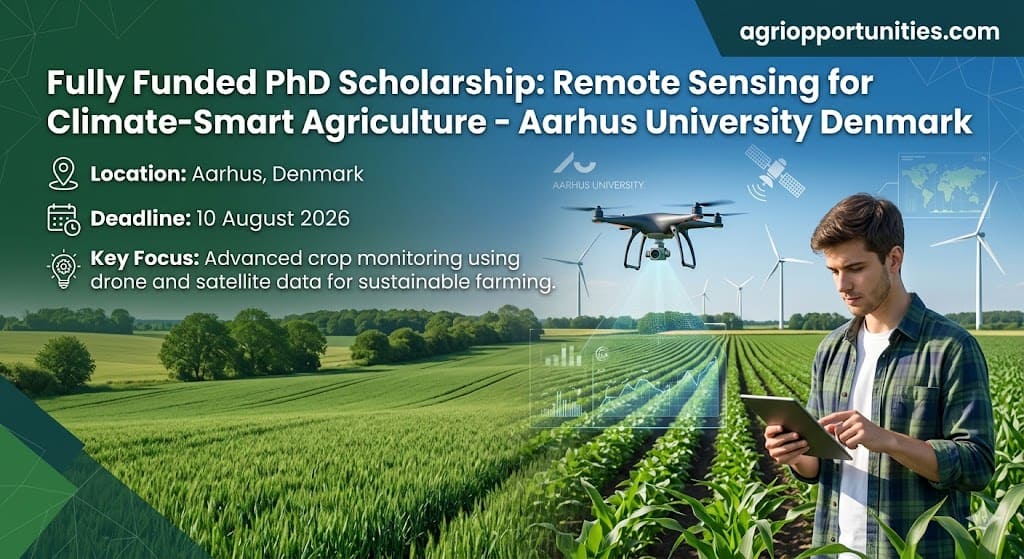
Fully Funded PhD Scholarship: Remote Sensing for Climate-Smart Agriculture – Aarhus University Denmark

About Aarhus University & Pioneer Center Land-CRAFT
Applications are open for a PhD position in Remote Sensing for Climate-Smart Agriculture at the Department of Agroecology, Aarhus University, Denmark. The position is part of the Pioneer Center Land-CRAFT, which brings together experts on climate impact research and process-based modelling of biogeochemistry, agronomy, biology, and geography from Aarhus University and University of Copenhagen, as well as international partners. The position is available from November 1, 2026, or later.
Scholarship Overview
Project Description
Food security, climate change, and loss of biodiversity represent three of today’s major environmental sustainability challenges. Climate-smart agriculture aims to provide innovative solutions to improve crop production, reduce greenhouse gas emissions, and strengthen agroecosystem resilience to climate extremes. Timely, high-resolution information on agroecosystem dynamics is critical for unlocking the complex interactions among crops, management activities, and environmental factors.
This project aims to develop novel remote sensing algorithms and knowledge-guided machine learning frameworks to monitor crop nitrogen, agroecosystem productivity, and greenhouse gas fluxes for climate-smart agriculture. The remote sensing derived information will be used to inform climate-smart agriculture practices and policies for Danish and EU wheat cropping systems.
Why This Scholarship Stands Out
This PhD is unique because it combines cutting-edge remote sensing (hyperspectral, solar-induced fluorescence, multispectral, thermal infrared, passive and active microwave) with deep learning and knowledge-guided machine learning to address climate-smart agriculture. You will work with large-scale, multi-source remote sensing datasets and cloud-computing platforms. The project is embedded in Land-CRAFT, a Pioneer Center that brings together top researchers from Aarhus University and University of Copenhagen. For a student interested in remote sensing, machine learning, and sustainable agriculture, this is an opportunity to develop algorithms that could inform policy for Danish and EU wheat cropping systems.
Key Responsibilities
- Develop novel remote sensing algorithms to integrate soil-vegetation radiative transfer models and deep learning into knowledge-guided machine learning to quantify crop productivity, nitrogen status, and yield from satellite remote sensing at regional or global scale
- Leverage a diverse suite of remote sensing modalities (hyperspectral, solar-induced fluorescence, multispectral, thermal infrared, passive and active microwave) across multiple scales
- Assess the potential impacts of climate change and management practices on crop productivity, yield, nutrient use efficiency, and soil carbon sequestration
- Develop remote sensing products to understand spatial and temporal patterns of nutrient and carbon fluxes
- Collaborate with stakeholders, including farmers, policymakers, and researchers for field data collection and research dissemination
Candidate Profile and Eligibility
| Requirement | Details |
|---|---|
| Education | M.Sc. degree in Geoinformatics, Remote Sensing, Agriculture, Environmental Sciences, Data Sciences, Geography, Ecology, or closely related fields |
| Programming | Strong programming skills (preferably in Python) and experience handling large-scale, multi-source remote sensing datasets and cloud-computing platforms |
| Experience | Rich experience in satellite remote sensing for crop nitrogen and yield predictions |
| Skills | Strong skills in large-scale remote sensing data processing, radiative transfer modelling, and deep learning |
| Language | Demonstrated oral and written communication skills in English |
| Collaboration | Ability and interest to collaborate across disciplines |
What They Offer
| Benefit | Details |
|---|---|
| Position | PhD Fellow |
| Duration | 3 years |
| Start Date | November 1, 2026 or later |
| Location | Aarhus, Denmark |
| Research Environment | Land-CRAFT Pioneer Center (Aarhus University + University of Copenhagen + international partners) |
| Salary | In accordance with applicable collective agreement |
My Application Tips
- Highlight your remote sensing experience – Hyperspectral, multispectral, thermal, or microwave data
- Emphasize programming skills – Python, large-scale data processing, cloud-computing platforms (Google Earth Engine, etc.)
- Show machine learning or deep learning experience – Knowledge-guided ML is a key component
- Demonstrate understanding of crop monitoring – Nitrogen status, yield prediction, productivity
- Upload a project description – Simply copy the project description and upload as a PDF
Who Should Apply
This PhD is perfect for a student with a background in remote sensing, geoinformatics, data science, or environmental science who wants to apply machine learning to climate-smart agriculture. If you are interested in how satellite remote sensing can monitor crop nitrogen, productivity, and greenhouse gas fluxes to inform policy for wheat cropping systems, this project offers training across remote sensing, deep learning, and agricultural systems.
How to Apply
Submit your application via the link under ‘how to apply’ on the Aarhus University website.
Required documents:
- Project description (copy the project description and upload as a PDF)
Application deadline: August 3, 2026 – 23:59 CEST
Preferred starting date: November 1, 2026
For further information, contact: Associate Professor Sheng Wang – swan@agro.au.dk (main supervisor) or Professor Klaus Butterbach-Bahl – klaus.butterbach-bahl@agro.au.dk (co-supervisor)
Great content! Keep up the good work!
I am looking PhD opportunity