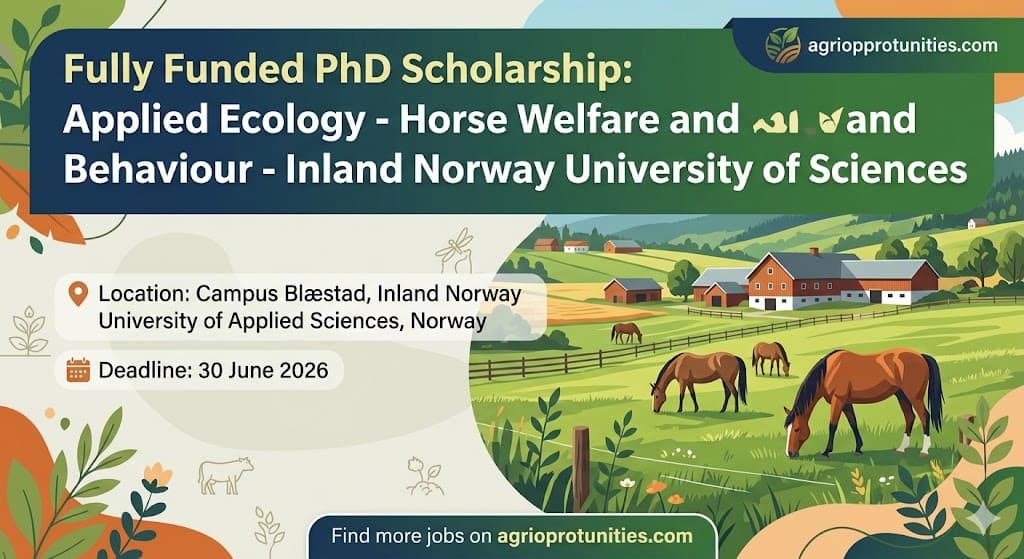
Fully Funded PhD Scholarship: Applied Ecology – Horse Welfare and Behaviour – Inland Norway University of Applied Sciences

About Inland Norway University of Applied Sciences
Applications are open for a PhD position in applied ecology, focusing on horse welfare and behaviour, at Inland Norway University of Applied Sciences (INN), Faculty of Applied Ecology, Agricultural Sciences and Biotechnology. INN will fund this position for three years, beginning in August 2026. The selected candidate will enroll in INN’s PhD program in Applied Ecology and Biotechnology and will work at Campus Blæstad.
Scholarship Overview
Project Description
The focus will be on yearling stallions of the Norwegian Swedish Coldblooded trotter, a common breed managed in different systems. Over two summer grazing seasons, at least 10 horses from three different systems—mountain pastures, lowland pastures, and stabled horses with access to paddocks or small grazing areas—will be monitored. The aim is to compare time budgets for welfare-related behaviours such as grazing, resting, and social interactions. Horses will also be assessed for stress levels and body development to study the relationship between these factors and behaviour.
The PhD student will use data from GPS collars and triaxial accelerometers, combined with video analysis and machine learning, to quantify different types of horse behaviour. Researchers will evaluate stress by analyzing biomarkers, specifically cortisol concentrations in fecal samples collected at multiple points during the grazing season. They will also monitor weight and body condition throughout the season using measuring tapes and Body Condition Scores (BCS). The research team will integrate these measurements into the overall analysis.
Why This Scholarship Stands Out
This PhD is unique because it combines animal welfare science with cutting-edge technology – GPS collars, triaxial accelerometers, and machine learning. You will monitor yearling stallions of the Norwegian Swedish Coldblooded trotter across three different management systems: mountain pastures, lowland pastures, and stabled horses. The goal is to provide horse owners with evidence-based knowledge about horse development and welfare under different environmental conditions, enabling informed choices based on animal welfare criteria. For a student interested in applied ecology, animal behaviour, and welfare science, this is an opportunity to do research with direct practical applications for horse management.
Key Responsibilities
- Monitor yearling stallions across three summer management systems
- Use GPS collars and triaxial accelerometers combined with video analysis and machine learning to quantify horse behaviour
- Analyse biomarkers (cortisol concentrations in faecal samples) for stress evaluation
- Monitor weight and body condition using measuring tapes and Body Condition Scores (BCS)
- Compare time budgets for welfare-related behaviours such as grazing, resting, and social interactions
Candidate Profile and Eligibility
| Requirement | Details |
|---|---|
| Education | Minimum master’s degree (120 credits) or equivalent in Agricultural Sciences, Biology, Ecology, Veterinary Sciences, or other relevant subject areas |
| Academic Record | Average grade B or better from master’s program |
| Data Skills | Previous experience from handling and statistical analysis of large datasets and spatial data |
| Programming | Excellent data programming skills in R are required |
| Language | Proficient in both written and oral English (TOEFL, IELTS, or Cambridge certificate for non-English speakers) |
| Personal Qualities | Passionate about research, good teamwork characteristics, and communication skills |
| Publications | Documented peer-reviewed scientific publications or other writing experience preferred |
Supervision Team
| Supervisor | Role |
|---|---|
| Associate Professor Morten Tofastrud | Main Supervisor |
| Associate Professor Mari Reiten | Co-supervisor |
| Professor Barbara Zimmermann | Co-supervisor |
| Professor Morten Tryland | Co-supervisor |
What They Offer
| Benefit | Details |
|---|---|
| Position | 100% PhD position |
| Duration | 3 years |
| Start Date | August 2026 |
| Location | Campus Blæstad, Norway |
| Salary | Position code 1017, PhD candidate (Government Salary Scale, paygrade LT 54) |
| Pension | Membership in the Norwegian Public Service Pension |
| Work Environment | Independent and flexible work setting, daily contact with inspiring skilled colleagues, campus surrounded by agricultural landscapes with forests and mountains |
My Application Tips
Include your master’s thesis and transcript if awaiting final documentation – You can apply before final degree completionems, this project offers training across remote sensing, deep learning, and agricultural systems.
Highlight your R programming skills – This is required for data analysis and statistical handling of large datasets
Emphasize experience with spatial data and large datasets – Handling and analysing large datasets is key
Show interest in animal behaviour and welfare – Understanding of horse behaviour is valuable
Demonstrate machine learning or video analysis experience – Quantifying behaviour using technology
How to Apply
Submit your application via the link on the University website.
Required documents:
- Application letter including a brief account of research interests and motivation
- CV detailing relevant educational background and experience (registered in Jobbnorge’s form)
- Copies of academic diplomas and transcripts (certified English translation required unless documents are in Norwegian)
- List of publications
- Names and contact information for two referees
- Any other documentation you would like us to consider
Attachments: Must be uploaded as separate files. If exceeding 30 MB, compress prior to upload.
For further details, contact: Morten Tofastrud – morten.tofastrud@inn.no