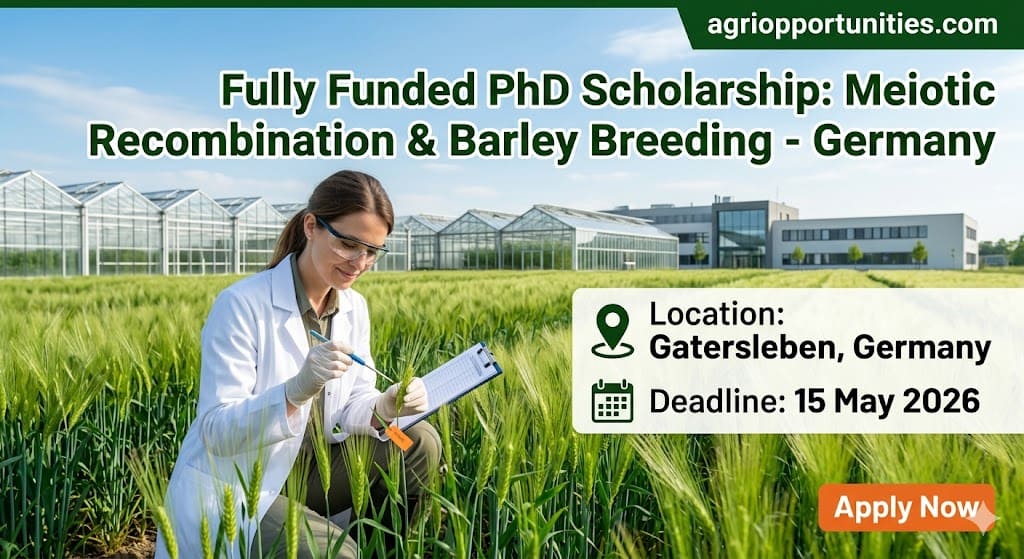
Fully Funded PhD Scholarship: Meiotic Recombination & Barley Breeding – Germany

🏛️ About Leibniz-Institute for Plant Genetics and Crop Plant Research (IPK)
Applications are open for a PhD Meiotic Recombination Barley Germany position at the Leibniz-Institute for Plant Genetics and Crop Plant Research (IPK) in Gatersleben. The project exploits natural genetic variation in meiotic recombination to overcome breeding barriers in barley. The IPK is a world-class research center with state-of-the-art facilities and scientists from all over the world. The “Meiosis” research group at IPK is interested in the process of plant meiosis that generates genetic variation harnessed in plant breeding. This position is part of the collaborative BMFTR-funded project “MZF: TWIN-3”.
🎯 Scholarship Overview
🔗 Project Summary
This PhD project aims to exploit natural genetic variation in meiotic recombination to overcome breeding barriers in barley. The project combines in silico analyses, molecular cytogenetics, single-pollen nucleus genotyping, and genetic mapping to unlock natural genetic diversity from wild relatives and improve barley resilience and breeding efficiency.
Your tasks:
- In silico allele mining: Screen natural genetic variation in meiosis-related genes using genomic datasets, predict structural impacts with tools like AlphaFold, and identify candidates for experimental validation
- Molecular cytogenetics: Conduct chromosome analysis, immunolocalization and high-resolution microscopy (3D-SIM, PALM) to characterize meiotic phenotypes, and use single-pollen nucleus genotyping to quantify crossover rates
- Genetic mapping: Evaluate meiotic variants in segregating populations to assess their impact on hybrid and interspecific crossover rates to inform breeding strategies
🌟 Why This Scholarship Stands Out
This Fully Funded PhD: Meiotic Recombination & Barley Breeding is unique because it combines computational biology (in silico allele mining, AlphaFold structure prediction) with hands-on molecular cytogenetics (high-resolution microscopy, immunolocalization) and practical breeding applications (genetic mapping). You will work on barley – one of the world’s most important cereal crops – and address a fundamental challenge: how to unlock genetic diversity from wild relatives for crop improvement. Meiotic recombination is the engine of plant breeding, but it is tightly controlled. Understanding natural variation in recombination rates could accelerate breeding dramatically. The IPK offers world-class facilities including 3D-SIM and PALM super-resolution microscopy. For someone fascinated by chromosome biology and plant breeding, this is an ideal combination of fundamental and applied research.
✅ Candidate Profile and Eligibility
| Requirement | Details |
|---|---|
| Education | MSc degree (or equivalent) in Biology, Biochemistry, Crop Science or related field at PhD start |
| Experience | Practical experience in chromosome and molecular biology as well as working with plants is strongly desirable |
| Language | Solid oral and written English skills |
You fit to us if:
- You are fascinated by chromosome biology and have a strong interest in molecular biology and microscopy
- You have strong scientific curiosity and motivation
- You enjoy working in an interdisciplinary team
📝 My Application Strategy
- Highlight any cytogenetics experience – Immunostaining, FISH, chromosome spreads, or microscopy are directly relevant. Mention specific techniques
- Emphasize bioinformatics skills – The project involves in silico allele mining and AlphaFold. Mention any experience with sequence analysis, variant calling, or protein structure prediction
- Show interest in plant breeding – Understanding why recombination matters for breeding (hybrid vigor, introgression of wild traits) will strengthen your application
- Read about meiotic recombination control – Familiarize yourself with concepts like crossovers, chiasmata, interference, and recombination hotspots
- Mention your interest in barley – Barley is a model for temperate cereals. Show you understand its importance for German and European agriculture
💼 What They Offer
| Benefit | Details |
|---|---|
| Duration | 3-year PhD position |
| Start Date | Earliest July 1, 2026 |
| Salary | Up to 65% E13 TV-L |
| Research Environment | World-class research center with state-of-the-art facilities |
| Atmosphere | Collegial and collaborative working atmosphere |
| International | Scientists from all over the world |
🎓 Who Should Apply
This Fully Funded PhD: Meiotic Recombination & Barley Breeding is perfect for a student with a background in molecular biology or plant genetics who is fascinated by chromosomes and how they behave during cell division. If you enjoy microscopy (looking at spread chromosomes under high-resolution microscopes) and are also comfortable with computational analyses (mining genomic datasets, predicting protein structures), this project offers training in both. Candidates with experience in plant work, cytogenetics, or bioinformatics are especially encouraged. The ideal candidate is someone who wants to understand a fundamental biological process (meiosis) and apply that knowledge to accelerate crop breeding.
📝 How to Apply
Required Documents (single PDF file):
- Cover letter
- CV
- Certificates (MSc degree)
- References (if available)
📧 Questions: Kerstin Schweigert – jobs@ipk-gatersleben.de
📞 Research questions: Dr. Stefan Heckmann – Tel.: +49 (0) 39482 5608
📌 Reference Number: 15/03/26 (indicate in your correspondence)
Important for international applicants: Foreign qualifications must carry out an equivalence test in Germany (ZAB Statement of Comparability): https://zab.kmk.org/en/statement-comparability
Useful Links
Similar Posts
Tenure Track Scientist– Regional Scale Cropping System Analysis
Tenure Track Scientist Cropping System Analysis position is open in Research Area Agricultural Landscape Systems within the Integrated Crop Systems Analysis working group.
Postdoc Researcher Position: Evaluating The Impacts of Short Interval Reburning on Boreal Forest Resilience in NWT Forests, Canada
A Postdoc researcher position to evaluating the impact of short interval reburning on boreal forest resilience in NWT forests, Canada
Postdoctoral Research Position: Digital Plant Phenotyping – University of Bern, Switzerland
Postdoc in Digital Plant Phenotyping at University of Bern, Switzerland. 80 to 100 percent appointment until 31 December 2028. Split between plant experiments and computational biology. Apply until filled.
Fully Funded PhD Scholarship: Modelling Non-CO2 Greenhouse Gas Emissions from Agriculture – Wageningen University and Research, Netherlands
Fully funded PhD in Modelling non-CO2 Greenhouse Gas Emissions from Agriculture at Wageningen University, Netherlands. 4-year position, €3,204–€4,051/month. Deadline: 9 October 2026.
Fully Funded PhD Scholarship: Molecular Plant Physiology – Justus Liebig University Giessen – Germany
Applications are open for a PhD Molecular Plant Physiology Germany position at Justus Liebig University Giessen. The project investigates phytochrome signal transduction in higher plants, focusing on nuclear transport of phytochrome A.
Fully Funded PhD Scholarship: Remote Sensing for Climate-Smart Agriculture – Aarhus University Denmark
Applications are open for a PhD Remote Sensing Climate Smart Agriculture Denmark position at Aarhus University. The project develops novel remote sensing algorithms and knowledge-guided machine learning frameworks to monitor crop nitrogen, productivity, and greenhouse gas fluxes for Danish and EU wheat cropping systems.