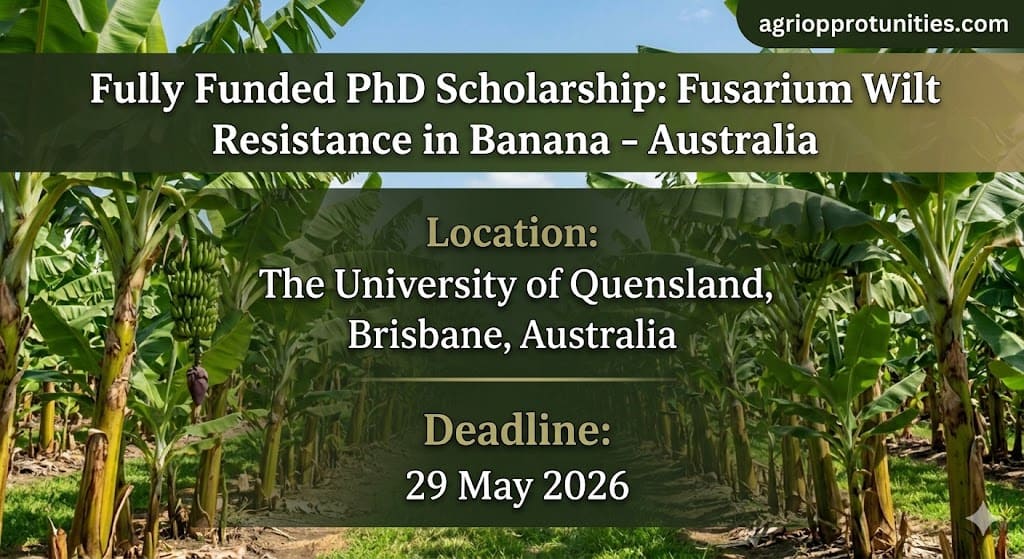
Fully Funded PhD Scholarship: Fusarium Wilt Resistance in Banana – Australia

About the University of Queensland
Applications are open for a PhD Fusarium Wilt Resistance Banana Australia position at The University of Queensland’s School of Agriculture and Food Sustainability. The project investigates the genetic basis of Fusarium wilt resistance in banana using genomics and molecular marker approaches. The School of Agriculture and Food Sustainability at The University of Queensland provides a collaborative and highly supportive research environment. Research facilities include controlled growth chambers and a newly constructed, state-of-the-art plant growth facility, allowing precise management of environmental conditions for banana and other crops. Molecular biology laboratories are fully equipped for advanced techniques, including DNA extraction, quantitative and probe-based PCR, and high-throughput genotyping.
Scholarship Overview
Project Summary
Banana (Musa spp.) is one of the world’s most important fruit crops, but production is increasingly threatened by Fusarium wilt (Panama disease). The emergence of Tropical Race 4 (TR4) poses a major risk, as widely grown Cavendish cultivars are highly susceptible. Developing resistant banana varieties is the most sustainable long-term solution.
You will investigate the genetic basis of Fusarium wilt resistance using genomics and molecular marker approaches. You will develop and validate Kompetitive Allele-Specific PCR markers to support marker-assisted selection in breeding programs, while whole genome sequencing and comparative genomics will identify candidate resistance genes and functional variants within resistance loci. In addition, you will also explore beneficial endophytic Fusarium strains and their potential role in suppressing pathogenic Foc, assessing interactions during plant colonisation. The research will provide tools and knowledge to accelerate the development of Fusarium wilt-resistant cultivars, supporting sustainable banana production globally.
Why This Scholarship Stands Out
This PhD is unique because it addresses a major global threat to banana production: Fusarium wilt Tropical Race 4 (TR4). Cavendish bananas, which dominate international trade, are highly susceptible to TR4, and no effective chemical control exists. Genetic resistance is the only sustainable solution. The project combines cutting-edge genomics (whole genome sequencing, comparative genomics) with molecular marker development (KASP markers for breeding programs) and plant-microbe interactions (beneficial endophytic Fusarium strains). You will work at a state-of-the-art plant growth facility with precise environmental controls. For a student passionate about plant pathology, genomics, and sustainable agriculture, this is an opportunity to contribute to the future of one of the world’s most important food crops.
Candidate Profile and Eligibility
| Requirement | Details |
|---|---|
| Education | Bachelor’s degree with honours (First Class or 2.1) or Master’s degree in Plant Biology, Plant Genetics, Horticulture, Plant Pathology, or related field |
| Academic Achievement | Demonstrated achievement in plant biology, plant genetics, horticulture, or plant pathology |
| Working Knowledge | Molecular biology techniques, including qPCR and DNA extraction |
| Desirable Background | Bioinformatics tools in R and Unix environment |
My Application Strategy
- Highlight your molecular biology experience – Be specific about DNA extraction, PCR, qPCR, and genotyping techniques
- Emphasize any plant pathology background – Familiarity with Fusarium wilt or other soil-borne fungal diseases is highly relevant
- Show bioinformatics interest – Mention any experience with R, Unix, or sequence analysis, even from coursework
- Demonstrate understanding of marker-assisted selection – KASP markers are used in breeding programs. Show you understand how molecular markers accelerate breeding
- Read Dr. Andrew Chen’s and Professor Elizabeth Aitken’s publications on banana or Fusarium wilt – Cite their work in your expression of interest
What They Offer
| Benefit | Details |
|---|---|
| Living Stipend | $37,500 per annum tax free (2026 rate), indexed annually |
| Tuition Fees | Covered |
| Research Environment | State-of-the-art plant growth facility and molecular biology laboratories |
| Location | St Lucia Campus, Brisbane, Australia |
| Facilities | Controlled growth chambers, high-throughput genotyping, bioinformatics resources |
Who Should Apply
This PhD is perfect for a student with a strong background in plant biology, genetics, or plant pathology who wants to apply genomics to solve a real-world agricultural problem. If you enjoy working at the bench (DNA extraction, PCR, genotyping) and are also interested in bioinformatics (sequence analysis, variant calling), this project offers training across both experimental and computational approaches. Candidates with experience in Fusarium wilt, banana, or marker-assisted breeding are especially encouraged. The ideal candidate is someone who wants to understand the genetic basis of disease resistance and translate that knowledge into tools that breeders can use.
How to Apply
Before you apply:
- Check your eligibility for the Doctor of Philosophy (PhD)
- Prepare your documentation
- If you have questions, contact Dr Andrew Chen (a.chen2@uq.edu.au)
When you apply:
Submit an expression of interest (EOI) for the program. You don’t need to apply separately for the project or scholarship.
Useful Links
Similar Posts
Two Fully Funded PhD Scholarships: Greenhouse Gas Mitigation in Agriculture – Denmark
Applications are open for Two PhD Scholarships in Greenhouse Gas Mitigation Agriculture Denmark at DTU Sustain. The projects focus on documenting methane emission reduction technologies from manure storage, including anaerobic digestion, acidification, flaring, and biofilters.
Fully Funded PhD Scholarship: Meiotic Recombination & Barley Breeding – Germany
Applications are open for a PhD Meiotic Recombination Barley Germany position at the Leibniz-Institute for Plant Genetics and Crop Plant Research (IPK) in Gatersleben. The project exploits natural genetic variation in meiotic recombination to overcome breeding barriers in barley.
Fully Funded PhD Scholarship: Biogeochemistry & Plant Physiology of Rare Earth Elements – USA
Applications are open for a Fully Funded PhD Biogeochemistry Rare Earth Elements USA position at the University of Kentucky’s Department of Plant and Soil Sciences. The project investigates the mechanisms by which plants take up and process rare earth elements from soil.
Fully Funded PhD Scholarship: Tomato Resistance to Leaf Mould Disease – Wageningen University – Netherlands
Applications are open for a PhD Tomato Resistance Leaf Mould Netherlands position at Wageningen University. The project aims to discover novel tomato genes for durable resistance to Fulvia fulva and develop next-generation predictive breeding strategies.
Fully Funded PhD Scholarship: Soil Microbiomes & Soil Health – Ireland
Applications are open for a Fully Funded PhD Soil Microbiomes Ireland position at Teagasc Johnstown Castle, in collaboration with the University of Galway. This PhD will investigate soil microbiomes in pasture-based systems and their role in soil health and grassland productivity, with a focus on nutrient and carbon cycling.
Fully Funded PhD Scholarship: Soil-Plant System Modelling – Université catholique de Louvain
Applications are open for a PhD Soil Plant System Modelling Belgium position at UCLouvain’s Earth and Life Institute as part of the Horizon Europe iRIS project. The research focuses on developing AI-based models to transform construction waste into functional soils.

Highly interested.
I am highly excited for this opportunity.
Email Id- singhmardeepak0697@hau.ac.in