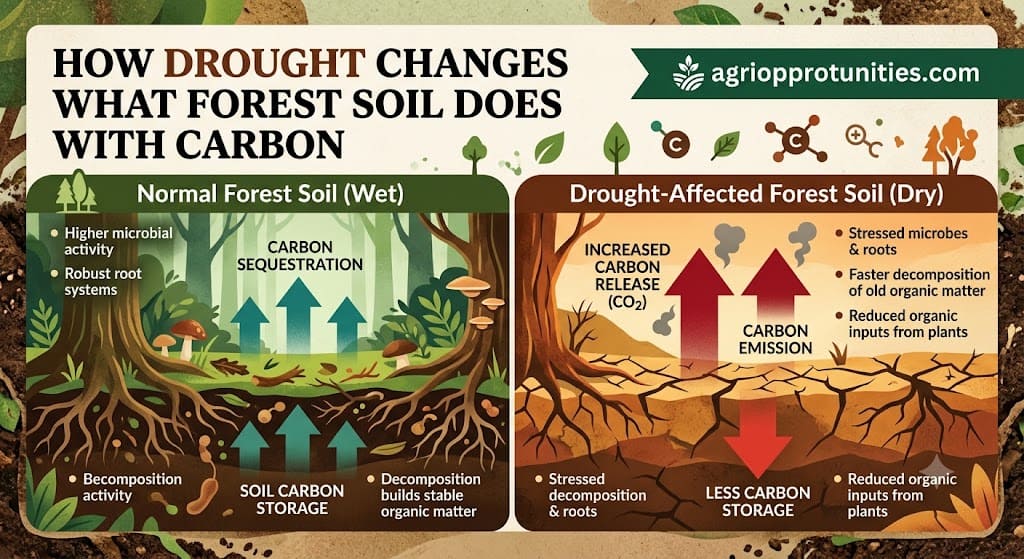
How Drought Changes What Forest Soil Does With Carbon

Drought disrupts the normal flow of carbon between tree canopies, roots, and soil, with consequences that extend well beyond visible tree stress — and recent isotope-tracing studies are revealing exactly where that carbon goes instead.
Forests are one of the planet’s most important carbon sinks, quietly pulling billions of tonnes of carbon dioxide out of the atmosphere every year. Drought threatens that role in ways that go well beyond the obvious image of stressed, wilting trees. I want to walk through what’s actually happening underground during a drought — how the normal flow of carbon between tree, root, and soil gets disrupted, and what some genuinely clever recent research has revealed about exactly where that carbon goes instead.

The Basic Carbon Balance a Healthy Forest Maintains
A forest’s net carbon balance comes down to a simple subtraction: carbon taken up through photosynthesis, minus carbon released back through respiration from both plants and soil. Under normal conditions, forests take up meaningfully more carbon than they release, which is exactly why they function as a genuine long-term carbon sink.
Why Drought Tips This Balance the Wrong Way
Drought and heat stress disrupt this balance specifically by reducing photosynthesis more sharply than they reduce respiration. Soil moisture limitation does suppress both processes, but photosynthesis is considerably more sensitive to water stress than respiration is.
The Result: Reduced Uptake, or Even Net Release
Because photosynthesis drops faster than respiration under drought, the net effect shifts toward reduced carbon uptake, and under severe enough conditions, forests can flip from being a net carbon sink to a net carbon source. Researchers specifically documented this kind of net carbon release at several sites in France during the intense summer 2022 drought — a genuinely concerning real-world demonstration that this isn’t just a theoretical risk.
When Drought and Heat Combine and Recur
The combined stress of intense drought and heat, especially when sustained over long periods or recurring across multiple seasons, leads to increased crown damage and eventually tree mortality — the visible endpoint of a stress cascade that begins with this underlying carbon imbalance well before any tree actually dies.
Tracing Carbon’s Actual Journey From Tree to Soil
Understanding drought’s effect on forest carbon requires knowing how carbon normally moves from a tree’s canopy down into the soil in the first place. A genuinely elegant piece of research answered this using carbon isotope tracing in a mature, 100-year-old pine forest, as part of a 15-year-long irrigation experiment designed specifically to study this question.
The Method: Labeling Fresh Tree Sugars
Researchers pulse-labeled the trees with a distinct carbon isotope (¹³C), essentially tagging freshly produced sugars so they could track exactly where that carbon went afterward, and how long it took to get there.
What They Found: A Four-Day Journey, With a Long Tail
It took about four days for newly labeled sugars to reach the rhizosphere — the root zone microbial community covered in the soil microbiome piece earlier in this series. Remarkably, the labeled carbon signal was still detectable in stem and soil respiration a full year later, showing that trees don’t simply pass fresh sugars straight through to the soil; they store a meaningful share of that carbon internally first, releasing it gradually for metabolic use over an extended period.
How Irrigation Changed This Timeline
When researchers removed the forest’s natural water stress through long-term irrigation, the average time carbon took to travel from canopy uptake to soil respiration dropped from 89 days down to just 40 days — a genuinely dramatic difference showing exactly how much water availability shapes the internal plumbing of a forest’s carbon economy, not just its total carbon uptake.
What Happens to the Soil Microbial Community Under Irrigation vs. Drought
The same long-term irrigation experiment found that removing water stress increased the labile (easily available) soil organic matter pool and shifted the resident soil microbiome from a largely oligotrophic life strategy (adapted to scarce, low-nutrient conditions) toward a more copiotrophic one (adapted to nutrient-rich, resource-abundant conditions).
A Genuine Open Question Remains
Researchers were candid that it remains uncertain whether the enhanced carbon inputs into soil organic matter under wetter conditions are fully balanced out by correspondingly faster microbial decomposition — meaning even this well-designed, long-running experiment couldn’t fully resolve whether wetter forest soil ends up storing more net carbon overall, or simply cycling more carbon through faster without necessarily building up a bigger long-term carbon stock.
🔬 A Genuinely Surprising Discovery
During drought, researchers found that total soil carbon dioxide efflux decreased, alongside a shift in how microbes allocated their carbon internally — evidence that soil microbial communities actively redirect carbon away from their normal respiratory pathway and toward increased production of stress-related volatile compounds instead. In plain terms: under drought, soil microbes appear to deliberately shift their own internal chemistry toward survival-focused compound production, rather than continuing business-as-usual respiration.
What Happens When Trees Actually Start Dying
Beyond the metabolic-level changes covered above, drought-driven tree decline and mortality trigger their own distinct cascade of soil biogeochemical changes, studied in detail through research on Holm oak forests across a climate gradient.
Reduced Carbon Inputs Change the Whole System
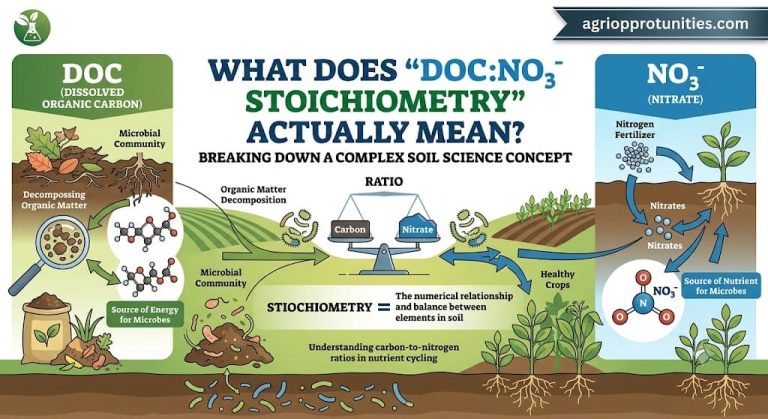
As trees decline and die, the reduction in labile carbon inputs to soil decreases heterotrophic respiration (the respiration carried out by organisms consuming organic carbon rather than producing their own through photosynthesis). This same research found that tree decline alters the balance of nitrate-producing and nitrate-consuming microbes — directly connecting to the nitrogen cycle piece earlier in this series — and promotes the accumulation of more mobile, leaching-prone forms of nitrogen and phosphorus in the soil.
A Genuinely Concerning Long-Term Implication
The same researchers found that these resulting stoichiometric imbalances between carbon, nitrogen, and phosphorus may actually prevent full ecosystem recovery even after a drought episode ends — meaning the soil-level consequences of a severe drought-driven tree mortality event can persist well beyond the drought itself, rather than simply resetting once rain returns.
A Related but Distinct Pathway: Bark Beetle-Driven Tree Death
Drought-weakened trees are also considerably more vulnerable to secondary threats like bark beetle infestation, and research simulating this kind of mortality event found its own distinct soil-level signature. Girdled trees (used to simulate beetle-killed trees experimentally) showed decreased dissolved organic carbon flux, suggesting a genuine reduction in carbon-based food sources available to soil microbes, compounded by lower soil moisture around the dying trees, which further reduced microbial activity and slowed decomposition rates.
An Open Question Researchers Are Still Working Through
Interestingly, this same study found no definitive change in overall soil respiration despite these disrupted carbon inputs, suggesting some additional carbon substrate beyond the tree’s own direct inputs continues reaching and supporting soil microbial respiration even as a tree dies — a genuine, still-unresolved detail the researchers flagged for future study.
Does Drought Increase or Decrease Total Soil Carbon Storage?
Given everything covered above, it’s worth addressing this question directly, since the honest answer is genuinely more complicated than a simple yes or no.
The Litter Fall vs. Litter Decomposition Mismatch
Research specifically focused on a drought-prone Scots pine forest found that frequent drought events reduce litter fall (the amount of dead plant material dropping to the forest floor) without correspondingly reducing litter decomposition rates at the same pace, potentially resulting in an overall decline in soil carbon stocks over time. This is a genuinely important, easy-to-miss dynamic: even if drought slows decomposition somewhat, as more basic soil moisture research would predict, if it slows the supply of new organic material even more, the net result can still be less carbon accumulating in soil overall.
Why the Broader Answer Remains Genuinely Uncertain
Forest soil carbon pools are driven by the combined interaction of primary production, litter decomposition, and long-term stabilization, and researchers studying this question directly acknowledge it remains unclear whether altered climatic conditions will ultimately increase or decrease total soil carbon under a warmer, more drought-prone future — a genuinely open scientific question rather than one with an already-settled answer.
Why This Matters Given the Scale of Forest Carbon Storage
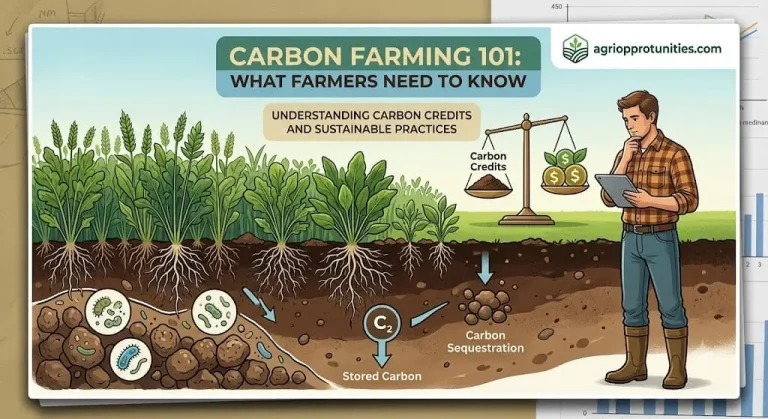
Forest soils have sequestered roughly 1.1 billion tonnes of carbon per year over recent decades, according to current estimates — a genuinely massive climate service that depends directly on the biological processes covered throughout this piece continuing to function as they have historically. Given that temperate forests specifically face increasing frequency and duration of summer drought under current climate projections, understanding exactly how these underground carbon processes respond isn’t an abstract academic question — it’s directly tied to how much climate buffering capacity forests will actually retain going forward.
Why This Matters for Students Considering This Research Area
Forest soil carbon research under drought stress sits at a genuinely rich, methodologically sophisticated intersection of plant physiology, soil microbiology, and climate science. The isotope-tracing techniques covered in this piece represent some of the most elegant experimental approaches in current ecosystem science, and given how much genuine uncertainty researchers themselves acknowledge remains in this field, it offers real opportunity for students interested in combining advanced tracer methodology with genuinely open, consequential climate science questions.
For current research and graduate opportunities in forest soil science and climate change research, browse live agriculture scholarship listings on Agri Opportunities.
Frequently Asked Questions
Why does drought reduce a forest’s net carbon uptake?
Drought and heat reduce photosynthesis more sharply than they reduce respiration, since soil moisture limitation affects both processes but photosynthesis is more sensitive, meaning the balance shifts toward reduced net carbon uptake or even net carbon release during severe drought.
How long does it take for a tree’s carbon to actually reach the soil?
Using carbon isotope tracing in a mature pine forest, researchers found it took about four days for newly produced tree sugars to reach the rhizosphere, though some of that carbon remained detectable in soil respiration for over a year, showing trees can store and slowly release carbon rather than transferring it immediately.
Does drought always reduce soil carbon decomposition?
Not necessarily in a simple way. While drought generally limits microbial enzyme activity by breaking the water films microbes rely on, research on drought-prone pine forests found that drought reduced litter fall more than it reduced litter decomposition, potentially resulting in an overall decline in soil carbon stocks.
What happens to soil microbes when trees die from drought?
Research on oak forests found that tree decline and mortality reduces labile carbon inputs to soil, which decreases microbial respiration and alters the balance of nitrogen and phosphorus cycling microbes, creating stoichiometric imbalances that can prevent the ecosystem from fully recovering even after the drought ends.
- • The Nitrogen Cycle Explained: How Fertilizer Becomes Greenhouse Gas
- • The Soil and Crop Microbiome Explained
- • Dryland Farming and Climate Change: Why Water-Scarce Soils Behave Differently
- • DOC:NO₃⁻ Stoichiometry: A Complex Soil Science Concept
Add Agri Opportunities as a preferred source on Google to see latest blog listings first.