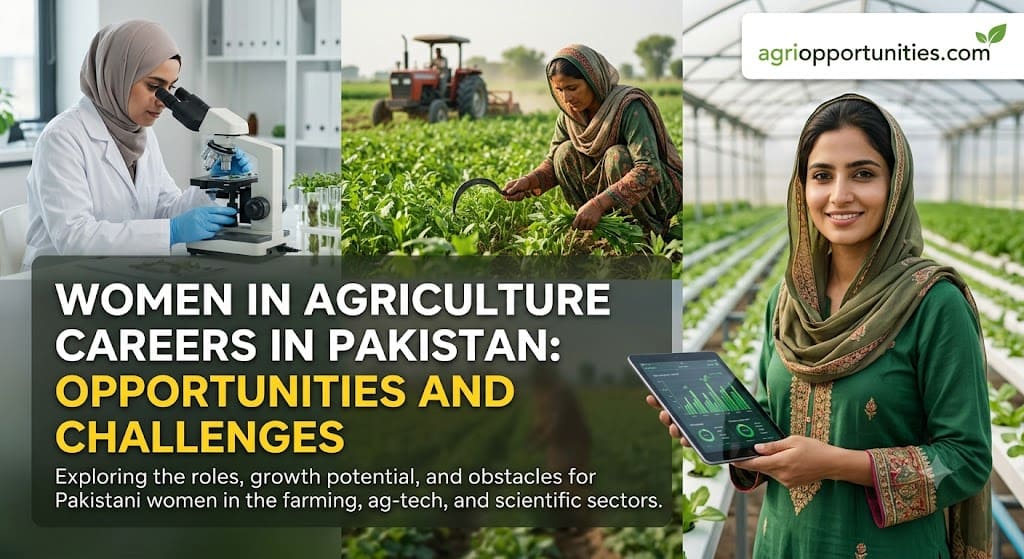
Women in Agriculture Careers in Pakistan: Opportunities and Challenges


Women in Agriculture Careers in Pakistan: Opportunities and Challenges
Women make up the majority of Pakistan’s agricultural workforce but own almost none of the land. Here’s the full picture, and where real opportunity is opening up.
Walk through any wheat field in Punjab during harvest, or past a cotton crop in Sindh during picking season, and the workforce you’ll see is overwhelmingly female. Women sow the seeds, weed the fields, tend the livestock, thresh the harvest, and process the dairy that ends up on the country’s tables. And yet, if you asked to see the land records for that same field, the name on the title is almost never hers. This contradiction — women as the backbone of Pakistan’s agricultural labor and almost entirely absent from its ownership, credit, and decision-making structures — is the single most important thing to understand about women’s role in Pakistani agriculture. It shapes everything else in this piece: the barriers women face, the opportunities now opening up, and what actually needs to change for those opportunities to become more than isolated success stories.
The Glass Wall: Barriers & Opportunities
Cooperative Farming
Women-led cooperatives provide collective bargaining power, shared training, and direct market access — bypassing exploitative middlemen.
OpportunityAgri-Tech & Hydroponics
Controlled-environment agriculture shifts focus from physical labor to technical skills — opening doors for educated urban women.
OpportunityExtension & Government Service
Policy target: 40% female extension officers by 2030. Public-sector agriculture roles are actively recruiting women.
OpportunityThe Scale of Women’s Contribution, in Numbers
The statistics here are worth sitting with, because they’re more dramatic than most people, even those working in agriculture, tend to assume. Depending on the specific data source and year, women make up somewhere between 60 and 70 percent of Pakistan’s agricultural workforce — figures cited across recent research range from 60 to 80 percent of farm labor, with the Pakistan Bureau of Statistics’ 2020–21 Labour Force Survey placing the figure at 67.2 to 67.9 percent. In some rural areas, women’s share of the agricultural workforce climbs even higher, with some estimates putting it closer to 70 percent specifically within rural communities.
Long Working Hours and Unequal Pay
This isn’t light or occasional labor. Research on rural Pakistani women’s working patterns found they work an average of 15.5 hours a day, with roughly 5.5 hours of that time dedicated specifically to livestock care alone — before accounting for the crop-related labor, household responsibilities, and childcare that fill the rest of their day.
Despite this workload, the same research found women earn just 16.3 percent of what men earn for their agricultural labor. This disparity highlights the gap between women’s substantial contribution to agricultural production and the economic recognition they receive for their work.
Women’s Land Ownership Remains Limited
Despite forming the clear majority of the agricultural workforce, women own less than 5 percent of agricultural land in Pakistan, according to UN Women data from 2023. Other research puts the figure even lower: a 2020–21 PBS Labour Force Survey analysis found less than 3 percent of rural women were officially registered landowners, while separate nutrition-focused research found only 1 to 2 percent of women own land autonomously, with around 10 percent sharing land ownership jointly with a spouse.
The Burden of Unpaid Agricultural Work
A related and perhaps even more striking figure: 76 percent of women employed in agriculture work entirely without pay, classified in official records as “family help” or “contributing family workers” rather than recognized laborers — compared to roughly 10 percent of men in similar roles. This lack of compensation and formal recognition can limit women’s financial independence and access to resources, despite their essential role in sustaining agricultural households.

Where Real Opportunity Is Opening Up
🌾 Cooperative Farming and Value Chain Leadership
One of the most consistently successful models has been women organizing into cooperatives that give them collective bargaining power, shared access to training and inputs, and a formal structure for selling produce directly rather than through often-exploitative middlemen. A group of women in Punjab, for example, formed a cooperative specifically to grow and sell organic vegetables, and with training and support now supply local markets on a steady, income-generating basis. Similarly, under a potato value chain project run by CABI (the Centre for Agriculture and Bioscience International), nearly 200 women farmers and laborers in a potato-growing region were trained across the full value chain — from Integrated Pest Management to seed potato cultivation — and moved from passive laborers into active roles supervising field activities and negotiating directly with input providers and buyers.
🐄 Livestock and Dairy Entrepreneurship
Given that women already perform the overwhelming majority of livestock care in most rural households, livestock and dairy represent a particularly natural entry point for formal entrepreneurship rather than unpaid family labor. Punjab’s Livestock Program, launched in 2024, provides free cattle and interest-free loans specifically to rural women, aiming to help them establish independent livestock businesses rather than simply managing animals owned and controlled by male family members.
📦 Export-Oriented Agribusiness and Value Addition
Pakistan’s agricultural export sector — mangoes, citrus, rice, dried fruits, honey — represents a significant and growing opportunity space, particularly for women willing to move beyond raw produce sales into value-added processing and branding. Rather than selling raw produce at low margins, women-led ventures cleaning, packaging, and branding products for premium markets, including Gulf export markets, are capturing considerably higher returns.

👩🏫 Agricultural Extension and Government Service
There’s a specific, structural opportunity here worth calling out directly: agricultural policy researchers have proposed a national target of ensuring at least 40 percent of extension officers are women by 2030, precisely because female extension officers are dramatically more effective at reaching and training female farmers than male officers operating within the same social and mobility constraints discussed earlier. For women with agricultural science degrees considering a public-sector career path, extension services represent a growing, policy-prioritized area where female representation is actively being sought rather than merely tolerated.
🤖 AgTech and Controlled-Environment Agriculture
This is arguably the most structurally promising space for women entering agriculture from an educated, urban background. Controlled-environment agriculture — greenhouses, vertical farms, hydroponic systems, indoor growing facilities — fundamentally shifts the skill requirements away from heavy manual field labor and physical strength-based tasks, and toward technical knowledge: data analysis, systems management, digital literacy, and precision growing techniques. This removes many of the traditional physical and cultural barriers that have historically excluded women from field-based farm management roles. Young women in Pakistani cities are increasingly launching hydroponic greenhouse ventures, organic food startups, and online vegetable delivery businesses — genuinely new categories of agricultural entrepreneurship that didn’t meaningfully exist a decade ago.
Real Stories, Not Just Statistics
Farm laborer trained through CABI’s Tomato Flagship Initiative. Grew over 4,000 tomato seedlings after training in nursery production. Sold a quarter at market and moved from feeling too shy to speak in front of men to seeing herself as building a genuine entrepreneurial career.
Built her business from a local market stand into a global exporting enterprise after an FAO-supported project helped her develop skills to produce goods meeting international standards — bypassing exploitative middlemen entirely.
Moved from small-scale sheep farming into a successful woolen shawl and hand-knotted carpet business after receiving agricultural training. Now a master trainer herself, teaching other women the skills that transformed her livelihood.
Independently owns and manages roughly 50 acres of land, employing around 25 other female farmers. Training in irrigation scheduling through IWMI strengthened her technical capacity and confidence, leading her to join formal technical working groups.
Programs and Organizations Actively Working on This
- Benazir Income Support Program (BISP) — Direct financial assistance to women, enabling investment in small-scale agricultural or livestock activities.
- Punjab’s Livestock Program (2024) — Provides free cattle and interest-free loans specifically to rural women for independent livestock businesses.
- CABI’s Better Cotton Growth and Innovation Fund — Trains women in cotton-growing communities in agricultural skills and complementary entrepreneurship.
- FAO Pakistan’s Livelihood and Food Security Improvement Fund — Funds training and mentorship for women and youth in agricultural and livestock livelihoods.
- IWMI’s WRAP Program — Gender-transformative approach to water resource management, building women’s technical capacity in irrigation.
The Economic Case, Beyond Fairness
It’s worth being explicit about something often left implicit in these conversations: closing this gender gap isn’t just a matter of fairness, though it certainly is that. It’s also a significant, quantifiable economic opportunity that Pakistan is currently leaving on the table. Research consistently suggests that if women farmers had equal access to the same resources as men — land, credit, extension services, technology — agricultural output in developing countries could rise by up to 30 percent. At a national level, some analysis suggests comprehensive financial inclusion and empowerment initiatives targeting women could add somewhere between 30 and 50 billion US dollars to Pakistan’s GDP.
What Actually Needs to Change
- Formal land titling reform that actively supports women claiming their legal inheritance and ownership rights.
- Targeted financial inclusion, reversing the recent decline in female microfinance borrowing and expanding formal banking access.
- A genuine push toward gender parity in extension services, with concrete targets like the proposed 40% female extension officer benchmark by 2030.
- Digital tools designed specifically for rural women, offering climate-resilient farming guidance and market prices in local languages.
- Formalized women-led cooperatives and market linkages in seed production, dairy processing, and organic food chains.
Practical Guidance If You’re a Woman Considering an Agriculture Career in Pakistan
If you’re a student or early-career professional weighing your options, a few practical observations are worth keeping in mind. Agricultural extension services are currently an area of active, policy-driven demand for women specifically. Controlled-environment agriculture and agri-tech ventures carry meaningfully less social friction than traditional open-field farm management roles. If you’re pursuing graduate study, HEC, Fulbright, DAAD, and Commonwealth scholarship programs do not discriminate by gender in their formal eligibility criteria. And if you’re already working in a family farming context, cooperative structures and value-chain training programs run by organizations like CABI and FAO have a genuine, documented track record of translating existing farm labor into recognized, income-generating entrepreneurship.
For current openings across agriculture, agribusiness, research, and extension roles in Pakistan, browse live agriculture job listings on Agri Opportunities, and for funded graduate study opportunities, browse current scholarship listings.
Frequently Asked Questions
What percentage of Pakistan’s agricultural workforce is female?
Estimates vary by data source and year, but most place women’s share of Pakistan’s agricultural workforce between 60 and 70 percent, with some studies citing figures as high as 67.9 percent based on Pakistan Bureau of Statistics Labour Force Survey data.
How much agricultural land do women in Pakistan actually own?
Despite forming the majority of the agricultural workforce, women own less than 5 percent of agricultural land in Pakistan, with some studies citing figures as low as 1 to 2 percent of women owning land autonomously.
What career paths are opening up for educated women in Pakistani agriculture?
Beyond traditional farm labor, educated women are increasingly entering agricultural extension services, agribusiness and export companies, agri-tech and controlled-environment agriculture ventures, cooperative leadership, and academic and research positions at agriculture universities.
What programs currently support women in Pakistani agriculture?
Programs include the Benazir Income Support Program, Punjab’s Livestock Program providing free cattle and interest-free loans, and international initiatives like CABI’s Better Cotton Growth and Innovation Fund and FAO’s Livelihood and Food Security Improvement Fund.
Switzerland runs the same broad employment-based PhD model as Denmark and Sweden, covered elsewhere on this site, but with a few genuinely distinctive details worth understanding before you apply — including some of the highest doctoral compensation in Europe, paired with famously high living costs. This guide focuses on Switzerland’s two federal institutes of technology, ETH Zurich and EPFL, the two most prominent destinations for agriculture-adjacent PhD research in the country.
PhD as Genuine, Well-Paid Employment
As with the Nordic systems covered elsewhere on this site, Swiss PhD students are not typically “scholarship students” in the traditional sense — they’re full-time university employees, commonly referred to as scientific or doctoral assistants, hired on contracts with salaries defined by national scales.
What This Actually Pays
As of 2026, EPFL’s basic starting salary for a doctoral assistant is 55,225 Swiss francs gross per year. More broadly across ETH and EPFL, doctoral stipends range from roughly 50,000 to 62,000 francs annually — genuinely well above typical European PhD compensation, including comparison points like Germany’s DFG-funded positions, which sit closer to 45,000 to 55,000 euros.
The Living Cost Reality Check
It’s worth being honest that this higher pay reflects genuinely higher costs, not just better funding. Zurich and Geneva rank among the most expensive cities globally for cost of living, placing in the same tier as Hong Kong, Singapore, and New York — meaning the higher salary needs to be weighed against a correspondingly higher cost base rather than treated as pure additional purchasing power.
Tuition Is Almost an Afterthought
Given the employment-based structure, tuition fees are genuinely minimal — often just a few hundred Swiss francs per semester, with ETH Zurich specifically citing fees around 809 CHF per semester. Your salary is effectively your entire funding package, rather than needing to separately cover significant tuition costs on top of living expenses.
How PhD Admission Actually Works
You Generally Need a Doctoral Program Behind You First
At EPFL specifically, you must be admitted by a doctoral program before you can be hired as a doctoral assistant. In some cases, a doctoral program may admit a candidate even without a corresponding funded position immediately available — in that situation, the candidate remains eligible for hiring for up to one year while funding is sought, and can pursue individual scholarships and external funding in parallel.
Finding a Supervisor Is the Real First Step
As with Germany’s traditional PhD model covered elsewhere on this site, Swiss admissions tend to be based on genuine fit and research alignment between you and a specific supervisor, rather than a standardized, purely metrics-based admissions process. Direct outreach to a professor whose research matches your interests — following the same approach recommended in the general research assistantship guide elsewhere on this site — is typically the practical starting point, sometimes taking several months of sustained outreach before securing a supervisor’s commitment.
A Concrete, Currently Open Example: ETH Zurich’s Agricultural Economics PhD
To illustrate these opportunities with a concrete example, consider a recent ETH Zurich vacancy relevant to agricultural research. ETH Zurich advertised a four-year doctoral position in Agricultural Economics and Policy under Professor Robert Finger in the Agricultural Economics and Policy Group. The position formed part of the ACHIEVE project, a Swiss research initiative exploring pathways to net-zero emissions in hard-to-abate sectors, including agriculture.
What Made This Position Attractive
The position offered a doctoral salary, employee benefits, and the opportunity to contribute directly to a major climate policy research project. By linking agricultural economics with Switzerland’s net-zero transition planning, the role allowed the successful candidate to investigate practical policy challenges rather than focus exclusively on theoretical research.
What the Application Actually Required
Applicants had to submit a cover letter, CV, academic transcripts, and contact details for two referees in a single PDF through ETH Zurich’s online application portal. The vacancy welcomed recent master’s graduates and candidates who were still completing a relevant degree in agricultural economics or a related discipline. Applicants should consult the original vacancy for the exact eligibility criteria and submission instructions.
A Language Detail Worth Noting
Although many research groups at Swiss universities operate primarily in English, some positions, particularly those involving public policy or local stakeholders, may require or prefer German or French proficiency. Check each vacancy’s language requirements carefully rather than assuming English alone will suffice, even at internationally oriented institutions such as ETH Zurich and EPFL.
Where to Actually Search for Swiss PhD Positions
Direct University Job Portals
ETH Zurich, EPFL, and other Swiss universities, including the universities of Zurich, Geneva, Lausanne, Bern, Basel, and Fribourg, advertise PhD vacancies through their official job portals. Applicants can also search academic recruitment platforms such as Academic Positions and FindAPhD to discover additional opportunities.
Structured Graduate Schools
Structured graduate schools offer another route into doctoral research. The Life Science Zurich Graduate School, a joint initiative of ETH Zurich and the University of Zurich, connects prospective PhD students with research groups across a broad range of life science disciplines. Its participating groups may offer opportunities in areas related to agriculture, plant science, environmental biology, and food systems. Applicants should check the graduate school’s current vacancies and funding arrangements, as available positions and eligibility requirements vary.
Swiss Government Excellence Scholarships
The Swiss Government Excellence Scholarships, administered through Switzerland’s federal scholarship programme, support eligible international researchers and postgraduate applicants through specific scholarship schemes. Depending on the applicant’s country and academic background, opportunities may include doctoral research or shorter research stays. Applicants should check the current country-specific eligibility rules, scholarship categories, and application deadlines. Many schemes also require support from a prospective Swiss academic supervisor, making early contact an important part of the application process.
What Makes ETH and EPFL Genuinely Distinctive as a Career Investment
ETH Zurich and EPFL offer strong research environments, international academic networks, and connections with industry. Their graduates pursue careers in academia, research institutions, technology companies, and other sectors. However, academic placement outcomes vary by discipline, career stage, and individual circumstances, so applicants should review programme-specific graduate outcomes rather than assume a particular probability of securing a tenure-track position. Both universities also maintain industry partnerships, including connections with major food and nutrition companies such as Nestlé, which may interest graduates considering careers in agriculture, food science, or industrial research.
Practical Tips for a Competitive Application
Contact prospective supervisors well in advance, especially when a project requires their support before you submit an application. Building a productive academic relationship can take time, so make supervisor outreach an early priority. Check the language requirements for each vacancy instead of assuming that English alone will suffice, particularly for applied research or positions involving local stakeholders. Finally, budget carefully for living expenses in Switzerland. Although doctoral salaries can be competitive, housing, health insurance, food, and transportation can significantly affect your disposable income in expensive cities such as Zurich and Geneva.
Looking for current doctoral opportunities? Browse agriculture PhD positions and scholarship listings on Agri Opportunities to explore opportunities in Switzerland and across Europe.
Frequently Asked Questions
How much does a PhD student at ETH Zurich or EPFL actually earn?
As of 2026, EPFL’s basic starting salary for a doctoral assistant is 55,225 Swiss francs gross per year, while ETH and EPFL doctoral stipends more broadly range from roughly 50,000 to 62,000 francs annually, well above typical European PhD compensation.
Do I need to find a supervisor before applying for a PhD in Switzerland?
Yes, in most cases. At EPFL specifically, you must be admitted by a doctoral program before you can be hired as a doctoral assistant, and finding a professor willing to supervise your specific research area is typically the first practical step.
How much does PhD tuition cost in Switzerland?
Tuition fees are very low, often only a few hundred Swiss francs per semester, since most PhD students are treated as full-time university employees rather than fee-paying students, meaning your salary functions as your primary source of funding.
What is the Swiss Government Excellence Scholarship?
It’s a national-level award, run by the Federal Commission for Scholarships for Foreign Students, available to postgraduate researchers from over 180 countries, funding either a full PhD of usually up to three years or a research stay during a PhD already underway elsewhere.
Add Agri Opportunities as a preferred source on Google to see latest blog listings first.