Sustainable and Regenerative Agriculture Careers in the USA: Roles and Realistic Pay


Sustainable and Regenerative Agriculture Careers in the USA
Entry-level, technical, and leadership career paths in sustainable and regenerative agriculture, with realistic salary data.
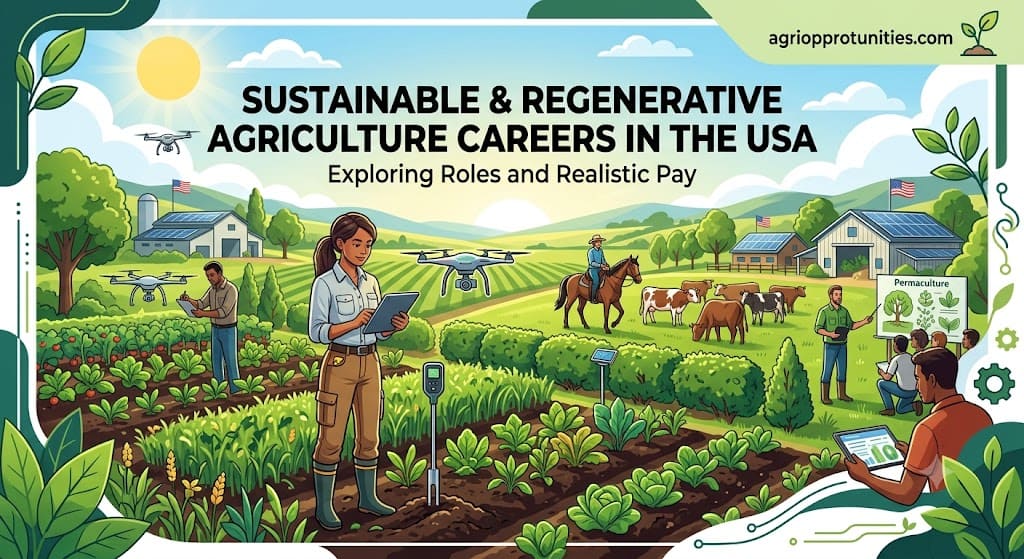
Sustainable and regenerative agriculture has moved from a niche philosophy to a genuine career category with its own job titles, employers, and pay scales. It’s also become a more concrete area of federal policy attention, with a recent executive order specifically advancing regenerative agriculture and USDA grant programs funding roles built around expanding regenerative markets. For anyone considering this path, it helps to think of it less as a single job and more as a career ladder, since the roles and required qualifications shift considerably as you move from entry-level fieldwork toward specialized scientific, certification, or policy work.
The Regenerative Agriculture Career Ladder
🌾 Farm & Field Roles
Market farming, diversified vegetable production, farm crew operations. Many positions list “passion for regenerative agriculture” as a requirement alongside practical farming experience.
🔬 Agronomists & Soil Scientists
Expert advice on soil management, field trials, data collection to validate regenerative outcomes. Conservation scientists and natural resource specialists fall in a similar range.
✅ Certification & Verification
Organizations like Regenified verify farming practices against regenerative standards. A growing niche for people with soil science or agronomy backgrounds.
👔 Farm Operations Directors & Managers
Overseeing budgets, staff, compliance, and digital farm management tools alongside regenerative practices. Requires agronomic knowledge + leadership skill.
✅ The Emerging Certification Niche
One of the most distinctive recent developments is the growth of dedicated regenerative certification organizations — companies built specifically to verify that a farm’s practices meet defined regenerative standards. Regenified, founded in 2022, is now the first regenerative certifier approved under USDA standards. This niche combines technical soil assessment skill with supply chain and brand requirements — a genuinely new professional category with less established competition.
Policy and Program-Funded Roles
A distinct category worth knowing about is positions funded directly through federal grant programs aimed at expanding regenerative agriculture markets — for example, USDA’s Advancing Markets for Producers (AMP) grant program has funded specific roles focused on growing regenerative agriculture adoption and market access in target regions. These positions tend to be grant-funded and time-limited rather than permanent corporate roles, but they offer a genuine entry point into policy-adjacent regenerative work, often at nonprofits or regional agricultural development organizations.

What Employers Consistently Look For
Across nearly every level of this career ladder, a few consistent themes show up in job postings: genuine hands-on farming or field experience is valued even in more technical and scientific roles, communication skills matter disproportionately for anyone working with farmers or the public on regenerative practices, and a demonstrated personal commitment to the underlying philosophy of regenerative agriculture is frequently listed as an explicit qualification.
📋 US Government Policy Support
Current federal policy includes an executive order advancing regenerative agriculture, alongside USDA grant programs like Advancing Markets for Producers that fund positions specifically focused on expanding regenerative practices and markets. This policy support creates real job opportunities at nonprofits and regional agricultural development organizations.
🌱 Building Toward a Regenerative Agriculture Career
- Pursue a bachelor’s degree in environmental science, sustainable agriculture, agronomy, or a closely related field.
- Seek hands-on farm experience specifically at operations practicing regenerative or diversified methods.
- Watch the certification niche — organizations like Regenified are expanding quickly and need people with technical soil assessment skills.
For current openings across sustainable and regenerative agriculture roles in the USA, browse live agriculture job listings on Agri Opportunities.
Frequently Asked Questions
What is the difference between sustainable and regenerative agriculture careers?
Sustainable agriculture careers generally focus on maintaining resource efficiency and reducing environmental harm, while regenerative agriculture careers focus specifically on actively rebuilding soil health, biodiversity, and ecosystem function, and increasingly involve verification and certification work tied to that outcome.
What does entry-level pay look like in regenerative agriculture?
Entry-level farm-based regenerative agriculture roles commonly pay in the range of 18 to 27 dollars per hour, based on current market data, while technician and specialist roles requiring a degree typically start in the mid-40,000 to mid-60,000 dollar range annually.
Is there a career path in regenerative agriculture certification?
Yes. A growing number of organizations verify and certify regenerative farming practices for supply chains, creating roles for people who can assess on-farm practices against defined regenerative standards, a niche that has expanded significantly as more brands seek regenerative sourcing claims.
Does US government policy currently support regenerative agriculture careers?
Yes, current federal policy includes an executive order advancing regenerative agriculture, alongside USDA grant programs like Advancing Markets for Producers that fund positions specifically focused on expanding regenerative practices and markets.
Browse live, currently open positions in sustainable agriculture, regenerative farming, soil health, certification, and agronomy.
Switzerland runs the same broad employment-based PhD model as Denmark and Sweden, covered elsewhere on this site, but with a few genuinely distinctive details worth understanding before you apply — including some of the highest doctoral compensation in Europe, paired with famously high living costs. This guide focuses on Switzerland’s two federal institutes of technology, ETH Zurich and EPFL, the two most prominent destinations for agriculture-adjacent PhD research in the country.

PhD as Genuine, Well-Paid Employment
As with the Nordic systems covered elsewhere on this site, Swiss PhD students are not typically “scholarship students” in the traditional sense — they’re full-time university employees, commonly referred to as scientific or doctoral assistants, hired on contracts with salaries defined by national scales.
What This Actually Pays
As of 2026, EPFL’s basic starting salary for a doctoral assistant is 55,225 Swiss francs gross per year. More broadly across ETH and EPFL, doctoral stipends range from roughly 50,000 to 62,000 francs annually — genuinely well above typical European PhD compensation, including comparison points like Germany’s DFG-funded positions, which sit closer to 45,000 to 55,000 euros.
The Living Cost Reality Check
It’s worth being honest that this higher pay reflects genuinely higher costs, not just better funding. Zurich and Geneva rank among the most expensive cities globally for cost of living, placing in the same tier as Hong Kong, Singapore, and New York — meaning the higher salary needs to be weighed against a correspondingly higher cost base rather than treated as pure additional purchasing power.
Tuition Is Almost an Afterthought
Given the employment-based structure, tuition fees are genuinely minimal — often just a few hundred Swiss francs per semester, with ETH Zurich specifically citing fees around 809 CHF per semester. Your salary is effectively your entire funding package, rather than needing to separately cover significant tuition costs on top of living expenses.
How PhD Admission Actually Works
You Generally Need a Doctoral Program Behind You First
At EPFL specifically, you must be admitted by a doctoral program before you can be hired as a doctoral assistant. In some cases, a doctoral program may admit a candidate even without a corresponding funded position immediately available — in that situation, the candidate remains eligible for hiring for up to one year while funding is sought, and can pursue individual scholarships and external funding in parallel.
Finding a Supervisor Is the Real First Step
As with Germany’s traditional PhD model covered elsewhere on this site, Swiss admissions tend to be based on genuine fit and research alignment between you and a specific supervisor, rather than a standardized, purely metrics-based admissions process. Direct outreach to a professor whose research matches your interests — following the same approach recommended in the general research assistantship guide elsewhere on this site — is typically the practical starting point, sometimes taking several months of sustained outreach before securing a supervisor’s commitment.
A Concrete, Currently Open Example: ETH Zurich’s Agricultural Economics PhD
To make this genuinely concrete rather than abstract, it’s worth looking at an actual recent ETH Zurich posting closely matching this site’s focus. ETH Zurich advertised a four-year doctoral position in Agricultural Economics and Policy, working under Professor Robert Finger within the Agricultural Economics and Policy Group, as part of the ACHIEVE project — a major national Swiss research initiative focused on pathways to net-zero for Switzerland’s hardest-to-abate emissions sectors, including agriculture.
What Made This Position Attractive
The role offered a full ETH Zurich doctoral salary, social benefits, and direct involvement in a genuinely consequential national climate policy project — connecting real agricultural economics research to Switzerland’s actual net-zero transition planning, rather than purely theoretical academic work disconnected from policy application.
What the Application Actually Required
Applicants needed to submit a cover letter, CV, academic transcripts, and contact details for two referees, all combined into a single PDF document, through ETH Zurich’s online application portal. The position was open to both recent master’s graduates and students still completing their degree in agricultural economics or a related discipline.
A Language Detail Worth Noting
Some Swiss positions, including certain policy-facing roles, may favor or require proficiency in one of Switzerland’s major working languages (German or French) alongside English, which can meaningfully narrow the international applicant pool for those specific roles — worth checking carefully on each individual posting rather than assuming English alone is always sufficient, even at internationally-oriented institutions like ETH and EPFL.
Where to Actually Search for Swiss PhD Positions
Direct University Job Portals
ETH Zurich, EPFL, and other Swiss universities including Zurich, Geneva, Lausanne, Bern, Basel, and Fribourg regularly advertise PhD openings directly on their own job portals, alongside general academic job boards like Academic Positions and FindAPhD.
Structured Graduate Schools
Beyond individually advertised positions, structured graduate schools offer another entry route — the Life Science Zurich Graduate School, a joint programme between ETH Zurich and the University of Zurich, offers over 100 fully funded PhD positions across roughly 500 research groups in the life sciences broadly, a genuinely large and relevant pool for agriculture-adjacent research interests.
Swiss Government Excellence Scholarships
Run by Switzerland’s Federal Commission for Scholarships for Foreign Students, these national-level awards are available to postgraduate researchers from over 180 countries across any discipline, funding either a full PhD (usually up to three years) or a shorter research stay during a PhD already underway elsewhere. Every application must be formally backed by a professor, reinforcing again how central that initial supervisor relationship is across nearly every Swiss funding route.
What Makes ETH and EPFL Genuinely Distinctive as a Career Investment
Beyond the funding mechanics, it’s worth knowing that ETH and EPFL graduates report notably strong academic placement outcomes, with some tracking suggesting a meaningful probability of landing a tenure-track position at a top-100 global university within five years of graduation — among the stronger placement outcomes for any doctoral programme outside a small handful of the most prestigious US and UK institutions. Both universities also maintain well-established industry connections with major companies including Nestlé, relevant for agriculture and food science graduates specifically considering an industry rather than purely academic career path.
Practical Tips for a Competitive Application
Start supervisor outreach well in advance, since securing a professor’s genuine commitment can take several months of sustained contact, and treat this relationship-building as the actual gating step in your application timeline rather than an afterthought. Confirm language requirements explicitly for any specific posting rather than assuming English alone suffices, particularly for policy-facing or applied research roles. And budget realistically for Swiss living costs specifically — the higher salary figures covered in this guide need to be weighed honestly against Zurich and Geneva’s position among the most expensive cities in the world, rather than treated as straightforwardly superior to lower-paying positions in more affordable countries.
For currently open PhD positions in Switzerland and across Europe, browse live agriculture scholarship listings on Agri Opportunities.
Frequently Asked Questions
How much does a PhD student at ETH Zurich or EPFL actually earn?
As of 2026, EPFL’s basic starting salary for a doctoral assistant is 55,225 Swiss francs gross per year, while ETH and EPFL doctoral stipends more broadly range from roughly 50,000 to 62,000 francs annually, well above typical European PhD compensation.
Do I need to find a supervisor before applying for a PhD in Switzerland?
Yes, in most cases. At EPFL specifically, you must be admitted by a doctoral program before you can be hired as a doctoral assistant, and finding a professor willing to supervise your specific research area is typically the first practical step.
How much does PhD tuition cost in Switzerland?
Tuition fees are very low, often only a few hundred Swiss francs per semester, since most PhD students are treated as full-time university employees rather than fee-paying students, meaning your salary functions as your primary source of funding.
What is the Swiss Government Excellence Scholarship?
It’s a national-level award, run by the Federal Commission for Scholarships for Foreign Students, available to postgraduate researchers from over 180 countries, funding either a full PhD of usually up to three years or a research stay during a PhD already underway elsewhere.
Add Agri Opportunities as a preferred source on Google to see latest blog listings first.