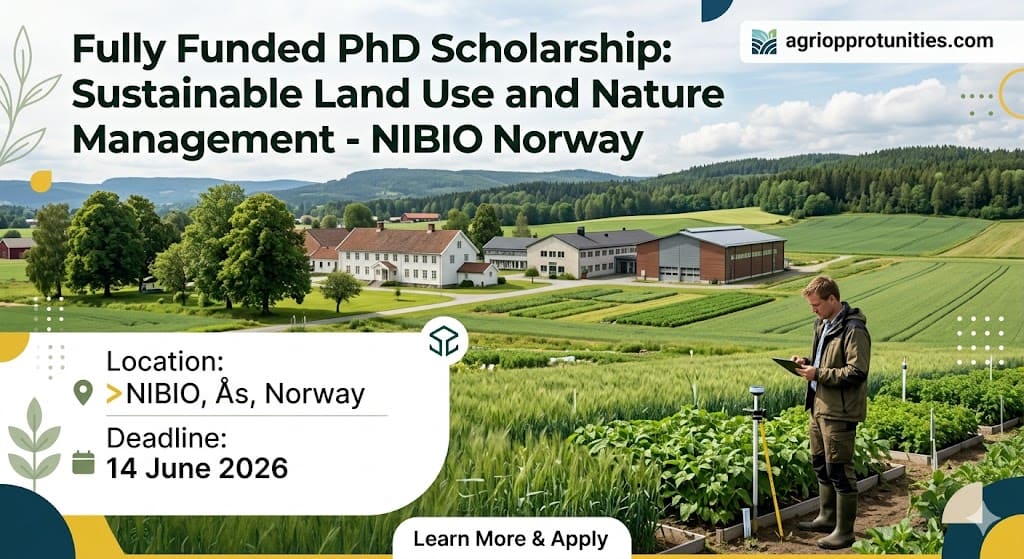
Fully Funded PhD Scholarship: Sustainable Land Use and Nature Management – NIBIO Norway

About NIBIO & INLAND Centre
Applications are open for a PhD Sustainable Land Use Norway position at NIBIO’s INLAND Centre in Ås. The project develops spatial models to project land-use change and link these to impacts on biodiversity, climate, and society. NIBIO (Norwegian Institute of Bioeconomy Research) is a leading research institute in Norway, owned by the Ministry of Agriculture and Food. This position is fully affiliated with INLAND – Center for Innovative Solutions for Sustainable Land Use and Nature Management – one of four research centres funded by the Research Council of Norway. The Centre is led by NIBIO and NMBU and brings together a broad consortium of research institutions, public-sector stakeholders, and industry partners. The place of work will be NIBIO’s headquarters in Ås, located 30 km south of Oslo.
Scholarship Overview
Project Description
As a PhD candidate in INLAND, you will develop spatial models to project land-use change and link these to analyses of impacts on biodiversity, climate, and society. You will work on some of society’s most complex land-use trade-offs and have the opportunity to contribute directly to the knowledge base used in policymaking, public administration, and international reporting.
You will process, analyse and integrate spatial and statistical datasets as a basis for research-based knowledge and decision support. Depending on the candidate’s qualifications and interests, the position will be affiliated with either the Department of Geomatics or the Department of Forests and Climate.
Why This Scholarship Stands Out
This PhD is unique because it addresses complex land-use trade-offs in Norway – balancing forestry, agriculture, reindeer husbandry, biodiversity conservation, and climate goals. You will develop spatial models to project land-use change and link these to impacts on biodiversity, climate, and society. The position offers access to high-quality data resources, strong national and international research collaborations, and direct contribution to policymaking. NIBIO offers free Norwegian language training (if you do not have skills in Norwegian, Swedish, or Danish at level A2). For a student interested in spatial modelling, land-use change, and sustainability, this is an opportunity to do research with direct policy impact.
Main Responsibilities
- Develop and apply spatial models to analyse and simulate future land use and land-use change, focusing on climate, biodiversity and primary industries
- Process, analyse and integrate spatial and statistical datasets as a basis for research-based knowledge and decision support
- Work as part of a PhD project carried out in line with the research objectives of INLAND and the requirements of the PhD programme at NMBU
- Actively disseminate research results through scientific publications, reports and relevant professional arenas
Candidate Profile and Eligibility
| Requirement | Details |
|---|---|
| Education | Master’s level competence in natural sciences (Ecology, Physical Geography, Geomatics/Computer Science, or other relevant fields) |
| Experience | Experience with spatial analyses and/or modelling |
| Language | Good command of English (spoken and written) |
- Strong competence in statistics, preferably geostatistics, related to land-use or landscape data
- Strong programming experience (R and/or Python)
- Experience with national greenhouse gas inventory for the land-use sector and/or other experience quantifying carbon dynamics
- Experience with biodiversity mapping
- Knowledge of forestry, agriculture and/or reindeer husbandry
- Interest in and understanding of complex issues related to sustainable land use and nature management
- Motivation to work interdisciplinarily and at the intersection between research and societal needs
- Skills in Norwegian (Scandinavian), both written and oral
Personal qualifications:
- Good collaboration and communication skills
- Strong analytical and problem-solving abilities
- Responsible, results-oriented and proactive
- Commitment and enthusiasm for working as part of an ambitious research team
- Ability to collaborate with both internal and external experts with diverse academic backgrounds
Important eligibility note: You cannot have a previous doctorate or have previously held a research fellowship position with funding from the Research Council of Norway, nor have previously been employed as a PhD research fellow at NMBU or NIBIO.
What They Offer
| Benefit | Details |
|---|---|
| Salary | NOK 555,000 – 635,000 per year (position code 1017) |
| Pension | Membership in Norwegian Public Service Pension Fund (good occupational pension scheme, group life insurance, low-interest home loans) |
| Norwegian Language Training | Free training to achieve A2 level if not already proficient |
| Location | Ås, Norway (30 km south of Oslo) |
| Work Environment | Interdisciplinary teams, flexible work, good colleagues |
My Application Strategy
- Highlight your spatial analysis and modelling experience – This is the core of the project
- Emphasise programming skills – R and/or Python experience is highly valued
- Show knowledge of Norwegian land-use sectors – Forestry, agriculture, reindeer husbandry
- Demonstrate interest in sustainability and land-use trade-offs – The position requires understanding of complex issues
- Mention any experience with greenhouse gas inventory or carbon dynamics – This will be evaluated positively
Who Should Apply
This PhD is perfect for a student with a background in ecology, physical geography, geomatics, or computer science who wants to apply spatial modelling to real-world land-use challenges in Norway. If you are interested in how land-use decisions affect biodiversity, climate, and society, and want to develop tools that inform policymaking, this project offers training across spatial analysis, statistics, and interdisciplinary research.
How to Apply
Send your application with CV electronically via the link on this page.
Application Deadline: June 14, 2026 – 23:59 (Europe/Oslo)
Note: Take originals of diplomas and letters of recommendation with you if invited to an interview.