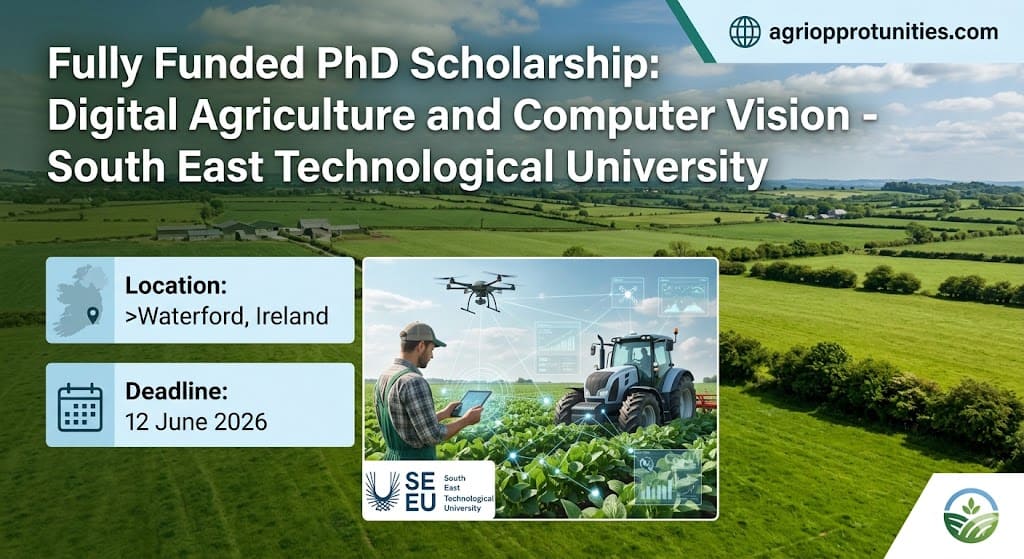
Fully Funded PhD Scholarship: Digital Agriculture and Computer Vision – South East Technological University

About SETU & VIP Ingredients Project
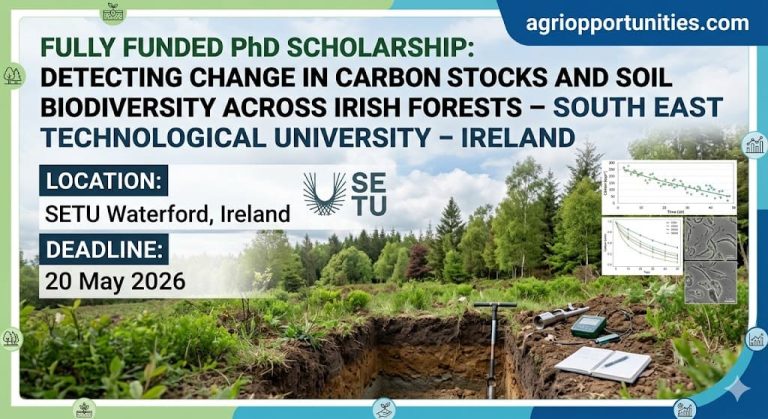
Applications are open for a PhD Digital Agriculture Computer Vision Ireland position at South East Technological University in Waterford. The VIP Ingredients project uses AI-driven image analysis and sensors to support quality-specific decision-making for plant-based ingredients. The SETU Department of Land Sciences is looking for a PhD student to work on the VIP Ingredients project. Funded by the Irish Department of Food, Agriculture and the Marine, VIP Ingredients aims to utilise precision farming, digitally enhanced processing technology, and functionality testing to extract innovative plant-based ingredients from Irish grown fava bean, pea, lupin and oats, for food applications. The successful candidate will be part of a wider national team and collaborate with other researchers and students in Teagasc, UCC, UCD and Irish food and agricultural companies.
Scholarship Overview
Project Summary
The SETU team will be tasked with assessing the feasibility of a variety of vision / digital systems to identify parameters of interest (PoE’s) or biological markers across a variety of crops (in-field) for feature extraction potential. These key parameters of interest (PoE’s) will form a digital foundation on which to improve processing and increase national food security.
Why This Scholarship Stands Out
This PhD is unique because it integrates digital agriculture, computer vision, and food processing. You will work at the intersection of field-based sensing (drones, in-field analysis), AI-driven image analysis, and shelf-life mapping. The project focuses on Irish-grown crops (fava bean, pea, lupin, oats) for plant-based ingredient extraction – a growing sector in Europe. You will collaborate with researchers at Teagasc, UCC, UCD, and Irish food and agricultural companies, providing a strong national research network. For a student interested in digital agriculture, computer vision, and food systems, this is an opportunity to develop skills across image analysis, machine learning, and precision agriculture.
Main Tasks
- Apply digital imaging techniques on data captured from drones and in-field analysis to identify points of interest, determine digital vegetation index, digital plant health and yield, and estimate composition
- Complete commercial profiling assessing intrinsic and extrinsic factors impacting product/ingredient readiness
- Digitally map product shelf-life, through a series of product/ingredient or supply route-specific, temporal, and dynamic profile conditions
Candidate Profile and Eligibility
| Requirement | Details |
|---|---|
| Education | Honours Degree (minimum 2:1) in Computer Science, Engineering, Agriculture, Food, Horticulture, Forestry, or Environmental Sciences |
| Knowledge | Computer science, agricultural engineering, data science, precision agriculture, remote sensing, plant science, or related discipline |
| Research Experience | Experience in conducting research independently |
| Quantitative Skills | Experience with quantitative, analytical, or computational methods |
| Communication | Experience in communicating research findings and preparing scientific reports |
| Teamwork | Evidence of teamwork skills |
Desirable:
- Strong academic background in digital imaging
- Strong academic background in precision agriculture
- Postgraduate diploma/MSc in Artificial Intelligence, precision agriculture, remote sensing
- Experience with image analysis, computer vision, machine learning, or artificial intelligence
- Knowledge of crop science and agricultural or food systems
- Knowledge of food analysis
- Interest in image analysis, digital agriculture
- Familiarity with statistical analysis and interpretation of experimental data
- Ability to manipulate and analyse datasets using programming or scripting
- Experience in statistical or programming-based environments
What They Offer
| Benefit | Details |
|---|---|
| Stipend | €25,000 per annum (tax free) |
| Tuition Fees | €5,750 per annum covered |
| Duration | 4 years |
| Start Date | September 1, 2026 |
| Location | Waterford, Ireland |
| Research Team | National collaboration with Teagasc, UCC, UCD, and industry |
My Application Tips
- Highlight your computer vision or image analysis experience – This is core to the project
- Emphasise precision agriculture or remote sensing background – Drone-based imaging and in-field analysis
- Show programming skills – Python, machine learning, or statistical programming
- Demonstrate interest in plant-based ingredients and food systems – The project focuses on fava bean, pea, lupin, and oats
- Mention any experience with AI or machine learning – AI-driven image analysis is a key component
Who Should Apply
This PhD is perfect for a student with a background in computer science, engineering, agriculture, or environmental sciences who wants to apply digital technologies to agriculture and food processing. If you are interested in how drones, computer vision, and AI can improve crop monitoring, ingredient extraction, and shelf-life prediction, this project offers training across digital agriculture, image analysis, and food science.
How to Apply
Complete the online Application Form from the SETU website quoting the advert reference number.
For informal queries, contact: Dr Anastasia Ktenioudaki – Anastasia.ktenioudaki@setu.ie
For application queries: Postgraduate Admissions Office – researchadmissions@setu.ie or +353 (0)51 302883
Application Deadline: June 12, 2026 – 4:00 PM Irish Time