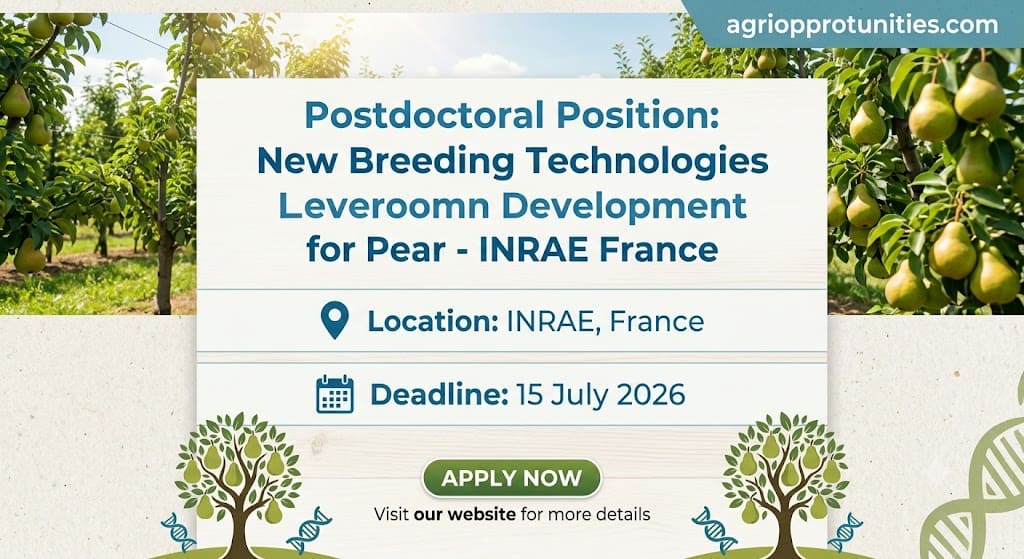
Postdoctoral Position: New Breeding Technologies Development for Pear – INRAE France

Introduction
INRAE, the French National Research Institute for Agriculture, Food, and Environment, is the world’s leading research organisation specialising in agriculture, food and the environment. You’ll join the Institute for Research in Horticulture and Seeds (IRHS), a leading research centre bringing together expertise in plant sciences, from genetics and genomics to physiology, plant pathology, microbiology and bioinformatics.
This position is part of the European SMARTER-FRUIT project. In a context of evolving European regulations and growing interest in New Breeding Technologies (NBTs), the project aims to develop innovative methods for producing NGT1 pear plants free from foreign DNA and to evaluate their potential for accelerating breeding.
Quick Facts
| Position | Postdoctoral Researcher |
| Project | New Breeding Technologies Development for Pear (SMARTER-FRUIT) |
| Location | INRAE, Institute for Research in Horticulture and Seeds, Beaucouzé, France |
| Qualification | PhD in Plant Biotechnology, Plant Biology, Genetics, Molecular Biology, or closely related field |
| Experience | Postdoctoral experience appreciated; within 6 years of PhD required |
| Duration | 2 years |
| Deadline | 15 July 2026 |
| Apply Via | INRAE recruitment portal |
Why This Postdoc Matters
European regulations on New Breeding Technologies are evolving, and the pear industry needs disease-resistant varieties. Fire blight, caused by Erwinia amylovora, is one of the most devastating diseases affecting pear production. Traditional breeding takes decades for perennial fruit crops.
This project addresses this challenge by developing:
- Mobile CRISPR-RNA editing for pear
- Trans-grafting approaches
- Intragenic strategies (no foreign DNA)
Your work will directly contribute to producing NGT1 pear plants free from foreign DNA—a critical requirement for regulatory approval in Europe.
Research Environment
You’ll join the ResPom team, which focuses on understanding and improving the immunity of apple and pear trees against major pests and diseases through integrated approaches ranging from molecular biology to orchard-scale studies.
Facilities include:
- State-of-the-art plant tissue culture and transformation labs
- Controlled environment growth facilities
- Molecular biology and genomics platforms
- Orchard-scale field trials
The Institute for Research in Horticulture and Seeds is a leading research centre in plant sciences, bringing together experts in genetics, genomics, physiology, plant pathology, microbiology and bioinformatics.
What You’ll Actually Be Doing
Development of NBT tools and plant material:
- Design and clone genetic constructs
- Develop mobile CRISPR-RNA editing, trans-grafting approaches, and intragenic strategies
- Carry out in vitro procedures including plant tissue culture, genetic transformation, and micrografting
Molecular and phenotypic characterisation:
- Perform molecular analyses (T-DNA integration verification, recombination analyses, sequencing, gene expression studies)
- Assess genome editing efficiencies
- Conduct phenotypic evaluations under Erwinia amylovora infection conditions
Scientific dissemination:
- Analyse, interpret and present research results
- Contribute to publications, reports and project deliverables
- Supervise trainees
Who Should Apply
This position is best for a PhD graduate in plant biotechnology, plant biology, genetics, or molecular biology who wants to develop expertise in New Breeding Technologies for perennial fruit crops.
Essential experience:
- Plant biotechnology and molecular biology techniques
- Cloning, PCR, sequencing and gene expression analyses
- Plant tissue culture, genetic transformation and regeneration procedures
- Genome editing (CRISPR-Cas9)
- Microbiology (E. coli and Agrobacterium culture)
- Ability to analyse and communicate scientific results
Note: Candidates must be within 6 years of obtaining their PhD, in accordance with project requirements.
Skills That Will Help You Stand Out
| Skill | Why It Matters |
|---|---|
| CRISPR-Cas9 | Core NBT tool |
| Plant tissue culture | For pear transformation and regeneration |
| Genetic transformation | Agrobacterium-mediated transformation |
| Molecular biology | Cloning, PCR, sequencing, gene expression |
| Microbiology | E. coli and Agrobacterium culture |
| Fire blight experience | Directly relevant (Erwinia amylovora) |
| Scientific writing | Publications and project deliverables |
| English communication | International project, partners across Europe |
Career Impact
INRAE is the world’s leading research organisation in agriculture. A postdoc at INRAE is recognised internationally.
Career paths from this position:
- Permanent researcher positions at INRAE or other European research institutes
- R&D leadership in ag-biotech companies
- Faculty positions in plant science departments
- Regulatory and policy roles in NBT governance
The SMARTER-FRUIT project involves international partners, providing strong networking opportunities.
Application Tips
- Highlight your NBT experience – CRISPR, cisgenesis, intragenesis, or trans-grafting experience is directly relevant.
- Emphasise plant tissue culture skills – Pear transformation and regeneration is a core requirement.
- Show molecular biology expertise – Cloning, PCR, sequencing, gene expression analysis.
- Mention any fire blight experience – Even if limited, show awareness of the disease.
- Tailor your application to the project – Show you understand the regulatory context for NBTs in Europe.
- Apply early – Postdoc positions at INRAE are competitive.
How to Apply
Apply through the INRAE recruitment portal.
Frequently Asked Questions
- Can recent PhD graduates apply? Yes, the position is open to candidates within 6 years of obtaining their PhD.
- Is previous postdoctoral experience required? Appreciated but not required. Recent PhD graduates are welcome.
- What’s the working language? Frequent communication in English. Basic French is helpful but not required.
- Is this a permanent position? No, this is a 2-year postdoctoral contract.
- What are the benefits? Up to 30 days annual leave + 15 days RTT, childcare support, training, social support, holiday services, sports and cultural activities, collective catering.
- What’s the salary? Not specified, but follows French public sector scales.
- Will I supervise students? Yes, you’ll supervise trainees involved in project activities.