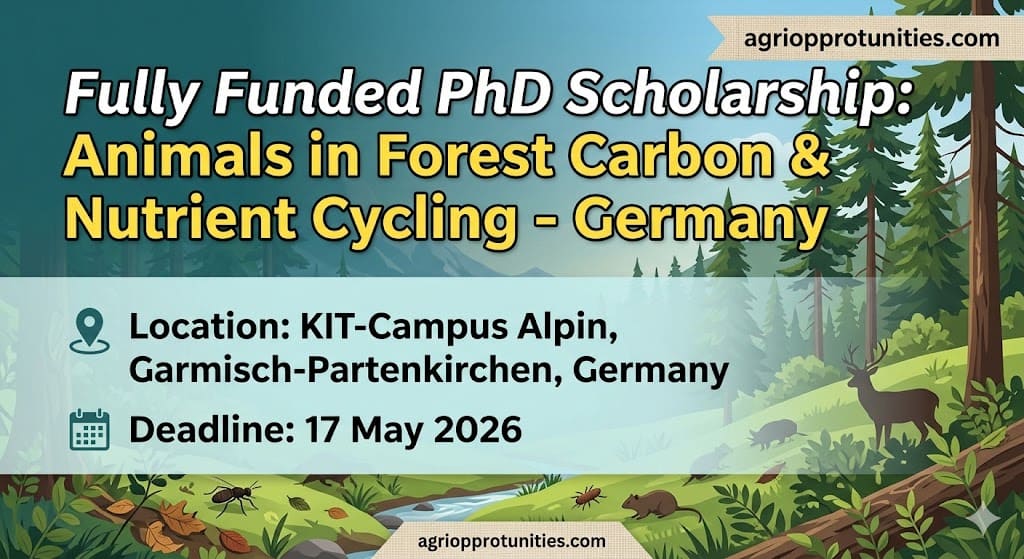
Fully Funded PhD Scholarship: Animals in Forest Carbon & Nutrient Cycling – Germany

🏛️ About Karlsruhe Institute of Technology (KIT)
Applications are open for a PhD Animals Forest Carbon Cycling Germany position at KIT’s Campus Alpin in Garmisch-Partenkirchen. The project investigates how full trophic chains affect carbon and nutrient cycling in natural ecosystems under climate change. KIT is one of Germany’s largest and most prestigious research universities, combining a long university tradition with internationally recognized research. The Global Land-Ecosystem Modelling Group at KIT’s Campus Alpin in Garmisch-Partenkirchen specializes in understanding how ecosystems function under climate change. The position is part of C4LaNd, a multidisciplinary, international research training group, in partnership with Melbourne’s Quantitative Ecology Group.
🎯 Scholarship Overview
🔗 Project Summary
The overarching question of this doctoral research will be:
How does the presence or absence of full trophic chains affect carbon and nutrient cycling in natural ecosystems, in the present day and under future climate change?
Lines of research include:
- Familiarize yourself with the ecosystem models LPJ-GUESS and Madingley
- Further develop key processes in Madingley (e.g. selective or height-dependent feeding; introduction of detritivores, etc.)
- Explore literature and other data sources to support parameterization and model evaluation
- Conduct simulations and evaluate output against observations
- Develop ideas for model applications, simulation set-up, analysis and publications
- Document code development and performance
🌟 Why This Scholarship Stands Out
This PhD is unique because it focuses on a largely overlooked component of ecosystem modeling: animals. Most carbon cycle models only consider plants and microbes, yet animals – from insects to large herbivores – profoundly affect nutrient cycling through grazing, trampling, and waste deposition. You will work with two complementary models: LPJ-GUESS (a dynamic global vegetation model) and Madingley (a mechanistic model of animal populations). The position includes a one-year research stay at the University of Melbourne, where you will collaborate with the Quantitative Ecology Group. This is rare – most ecosystem modeling PhDs are purely plant-focused. The skills you develop in C++ and model development are highly transferable to both academic research and climate tech careers. For someone who wants to understand whole ecosystems, not just trees, this is ideal.
✅ Candidate Profile and Eligibility
| Requirement | Details |
|---|---|
| Education | M.Sc. degree in Environmental Science, Ecology, Meteorology, or related areas |
| Coding | Knowledge in coding languages, ideally C++ |
| Programming | Proficiency in Python or R |
| Language | Fluency in English (written and spoken) |
| Collaboration | Delight in engaging within an international, multidisciplinary training programme |
| International Stay | Willingness to undertake a one-year research placement at the University of Melbourne |
| Community | Readiness to engage within the LPJ-GUESS and Madingley communities |
| Travel | Willingness to travel between Garmisch-Partenkirchen and Karlsruhe for C4LaNd courses |
📝 My Application Strategy
- Demonstrate your C++ skills – Even if from coursework, provide specific examples of projects or assignments. Model development requires this language
- Show interest in animal ecology – Read papers on trophic cascades, rewilding, or herbivory impacts on carbon cycling. Mention them in your motivation letter
- Familiarize yourself with LPJ-GUESS and Madingley – Both models are open-source. Download the user guides and mention your initiative in the application
- Highlight the Australia connection – Explain why collaborating with Melbourne’s Quantitative Ecology Group excites you (they are world leaders in animal movement and population modeling)
- Prepare a 5-minute explanation of why animals matter for carbon cycling – most ecologists overlook this, so showing understanding sets you apart
💼 What They Offer
| Benefit | Details |
|---|---|
| Salary | TV-L (75%) – approx. €2,300-€2,700 monthly after taxes depending on experience |
| Duration | 3.5 years of funding |
| Location | Garmisch-Partenkirchen, Bavaria (Alpine setting) |
| International Stay | One-year research placement at University of Melbourne, Australia |
| Models | Access to and training in LPJ-GUESS and Madingley |
| Research Environment | C4LaNd international research training group |
| Networking | Partnership with Melbourne’s Quantitative Ecology Group |
🎓 Who Should Apply
This scholarship is perfect for an M.Sc. graduate who is passionate about ecosystem modeling but wants to move beyond plant-only approaches. If you enjoy coding (especially C++) and are curious about how animals shape landscapes, this project offers a unique niche. Candidates with ecology backgrounds who want to develop advanced quantitative skills are especially encouraged. The ideal candidate is someone who sees forests not just as trees, but as dynamic systems where animals are active ecosystem engineers.
📝 How to Apply
Required Documents (single PDF):
- Letter of motivation
- CV
- Contact details of two references
- Bachelor and Master studies transcripts
📧 Contact for inquiries: almut.arneth@kit.edu
Useful Links
Similar Posts
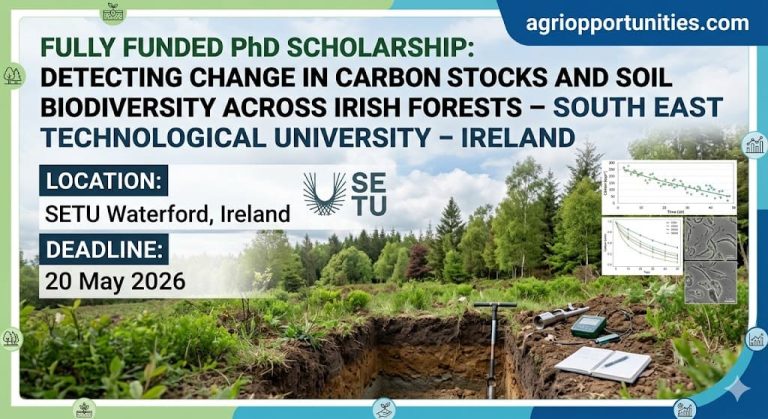
Fully Funded PhD Scholarship: Detecting Change in Carbon Stocks and Soil Biodiversity Across Irish Forests – South East Technological University – Ireland
Applications are open for a PhD Forest Soil Biodiversity Ireland position at South East Technological University in Waterford. The C-BioStock project investigates how clear-felling affects soil biodiversity and carbon stocks in native and commercial Irish forests.
Fully Funded PhD Scholarship: Plant Pathology – Montana State University USA
Applications are open for a PhD Plant Pathology USA position at Montana State University’s Eastern Agricultural Research Center in Sidney, Montana. The project focuses on dry bean disease management in irrigated production systems.
Fully Funded PhD Scholarship: Smart Horticulture – Australia
Applications are open for a Fully Funded PhD Smart Horticulture Australia position at Western Sydney University (WSU), Hawkesbury campus, where the National Vegetable Protected Cropping Centre and the School of Science are located. This PhD project focuses on improving energy, water, and nutrient efficiencies in high-tech greenhouse systems.
Fully Funded PhD Scholarship: Pesticide Effects on Soil Biodiversity – France
Applications are open for a PhD Pesticide Soil Biodiversity France position at Université de Poitiers, UMR CNRS 7267. This 3-year PhD thesis will focus on soil invertebrates and the effects of pesticides on biodiversity in agricultural areas.
Fully Funded PhD Scholarship: Sustainable Fertiliser Management and Greenhouse Gas Mitigation – University of Copenhagen – Denmark
Applications are open for a PhD Nitrous Oxide Mitigation Agriculture Denmark position at the University of Copenhagen. The SYNERGI project quantifies N2O emissions and nitrate leaching from synthetic and organic fertilizers and assesses synthetic nitrification inhibitors.
Fully Funded PhD Scholarship: Reduced Tillage & Soil Properties – Slovakia
Applications are open for a PhD Reduced Tillage Soil Slovakia position at the Slovak University of Agriculture in Nitra, Faculty of Agrobiology and Food Resources. This PhD research focuses on the effects of conventional and reduced tillage and the application of microbial preparations on soil properties.