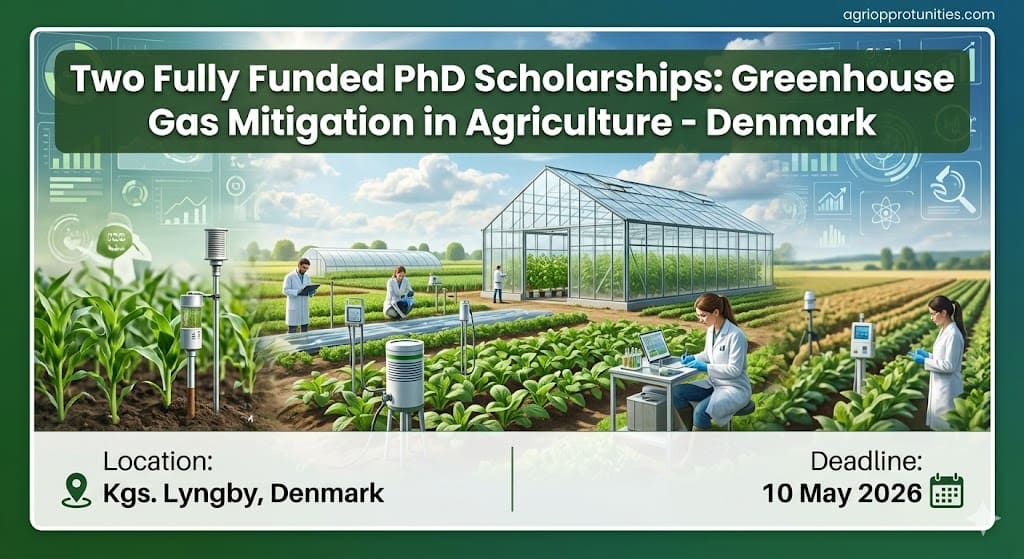
Two Fully Funded PhD Scholarships: Greenhouse Gas Mitigation in Agriculture – Denmark

About DTU
Applications are open for Two PhD Scholarships in Greenhouse Gas Mitigation Agriculture Denmark at DTU Sustain. The projects focus on documenting methane emission reduction technologies from manure storage, including anaerobic digestion, acidification, flaring, and biofilters. DTU – the Department of Environmental and Resource Engineering – is one of the largest university departments specializing in environmental and resource engineering in Europe. The department conducts research, development, and scientific advice, and provides educational programs and service to society. DTU is one of Europe’s leading elite technical universities, founded by Hans Christian Ørsted in 1829. You will join the research group “Waste, Climate and Monitoring” at DTU Sustain, working with greenhouse gas quantification and mitigation from the agriculture sector.
Scholarship Overview
Project Summary
Both projects are funded by the Danish Ministry of Green Transition and focus on documenting the GHG reduction efficiencies of several technologies to reduce methane emission from manure storage: anaerobic digestion, acidification, flaring, and biofilters. Using biofilters to reduce emissions is a technology being developed at DTU Sustain, and part of the projects will be to construct additional systems in full scale.
The documentation must meet the requirements to be included in the Danish National Inventory Report submitted to the UNFCCC. The datasets generated will likely be the largest of their kind, providing valuable insights related to GHG mitigation from agriculture.
Why This Scholarship Stands Out
The projects involve hands-on field measurements using a mobile analytical platform (a vehicle fitted with gas analysers) across many farms in Denmark. One PhD will focus on coupled models to simulate microbial methane oxidation in biofilters, requiring numerical modelling experience (COMSOL is an advantage). The datasets generated will inform Denmark’s National Inventory Report to the UNFCCC – meaning your research will directly influence national climate policy. For students interested in climate change mitigation, engineering, and field research, these positions offer a rare combination of practical fieldwork and quantitative analysis.
Candidate Profile and Eligibility
| Requirement | Details |
|---|---|
| Education | Two-year master’s degree (120 ECTS) in Environmental Engineering or related field |
| Experience | Some experience in laboratory or field studies (preferred) |
| Hands-on Work | Interest in performing research involving field measurements |
| Independence | Ability to work independently and plan work with supervisors |
| Language | Good communication skills in English (written and spoken) |
| Driver’s License | Valid driver’s license is necessary for field work |
| Data Skills | Familiarity with organizing and analysing large datasets using tools such as Excel or Python |
One PhD student will work with coupled models to simulate microbial methane oxidation in biofilters. This work requires experience in numerical modelling, for which experience with COMSOL is an advantage.
Key Responsibilities
- Conduct field measurements using a mobile analytical platform (vehicle fitted with gas analysers) across many farms in Denmark
- Collaborate with external experts and companies to determine representative monitoring sites
- Generate and analyse large datasets on GHG mitigation effectiveness
- For one PhD: develop coupled models to simulate microbial methane oxidation in biofilters using COMSOL or similar tools
My Application Strategy
- Highlight your environmental engineering background – This is the preferred educational qualification
- For the modelling-focused PhD, showcase numerical modelling skills – Experience with COMSOL is an advantage
- Demonstrate data analysis proficiency – Excel or Python skills for handling large datasets
- Include all required documents in one PDF – Cover letter, CV, transcripts, diploma, description of lab/field experience, description of modelling experience (if applicable), and driver’s license statement
What They Offer
| Benefit | Details |
|---|---|
| Duration | 3 years |
| Location | Kgs. Lyngby, Denmark |
| Research Environment | One of Europe’s largest environmental engineering departments |
| Collaboration | Work with external companies and experts across Denmark |
| Mobile Lab | Access to vehicle fitted with gas analysers for field measurements |
| Impact | Research directly informs Denmark’s National Inventory Report to the UNFCCC |
Who Should Apply
These PhDs perfectly suit students with an environmental engineering background who enjoy hands-on field work. If you want to measure, mitigate, and model manure storage emissions—and see your research directly influence national climate policy—these projects train you across field measurement, data analysis, and, for one position, numerical modelling. We especially encourage candidates who hold driver’s licenses and have experience with Python, Excel, or COMSOL. The ideal candidate wants to get out of the lab and onto farms, collecting real-world data that matters for climate action.
How to Apply
Submit your complete online application as one PDF file by May 10, 2026 (23:59 Danish time).
Apply via the “Apply now” link on DTU’s website.
Required documents (in English, one PDF):
- Letter motivating the application (cover letter)
- Curriculum vitae
- Grade transcripts and BSc/MSc diploma (including official description of grading scale)
- Description of experience with laboratory and field studies (can be included in CV)
- Description of experience with numerical modelling (can be included in CV – required for the modelling-focused PhD)
- Statement regarding possession of a valid driver’s license (can be included in CV)
You may apply before obtaining your master’s degree but cannot begin before receiving it.
Further information: Professor Charlotte Scheutz – chas@dtu.dk
Useful Links
Similar Posts
Fully Funded PhD Scholarship: Pesticide Effects on Soil Biodiversity – France
Applications are open for a PhD Pesticide Soil Biodiversity France position at Université de Poitiers, UMR CNRS 7267. This 3-year PhD thesis will focus on soil invertebrates and the effects of pesticides on biodiversity in agricultural areas.
Fully Funded PhD Scholarship: Arctic Plant Ecology – Germany
Applications are open for a Fully Funded PhD Arctic Plant Ecology Germany position at Leibniz University Hannover, Institute of Earth System Sciences. This PhD project is part of the research initiative “Nuolja muorji observatory: drivers of Arctic wild berry yield and quality under climate and land-use change”.
Fully Funded PhD Scholarship: Plant Microbiome of Cereals – Leibniz Centre for Agricultural Landscape Research – Germany
Applications are open for a PhD Plant Microbiome Cereals Germany position at the Leibniz Centre for Agricultural Landscape Research (ZALF) in Müncheberg, near Berlin. The DFG-funded MicroResponS project investigates how wheat microbiome functions respond to water stress and fungicide influence.
Fully Funded PhD Scholarship: Plastic Chemical Additives in Soil – Spain
Applications are open for a PhD Plastic Chemical Additives Soil Spain position at IMDEA Agua in Alcalá de Henares, Madrid. The research focuses on plastic chemical additive release from plastic debris and their impact on soil ecosystems.
Fully Funded PhD: From Ocean to Soil – Seaweed-Derived Bioplastic Mulches, Ireland
A Fully Funded PhD Scholarship South East Technological University. This PhD Seaweed Bioplastic Mulch project will investigate a novel solution by developing biodegradable mulch films derived from seaweed biomass.
Two Fully Funded Master’s Scholarships: Forest Management & Wildlife Conservation – USA
Applications are open for Fully Funded MSc Scholarships at Southern Illinois University (SIU) in Carbondale, Illinois. Two competitive M.S. Graduate Research Assistantships are available starting in Summer or Fall 2026.