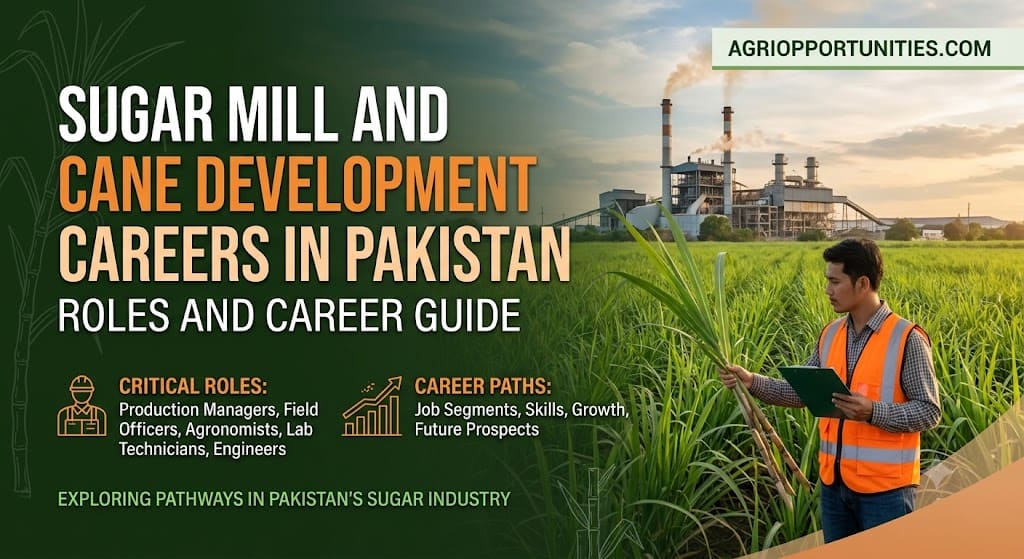
Sugar Mill and Cane Development Careers in Pakistan: Roles and Career Guide

Sugar Mill and Cane Development Careers in Pakistan: Roles and Career Guide
Pakistan’s sugar mills sit at an interesting intersection of agriculture and heavy industry — part of the workforce is out in the field working directly with cane growers, while another part runs genuinely complex industrial processing infrastructure. This guide covers both sides, focusing on the cane development and procurement career track most relevant to agriculture graduates, while also explaining how the broader mill structure works.

Why Sugar Mill Careers Follow a Genuinely Seasonal Pattern
Before covering specific roles, it’s worth understanding a structural fact that shapes the entire hiring pattern in this sector: sugarcane crushing is a distinctly seasonal operation, running for a defined crushing season each year (typically starting in the cooler months and continuing for several months depending on cane availability). Mills significantly expand their workforce during this active crushing period to handle cane procurement, processing, and quality control, then scale back to a smaller core team during the off-season. Understanding this cycle matters directly for job seekers — many postings, including data entry operators, quality checkers, and various technical roles, are explicitly tied to “cane crushing season management” rather than being permanent, year-round positions.
The Core Agriculture-Facing Role: Cane Development Officer
This is the role most directly relevant to agriculture graduates specifically. A Cane Development Officer works directly with sugarcane growers within a mill’s catchment area, providing agronomic advice aimed at improving cane yield and sugar recovery quality, encouraging adoption of better cane varieties and cultivation practices, and helping build the long-term grower relationships a mill depends on for a reliable, high-quality cane supply.
Why Mills Invest So Heavily in This Advisory Function
A sugar mill’s entire economic model depends on securing enough cane, of high enough quality, within its catchment area every season — and unlike many other agri-input businesses, mills don’t simply buy a commodity on the open market; they actively cultivate long-term relationships with specific growers whose land falls within a defined geographic catchment. This is exactly why the Cane Development Officer role exists as a genuinely distinct, advisory-focused position rather than being folded into a general procurement function — improving grower-level agronomy directly improves the mill’s own supply security and processing efficiency.
The Commercial Counterpart: Cane Procurement Officer (CPO)
Working alongside the development function, the Cane Procurement Officer role focuses on the commercial and logistical side: securing sugarcane supply agreements from growers ahead of and during the crushing season, coordinating harvest and delivery logistics, and managing the commercial relationship and payment process with growers supplying cane to the mill.
How These Two Roles Actually Work Together
In practice, Cane Development and Cane Procurement functions work closely together rather than operating as entirely separate silos — a mill’s long-term agronomic investment in grower relationships (through the Development Officer function) directly supports and eases the annual commercial procurement process (handled by the Procurement Officer), since growers who trust the mill’s agronomic advisors are generally easier to secure reliable supply agreements with.
Quality and Inspection Roles
Beyond the development and procurement functions, mills maintain dedicated Cane Inspector and Quality Sugar Analyst roles, responsible for assessing incoming cane quality (sugar content, maturity, freshness) and monitoring sugar quality throughout the processing chain — a genuinely technical, laboratory-adjacent role distinct from the field-based advisory and commercial functions described above.

The Separate Industrial and Engineering Track
It’s worth being clear that sugar mills operate substantial industrial processing infrastructure entirely separate from the agriculture-facing roles described above — this includes boiling house operations, turbine engineering, electrical and mechanical maintenance, and process house management. Postings for roles like Turbine Engineer, Process House Engineer, Assistant Foreman Boiler, and various skilled technical trades represent a genuinely distinct engineering and industrial career track within the same company, relevant for candidates with a mechanical, electrical, or chemical engineering background rather than an agriculture one.
Senior Management: Deputy General Manager (Cane)
At the senior end of the agriculture-facing track, a Deputy General Manager (Cane) role oversees the entire cane development, procurement, and grower relationship function across a mill’s full catchment area, typically requiring extensive experience across both the agronomic and commercial sides of cane management covered above, plus genuine people-management experience overseeing the development and procurement teams beneath this role.
How Government-Sector Sugar Mills Differ
Beyond privately-owned mills, Pakistan also has a cooperative and government sugar mill sector, with recruitment processes run through formal, structured public examination systems rather than direct company applications. These processes typically cover a broader range of technical, clerical, and cane-specific positions (including titles like Assistant Cane Development Officer and Deputy Cane Development Officer) filled through competitive written examinations rather than a standard private-sector interview process — worth knowing if you’re specifically interested in the more structured, exam-based government recruitment route rather than direct private company applications.
Practical Advice for Building a Career in This Sector
Given how central grower relationships and agronomic trust are to the Cane Development Officer role specifically, genuine field experience working directly with farmers — even informally, during your degree — represents real, directly relevant preparation for this career path. Understand the seasonal nature of this industry clearly before applying, since many postings are explicitly tied to the crushing season rather than year-round employment, and factor this into your own career planning and financial expectations. And if your interest leans toward the engineering and industrial side rather than the agriculture-facing roles, search specifically for the technical and engineering titles covered above, since these represent an entirely separate application and qualification pathway within the same broader sugar mill industry.
For current openings across sugar mill, cane development, and cane procurement roles in Pakistan, browse live agriculture job listings on Agri Opportunities.
Pakistan’s sugar industry offers a unique blend of agronomic advisory and industrial processing careers. Whether your interest lies in field-based cane development or technical quality control, the sector rewards those who understand both the farming and the milling sides of the value chain.
Explore live sugar mill and cane development jobs in Pakistan →Frequently Asked Questions
What does a Cane Development Officer actually do?
A Cane Development Officer works directly with sugarcane growers in a mill’s catchment area to improve cane yield and quality, providing agronomic advice, encouraging better varieties and cultivation practices, and helping secure a reliable cane supply for the mill ahead of the crushing season.
Why do sugar mills in Pakistan hire so many seasonal staff?
Sugarcane crushing is a distinctly seasonal operation, typically running for a defined crushing season each year, and mills significantly expand their workforce during this period to handle cane procurement, processing, and quality control before scaling back to a smaller core team during the off-season.
What is the difference between a Cane Procurement Officer and a Cane Development Officer?
A Cane Procurement Officer focuses on the commercial and logistical side of securing sugarcane supply from growers ahead of and during the crushing season, while a Cane Development Officer takes a more agronomic, advisory role focused on improving cane yield and quality at the farm level over the longer term.
Are there technical and engineering roles in sugar mills separate from the cane and agriculture side?
Yes. Sugar mills operate substantial industrial processing infrastructure, requiring engineers, chemists, and technical operators for boiling house operations, turbines, and quality analysis, representing a genuinely distinct career track from the agriculture-facing cane development and procurement roles.
Add Agri Opportunities as a preferred source on Google to see our latest career guides and job listings first.
My name is Zahid Khan. I am from Khyber Pakhtunkhwa, Pakistan. I have spent 10 years outside Pakistan. I am looking for a job. Can I get a job?
Thank you for your interest in the opportunity.
Kindly apply directly through the application link provided in the post, as the hiring process is managed by the employer.
Please note that we are not the hiring authority or recruitment team. We only share the latest agriculture-related job opportunities to support and help the agricultural community.
Wishing you the very best with your application and career journey.