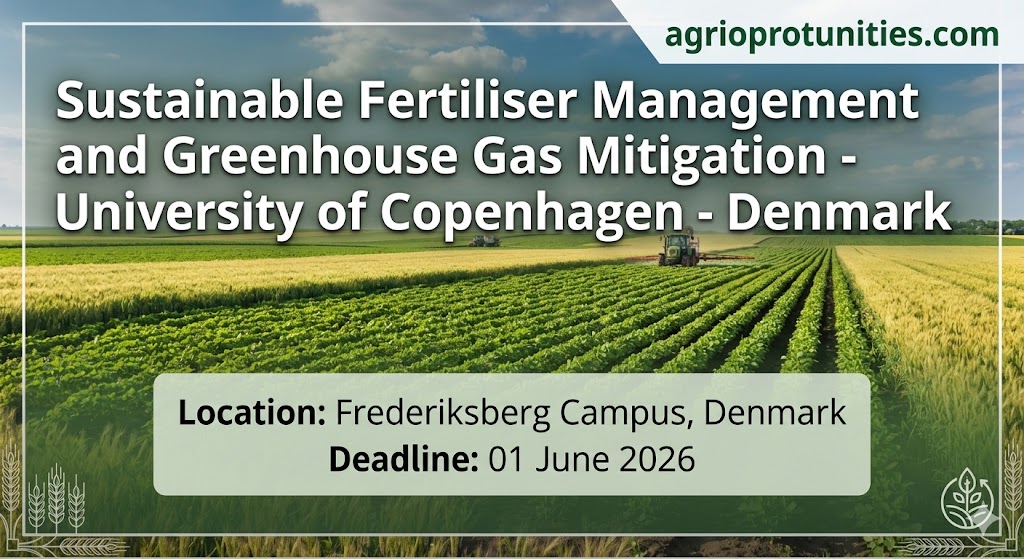
Fully Funded PhD Scholarship: Sustainable Fertiliser Management and Greenhouse Gas Mitigation – University of Copenhagen – Denmark

About the University of Copenhagen
Applications are open for a PhD Nitrous Oxide Mitigation Agriculture Denmark position at the University of Copenhagen. The SYNERGI project quantifies N2O emissions and nitrate leaching from synthetic and organic fertilizers and assesses synthetic nitrification inhibitors. The Climate Change Mitigation and Sustainable Soil Management research group at the Department of Plant and Environmental Sciences (PLEN), University of Copenhagen, focuses on soil fertility issues and environmental impacts related to sustainable agriculture with a special focus on nutrient cycling and climate change. The research aims at a mechanistic understanding of soil nutrient and organic matter dynamics at both micro-scale biogeophysical processes and ecosystem scales. Research facilities include modern laboratories, growth chambers, greenhouses and experimental fields.
Scholarship Overview
Project Description
Nitrous oxide (N2O) is an important greenhouse gas. About 70% of N2O emissions comes from agricultural fields as a consequence of nitrogen fertilization. N2O is produced during nitrification and denitrification following the application of mineral and organic fertilizers. Synthetic nitrification inhibitors (SNIs) have been proposed as an effective measure to reduce N2O emissions, with studies showing average reductions of 40-50%, along with a comparable decrease in nitrate (NO3-) leaching.
The overall objective of this project is to quantify N2O emissions and NO3- leaching from synthetic and organic fertilizers applied to major crops, such as winter wheat and spring barley, and to assess the effectiveness of SNIs in mitigating these nitrogen losses.
As part of this PhD, activities will include:
- Conducting controlled laboratory incubation experiments to investigate the effects of SNIs on N2O emissions under different soil types and moisture regimes on nitrifier and denitrifier activities and the interaction of SNIs with biochar to explore potential synergies for N2O mitigation
- Performing field experiments to assess the impacts of SNIs on N2O emissions and NO3- leaching from synthetic and organic fertilizers applied to spring- and winter-sown crops
Why This Scholarship Stands Out
This PhD is unique because it addresses a critical climate challenge: reducing N2O emissions from agriculture, which accounts for 70% of total N2O emissions. The project combines laboratory incubation experiments with field-scale measurements, providing training in both controlled and real-world conditions. You will work with closed chamber measurements, gas chromatography, and laser-based analysers for GHG flux quantification. The SYNERGI project involves multiple partners, and you will have the opportunity for a secondment to another institution. For a student interested in agricultural greenhouse gas mitigation, this is an opportunity to generate evidence that could inform national GHG inventories and fertilizer management policies.
Duties and Responsibilities
- Carry through an independent research project under supervision
- Complete PhD courses corresponding to approx. 30 ECTS
- Participate in active research environments, including a stay at another research institution, preferably abroad
- Teaching and knowledge dissemination activities
- Write scientific papers aimed at high-impact journals
- Write and defend a PhD thesis on the basis of your project
Candidate Profile and Eligibility
| Requirement | Details |
|---|---|
| Education | MSc degree in Environmental Science, Soil Science, Biology, Physical Geography, Agronomy or related discipline |
| Knowledge | Solid knowledge about soil biogeochemistry and plant biology in agricultural systems |
| Interest | Interest and flair for conducting experimental environmental and agricultural research in both laboratory and field |
| GHG Experience | Interest in or experience with measuring GHG fluxes using closed chambers, gas chromatography and laser-based analysers |
| Data Skills | Good computer skills, experience with advanced data management and analysis, including statistical tools and methods |
| Language | Excellent English language skills (written and oral) |
| Interpersonal | Good communicative and interpersonal skills |
My Application Strategy
- Highlight your experience with GHG measurements – Closed chamber techniques, gas chromatography, or laser-based analysers are directly relevant
- Emphasize soil science background – Knowledge of nitrification, denitrification, and nitrogen cycling is essential
- Show field experiment experience – Field trials and plot-level measurements are a core component
- Demonstrate data analysis skills – Statistical analysis of complex environmental datasets
- Submit a short reflection (max one page) – Outline how you would approach the project objectives
What They Offer
| Benefit | Details |
|---|---|
| Duration | 3 years (full-time) |
| Start Date | September 1, 2026 |
| Location | Frederiksberg Campus, Copenhagen, Denmark (field trials at Taastrup) |
| Research Environment | Modern laboratories, growth chambers, greenhouses, experimental fields |
| Secondment | Opportunity to spend time at another institution |
Who Should Apply
This PhD is perfect for a student with a background in soil science, environmental science, or agronomy who wants to work on climate change mitigation. If you are interested in how nitrogen fertilizers affect greenhouse gas emissions, and how synthetic nitrification inhibitors can reduce those emissions, this project offers training in both laboratory incubation experiments and field-scale measurements. Candidates with experience in GHG flux measurement techniques are especially encouraged. The ideal candidate is someone who wants to generate evidence that can directly inform agricultural policy and practice.
How to Apply
Submit your application electronically by clicking APPLY NOW on the University of Copenhagen website.
Required documents (in English):
- Cover letter/motivated letter of application (max one page)
- Short reflection on your research interests, experiences, and how the project objectives can be approached (max one page)
- Curriculum vitae (including education, experience, language skills)
- Original diplomas for Bachelor and Master and transcript of records (with English translation if needed)
- Publication list (if possible)
- Contact information for two referees
Application deadline: June 1, 2026 – 23:59 GMT+1
Interviews: June-July 2026
For specific information about the PhD fellowship, contact: Principal Supervisor Professor Sander Bruun – sab@plen.ku.dk
Useful Links
Similar Posts
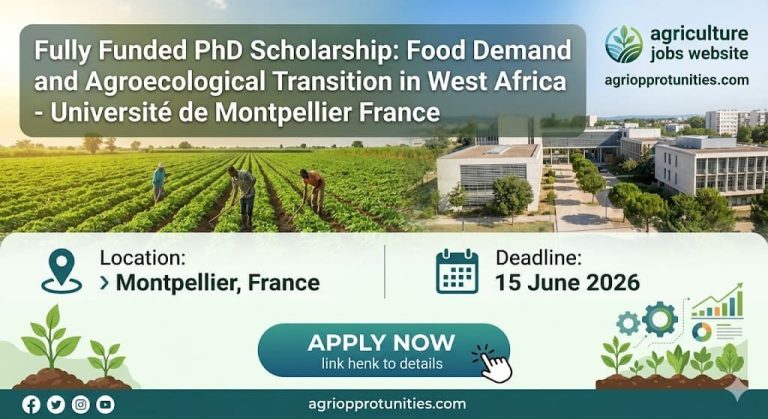
Fully Funded PhD Scholarship: Food Demand and Agroecological Transition in West Africa – Université de Montpellier, France
Applications are open for a PhD Agricultural Economics West Africa France position at Université de Montpellier and CIRAD. The research focuses on food demand and agroecological transition in Senegal’s Niayes area and Lake Guiers region.
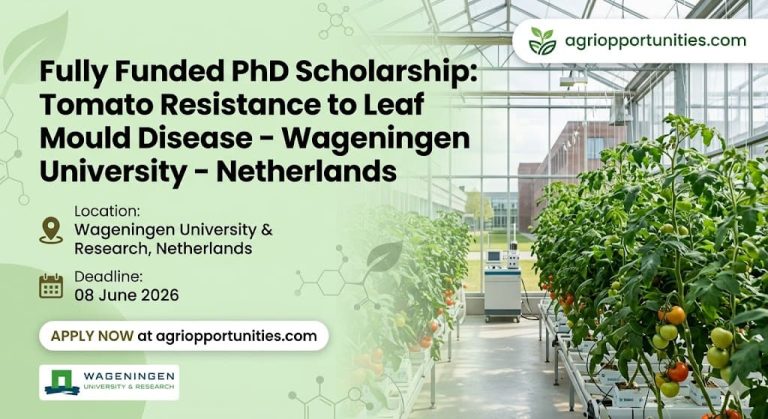
Fully Funded PhD Scholarship: Tomato Resistance to Leaf Mould Disease – Wageningen University – Netherlands
Applications are open for a PhD Tomato Resistance Leaf Mould Netherlands position at Wageningen University. The project aims to discover novel tomato genes for durable resistance to Fulvia fulva and develop next-generation predictive breeding strategies.
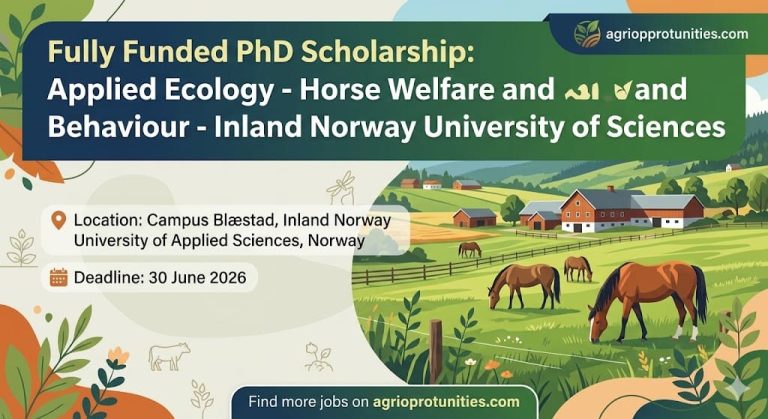
Fully Funded PhD Scholarship: Applied Ecology – Horse Welfare and Behaviour – Inland Norway University of Applied Sciences
Applications are open for a PhD Horse Welfare Behaviour Norway position at Inland Norway University of Applied Sciences, Campus Blæstad. The project monitors yearling stallions of the Norwegian Swedish Coldblooded trotter across different summer management systems using GPS collars and triaxial accelerometers.
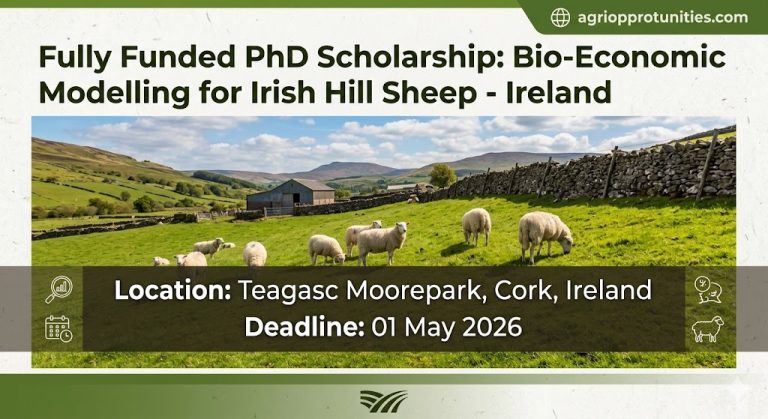
Fully Funded PhD Scholarship: Bio-Economic Modelling for Irish Hill Sheep – Ireland
Applications are open for a PhD Bio-Economic Modelling Hill Sheep Ireland position at Teagasc Moorepark, in collaboration with Munster Technological University. The project develops a whole-farm bio-economic model for the Irish hill sheep sector.
Fully Funded PhD Scholarship: Plastic Chemical Additives in Soil – Spain
Applications are open for a PhD Plastic Chemical Additives Soil Spain position at IMDEA Agua in Alcalá de Henares, Madrid. The research focuses on plastic chemical additive release from plastic debris and their impact on soil ecosystems.
Fully Funded PhD Scholarship: Fusarium Wilt Resistance in Banana – Australia
Applications are open for a PhD Fusarium Wilt Resistance Banana Australia position at The University of Queensland’s School of Agriculture and Food Sustainability. The project investigates the genetic basis of Fusarium wilt resistance in banana using genomics and molecular marker approaches.