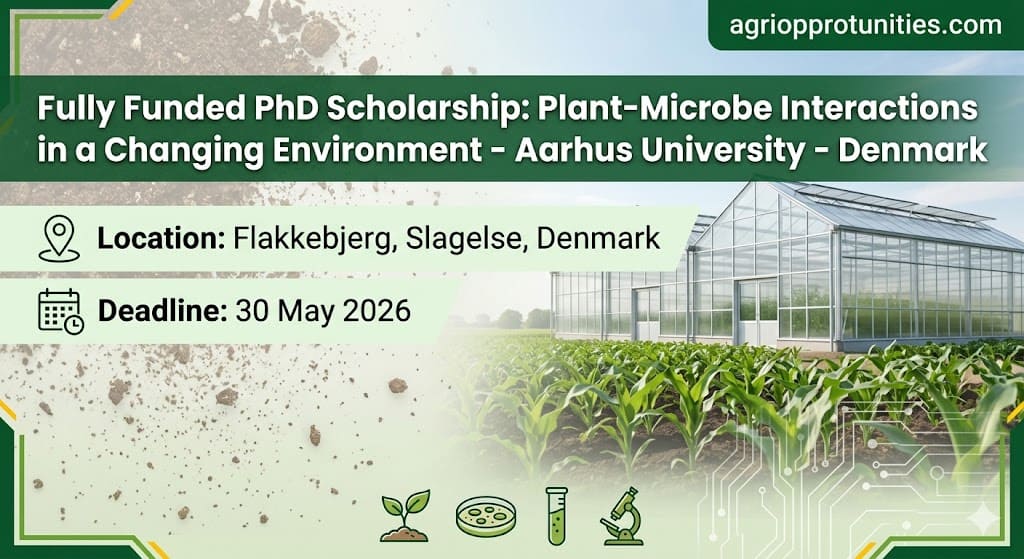
Fully Funded PhD Scholarship: Plant-Microbe Interactions in a Changing Environment – Aarhus University – Denmark

About Aarhus University
Applications are open for a PhD Plant Microbe Interactions Climate Change Denmark position at Aarhus University, Research Centre Flakkebjerg. The project uses culturomics, metatranscriptomics, and metagenomics to study how environmental changes affect plant-associated microbial communities. Aarhus University is a leading research university in Denmark. The place of work is Research Centre Flakkebjerg, Institute for Agroecology, Plant Pathology and Microbiology. The position is available from 1 December 2026 or later.
Scholarship Overview
Project Description
Plant associated microbes hold great potential for improved plant health and nutrition. This project will provide a mechanistic understanding of plant-microbe interactions, testing the effects of environmental changes on plant-associated microbial communities using advanced molecular and data processing methods. The goal is to shed light on the key mechanisms driving the dynamics of plant-microbe interactions.
The work will focus on a series of field (following a space-for-time substitution method) and greenhouse experiments, simulating climate change and examining the formation and evolution of plant-microbe interactions using methods like culturomics, metatranscriptomics, and metagenomics.
Why This Scholarship Stands Out
This PhD is unique because it combines field and greenhouse experiments with cutting-edge molecular methods (culturomics, metatranscriptomics, metagenomics) to understand how climate change affects plant-microbe interactions. The space-for-time substitution method allows you to study climate change effects without waiting decades. Plant-associated microbes hold great potential for improving plant health and nutrition – understanding how environmental changes affect these relationships is critical for developing climate-resilient agriculture. Research Centre Flakkebjerg is a well-equipped facility focused on agroecology. For a student interested in microbial ecology, plant science, and climate change, this is an opportunity to do integrated research across molecular biology, bioinformatics, and field experiments.
Key Responsibilities
- Conduct field and greenhouse experiments simulating climate change
- Use culturomics, metatranscriptomics, and metagenomics to examine plant-microbe interactions
- Apply molecular techniques and bioinformatics to analyze microbial communities
- Study the formation and evolution of plant-microbe interactions under environmental change
Candidate Profile and Eligibility
| Requirement | Details |
|---|---|
| Education | MS degree in Biology, Ecology, Microbiology, Molecular Biology or equivalent |
| Fieldwork | Enjoys working in the field and laboratory |
| Experience | Experience in molecular techniques, bioinformatics and statistics is an advantage |
| Language | Good communication and writing skills in English |
What They Offer
| Benefit | Details |
|---|---|
| Position | PhD Fellow |
| Location | Research Centre Flakkebjerg, Slagelse, Denmark |
| Start Date | December 1, 2026 or later |
| Salary | In accordance with applicable collective agreement |
| Research Environment | Institute for Agroecology, Plant Pathology and Microbiology |
My Application Strategy
- Highlight your molecular biology experience – Culturomics, metatranscriptomics, or metagenomics experience is highly valuable
- Emphasize bioinformatics and statistics skills – Data processing of microbial community data
- Show field and greenhouse experience – The project involves both types of experiments
- Demonstrate interest in climate change research – Understanding the broader context of environmental change
- Upload a project description – Copy the project description and upload as a PDF as required
Who Should Apply
This PhD is perfect for a student with a background in biology, ecology, microbiology, or molecular biology who enjoys both field and laboratory work. If you are interested in how climate change affects the invisible partnerships between plants and microbes, and want to use advanced molecular methods (metagenomics, metatranscriptomics) to understand these interactions, this project offers training across experimental design, molecular biology, bioinformatics, and statistics. Candidates with experience in molecular techniques are especially encouraged.
How to Apply
Submit your application via the link under ‘how to apply’ on the Aarhus University website.
Required documents:
- Cover letter (describing research interests, experiences, and motivation)
- Project description (copy the project description and upload as a PDF)
- Certificate of English language proficiency (e.g., IELTS, TOEFL) – optional but recommended
- Proof of research experience (optional)
Application deadline: May 30, 2026 – 23:59 CEST
For further information, contact: Professor Mo Bahram – bahram@agro.au.dk (main supervisor)
For application requirements: admission.gradschool.tech@au.dk
Useful Links
Similar Posts
Fully Funded MSc & PhD Scholarship: the Chinese Academy of Agricultural Sciences (CAAS), China
Fully funded 51 Master’s & 47 Doctoral scholarships are open in the Chinese Academy of Agricultural Sciences (CAAS)
Fully Funded PhD Scholarship: Forest Recovery After Tornado Disturbance – USA
Applications are open for a PhD Forest Recovery USA position at the University of Kentucky, Department of Forestry & Natural Resources. This fully funded PhD Assistantship is based in the Forest Dynamics and Management Lab under the supervision of Dr. Lance A. Vickers.
Fully Funded PhD Scholarship: Detecting Change in Carbon Stocks and Soil Biodiversity Across Irish Forests – South East Technological University – Ireland
Applications are open for a PhD Forest Soil Biodiversity Ireland position at South East Technological University in Waterford. The C-BioStock project investigates how clear-felling affects soil biodiversity and carbon stocks in native and commercial Irish forests.
Fully Funded PhD Scholarship: Controlled Environment Agriculture Technologies – USA
Applications are open for a PhD Controlled Environment Agriculture USA position at North Dakota State University. The research focuses on energy-efficient system operations and water-energy-food system interactions.
Fully Funded PhD Scholarship: Plant Pathology – Montana State University USA
Applications are open for a PhD Plant Pathology USA position at Montana State University’s Eastern Agricultural Research Center in Sidney, Montana. The project focuses on dry bean disease management in irrigated production systems.
Fully Funded PhD Scholarship: VIRTUE – Phytoremediation, Pyrolysis and Biochar for PFAS removal – Norway
Applications are open for a Fully Funded PhD PFAS Environmental Sciences Norway position at the Faculty of Environmental Sciences and Natural Resource Management (MINA), Norwegian University of Life Sciences (NMBU). This 3-year PhD position is connected to the project VIRTUE.