Why Cows Burp Methane, and Can It Be Reduced?

A soil and agricultural scientist’s detailed look at rumen methane production and the feed additives, breeding, and genetics being used to cut it.

Of all the climate statistics that surprise people outside agriculture, this one probably surprises them the most: a single cow can burp out enough methane in a year to have a genuinely measurable climate impact, and globally, livestock methane is a bigger deal than most casual climate conversations give it credit for. I want to walk through exactly why cattle produce so much of this gas, and then spend real time on what the current science says actually works to reduce it — because this has become one of the most active, well-funded research areas in agricultural science over the past several years.

First, Let’s Clear Up the Burp-vs-Fart Question
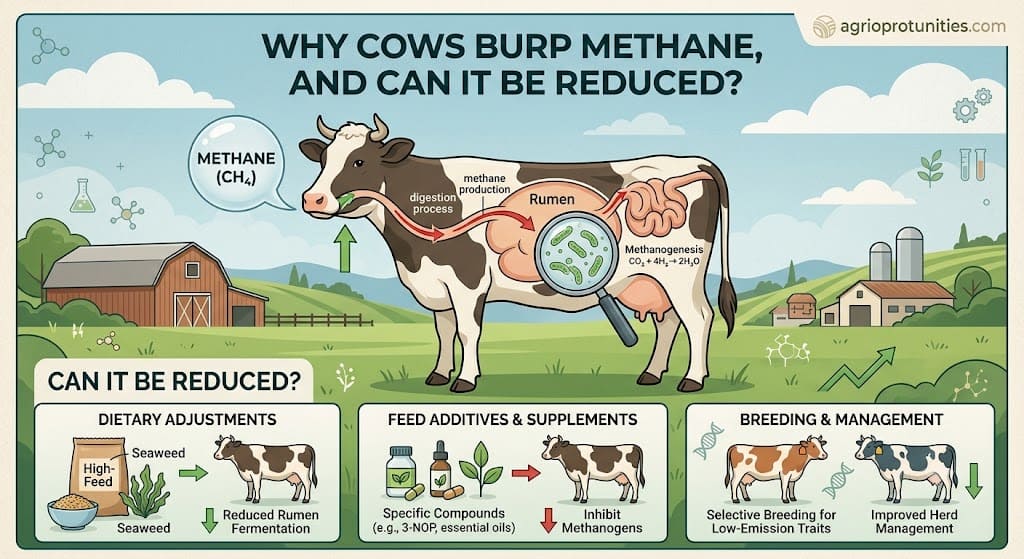
This comes up constantly, so let’s settle it directly. The overwhelming majority of a cow’s methane — generally estimated at 90 to 95 percent — comes out through burping, not flatulence. That’s because methane is produced by microbes living in the rumen, the first and largest of a cow’s four stomach chambers, sitting toward the front of the digestive tract rather than the back.
What the Rumen Actually Is, and Why It Matters
Cattle are ruminants, meaning they’ve evolved a specialized digestive system built around fermenting plant material before it’s ever properly digested. The rumen functions essentially as a large fermentation vat, housing an enormous, complex community of bacteria, protozoa, fungi, and archaea that break down tough plant fiber the cow’s own body couldn’t digest on its own.
This is genuinely why cattle can survive on grass and other fibrous forage that would be nutritionally useless to a human or a pig — the rumen microbiome does the heavy lifting of breaking cellulose down into usable nutrients.
How Methane Actually Forms in This Process
Rumen fermentation is a genuinely intricate microbial process, but the part relevant to methane comes down to hydrogen. As rumen bacteria ferment plant fiber, hydrogen gas is produced as a natural byproduct of that fermentation.
Enter the Methanogens
A group of microorganisms known as methanogens—including species such as Methanobrevibacter ruminantium and Methanobrevibacter smithii—uses hydrogen produced during fermentation to combine with carbon dioxide and form methane. This process benefits the rumen by preventing hydrogen from building up to levels that would otherwise slow fermentation and reduce the cow’s digestive efficiency.
For the cow, however, methane is essentially a waste product. Instead of capturing that energy for growth or milk production, the animal releases it into the atmosphere through burping.
Why This Matters at a Global Scale
Individually, a single cow’s methane output might sound trivial. Multiplied across the world’s cattle population, it isn’t. Livestock methane is one of agriculture’s largest single greenhouse gas contributions, and because methane traps heat far more intensely than carbon dioxide over shorter timeframes, even modest percentage reductions across a global cattle herd represent a genuinely meaningful climate lever.
The Feed Additive Approach: Directly Targeting Methanogens
Given that methanogens are the actual source of the problem, a major research focus has gone into feed additives that directly suppress their activity. Several distinct approaches have emerged, each with a different mechanism and a different practical trade-off.
3-Nitrooxypropanol (3-NOP)
Works by specifically inhibiting methyl-coenzyme M reductase (MCR), which methanogens rely on for the final step of methane production — effectively blocking the assembly line at its last stage. Research in young, growing beef cattle has shown significant methane reductions.
Red Seaweed (Asparagopsis)
Contains bromoform, which inhibits the same MCR enzyme. Has demonstrated methane reductions as high as 80 to 99 percent in various trials, making it one of the most potent methane-reducing feed additives studied so far.
Nitrate
Provides an alternative pathway for hydrogen use in the rumen, competing with methanogens for the same hydrogen supply that would otherwise fuel methane production.
Garlic Oil & Essential Oils
Various essential oil combinations have shown promising rumen fermentation alterations in laboratory settings, though the evidence base for real-world, in-animal effectiveness remains less established.

Why Diet Composition Changes the Result
Interestingly, the same research found that low-forage, low-fiber diets were more sensitive to Asparagopsis supplementation, achieving stronger methane reductions at equivalent inclusion levels compared to higher-forage diets. A related study on 3-NOP found a similar pattern, suggesting this interaction between diet composition and methanogenesis-inhibitor efficacy is a genuine, reproducible phenomenon rather than a one-off finding.
⚠️ The Genuine Challenges With Seaweed as a Solution
Despite the impressive reduction numbers, Asparagopsis comes with real, unresolved practical challenges:
- Bromoform Itself Is a Concern — Bromoform is a potential toxin and a recognized ozone-depleting substance, creating a genuinely uncomfortable irony.
- Heavy Metal and Iodine Content — Seaweed can also contain heavy metals and elevated iodine levels, posing potential animal health risks.
- Storage Stability Problems — Asparagopsis effectiveness declines as its bromoform content degrades during storage.
- Scaling Up Sustainably — Farming Asparagopsis at the scale needed to supply a meaningful share of global cattle feed is a genuinely different undertaking.
Other Feed Additive Options Worth Knowing About
Beyond 3-NOP and seaweed, researchers have tested a broader range of additives, with varying levels of evidence behind each.
🧪 Brown Seaweed (Ascophyllum nodosum)
A gentler alternative to the more potent but riskier Asparagopsis species, brown seaweed’s polyphenol content also plays a role in reducing enteric methane and modulating rumen fermentation, though generally with a less dramatic effect size than bromoform-based approaches.
🌿 Essential Oil Blends
Various essential oil combinations have been tested for their ability to alter rumen fermentation pathways, generally showing more modest methane reductions than the strongest direct methanogenesis inhibitors, but offering a potentially more accessible or lower-risk option for some production systems.
The Hydrogen Problem: Why This Isn’t as Simple as “Just Block the Enzyme”
Here’s a genuinely important complication that mirrors a theme running through this whole series: intervening in one part of a biological system tends to create ripple effects elsewhere. When methanogenesis-inhibiting additives are used, an increase in hydrogen gas production and accumulation is commonly observed, since the rumen no longer has methanogens consuming that hydrogen the way it normally would.
Where Does That Extra Hydrogen Go?
This hydrogen buildup can impose real metabolic constraints on the broader fermentation process, reflected in shifts like increased NADH-to-NAD+ ratios and reduced acetate formation — changes that can affect the cow’s overall digestive efficiency and nutrient absorption if not properly managed.
The Solution: Combining Additives Strategically
This is exactly why current research increasingly focuses on combining a direct methanogenesis inhibitor with a separate “hydrogen-sink” additive, one that redirects that excess hydrogen toward alternative, useful fermentation pathways like propionate or butyrate formation, or toward a process called reductive acetogenesis. Relying on a single high-dose additive alone, however effective in isolation, increasingly looks like a less sophisticated approach than these combination strategies that manage the whole rumen fermentation system together.
Genetics and Breeding: A Longer-Term, Complementary Approach
Feed additives address methane production day to day, but they require ongoing administration and cost. A genuinely different, longer-term strategy has emerged from research showing that methane emission levels are actually a heritable trait in cattle.
What This Means Practically
Because some individual cattle naturally produce meaningfully less methane than others, even on identical diets, selective breeding programs can gradually shift a herd’s average methane output downward over successive generations — similar in concept to breeding for any other production trait like milk yield or growth rate, just applied to an emissions characteristic instead.
This approach won’t replace feed additives entirely, but it offers a genuinely valuable complementary strategy, since genetic gains compound and persist across generations without requiring continuous additive administration or ongoing cost.
Diet Composition as a Standalone Lever
Beyond additives and genetics, the basic composition of what cattle eat independently shapes methane output. Diets higher in fiber generally support more methanogen activity and higher baseline methane production, while diets with more grain or lower fiber content shift fermentation patterns in ways that can reduce methane somewhat on their own, separate from any additive intervention.
This is part of why the diet-additive interaction discussed earlier matters so much practically — a livestock producer’s existing feeding system genuinely changes how much benefit a given additive will deliver, meaning recommendations need to be tailored to the specific production system rather than applied as a one-size-fits-all dosage.
Why a Combination Approach Is Where the Field Is Heading
Current research increasingly emphasizes that relying on any single compound at a high dose presents real limitations, whether that’s cost, storage stability, animal health risk, or the hydrogen accumulation problem discussed above. The direction the field is heading combines methanogenesis inhibitors with complementary hydrogen-sink additives and fermentation modulators together, tailored to a specific diet’s baseline hydrogen availability, rather than treating any single additive as a complete standalone solution.
Practical Considerations for Adoption
For any of these strategies to matter at a meaningful global scale, they need to be practical, affordable, and safe across a huge range of real-world farming systems — not just the carefully controlled research settings where the most dramatic reduction percentages have been demonstrated.
💰 Cost and Accessibility
Feed additives that require daily administration add an ongoing cost to livestock operations, a genuinely significant consideration for smallholder and pastoral systems common across much of the developing world, including South Asia, compared to large, well-capitalized commercial feedlots where additive costs are easier to absorb.
📋 Regulatory Approval
Different countries maintain different regulatory pathways for approving livestock feed additives, meaning even a genuinely effective, well-studied compound like 3-NOP faces its own country-by-country approval timeline before it can reach commercial use everywhere it might help.
Grazing Versus Feedlot Systems
Much of the most promising additive research has focused on feedlot or dairy systems where diet can be tightly controlled and additives mixed directly into feed. Extending these same benefits to grazing cattle, which consume pasture directly rather than a mixed ration, requires different delivery mechanisms — pelleted supplements, slow-release boluses, or water-based delivery systems — and remains a genuinely active area of ongoing research and product development.
Why This Matters for Students Considering This Research Area
Enteric methane research sits at a genuinely rich, fast-moving intersection of microbiology, animal nutrition, and climate policy right now, with substantial research funding and industry interest behind it. It rewards students comfortable working across rumen microbiology, feed formulation science, and genetics, and increasingly, researchers who can also navigate the practical constraints of cost, regulatory approval, and real-world farming system diversity — not just laboratory efficacy numbers in isolation.
For current research and graduate opportunities in animal science and enteric methane mitigation, browse live agriculture scholarship listings on Agri Opportunities.
Frequently Asked Questions
Do cows actually fart methane or burp it?
The overwhelming majority of a cow’s methane, generally estimated at 90 to 95 percent, is released through burping (eructation) rather than flatulence, since methane is produced by microbes in the rumen, the first and largest stomach chamber, located toward the front of the digestive system.
What organisms actually produce methane inside a cow?
Methane is produced by methanogens, specialized microorganisms including species like Methanobrevibacter ruminantium and Methanobrevibacter smithii, which use hydrogen produced during rumen fermentation to convert carbon dioxide into methane.
How effective is seaweed at reducing cattle methane emissions?
Asparagopsis taxiformis, a red seaweed rich in a compound called bromoform, has demonstrated methane reductions as high as 80 to 99 percent in various in vitro and in vivo trials, making it one of the most potent methane-reducing feed additives studied so far, though it comes with genuine safety and supply chain challenges.
Can breeding cattle for lower methane emissions actually work?
Yes. Research has found that methane emission levels are a heritable trait in cattle, meaning selective breeding programs can gradually reduce a herd’s average methane output over generations, offering a longer-term complement to feed additive strategies.