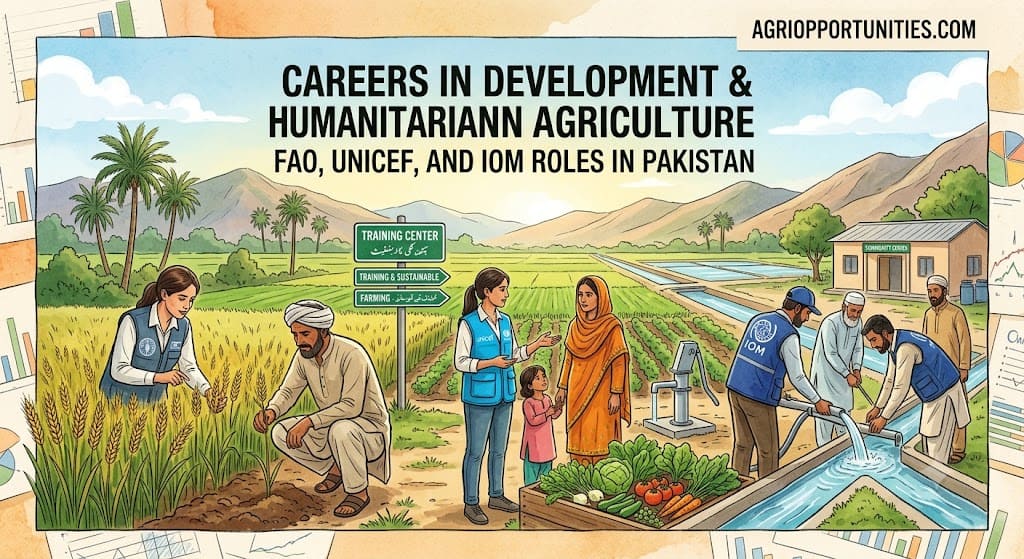
Careers in Development and Humanitarian Agriculture: FAO, UNICEF, and IOM Roles in Pakistan

Careers in Development and Humanitarian Agriculture
FAO, UNICEF, and IOM roles in Pakistan — how hiring works, contract types, and competitive applications
Pakistan hosts one of the largest United Nations country teams globally, and agriculture sits genuinely close to the center of that work — climate resilience, food security, and rural livelihoods programming all touch agriculture directly. This guide covers how hiring at agencies like FAO, UNICEF, and IOM actually works in Pakistan, the different contract types you’ll encounter, and what makes an application genuinely competitive in a hiring process that looks quite different from a standard private-sector job application.

Why Agriculture Sits So Close to the Center of UN Work in Pakistan
Pakistan’s UN presence is shaped by several recurring, overlapping realities: climate-disaster response, large refugee-hosting responsibilities, health system support, education, and social protection, delivered across federal and provincial structures simultaneously. Agriculture threads through nearly all of this — climate-disaster response frequently means restoring agricultural livelihoods after floods or drought, food security work is inherently agricultural, and rural development programming depends heavily on agronomic and livestock expertise.
The Main Agencies Actively Hiring for Agriculture-Adjacent Roles
FAO (Food and Agriculture Organization)
FAO is the most directly agriculture-focused UN agency, and its Pakistan office runs genuinely substantial programming: participatory groundwater management activities to build climate resilience, livestock value chain support to enhance food security specifically in Balochistan, technical support for agricultural value chain and market development, and broader climate change programme planning and implementation.
UNICEF
While UNICEF’s core mandate centers on children, its Pakistan programming includes climate, energy, and environment-focused roles that intersect meaningfully with agriculture and rural livelihoods, particularly given how directly climate shocks and food insecurity affect child welfare outcomes.
IOM (International Organization for Migration)
IOM’s Pakistan work includes climate mobility and migration policy roles — genuinely relevant to agriculture given how much rural-to-urban migration in Pakistan is driven by agricultural livelihood loss from drought, flooding, and broader climate pressure on farming communities.
Understanding the Different Contract Types
This is genuinely important to understand before you start applying, since UN agency job titles carry specific structural meanings that differ from typical private-sector job titles.
National Professional Officer (NPO)
A longer-term, staff-level position specifically open to nationals of the country where the role is based — meaning Pakistani nationals specifically for NPO roles based in Pakistan. These positions carry genuine career progression potential within the agency and represent the closest equivalent to a standard permanent professional job within the UN system.
General Service and Field Assistant Roles
These typically cover more operational, support, and logistics-focused positions — coordinating field operations, providing administrative and logistics support, or assisting with community outreach and project implementation. Several recent FAO Pakistan postings, including Field Assistant (Epidemiology) and various Operations Support roles, fall into this category.
Consultant and Roster Positions
Rather than a standard staff recruitment process, many shorter-term or specialized engagements are filled through a pre-approved roster of qualified candidates, from which the agency draws when a specific short-term need arises — a genuinely different hiring mechanism than applying to an individual, one-off vacancy. IOM’s “Consultant (Roster)” postings, for medical escorts or counselling services as recent examples, illustrate this model directly.
International Professional (P-Level) Positions
Senior technical and managerial positions, such as a Senior Environment and Safeguards Specialist or Procurement Services Manager, generally open to international candidates rather than restricted to Pakistani nationals, and requiring more extensive prior professional experience than entry-level NPO or field assistant roles.
How the Application Process Actually Works
Where to Actually Apply
For FAO specifically, applications go through the agency’s own employment portal at fao.org, where you build a complete profile — not just a CV upload, but a full structured profile covering employment records, academic qualifications, and language skills, plus an attached letter of motivation. UNICEF and IOM run their own equivalent portals, and aggregator sites like UNjobs, ReliefWeb, and Impactpool consolidate postings across multiple agencies, making them useful for broad searching even though the actual application still happens through each agency’s own system.
A Detail Easy to Miss: Degree Accreditation
FAO explicitly states it only considers higher educational qualifications obtained from an institution accredited or recognized in the World Higher Education Database (WHED), a list maintained by the International Association of Universities and UNESCO. This is genuinely worth checking directly for your specific university before investing time in an application, rather than discovering an accreditation issue only after submission.
Building a Complete, Accurate Profile
UN agency guidance consistently emphasizes accuracy and completeness in your profile — a single small mistake or inaccuracy can meaningfully reduce your chances, since these systems are used to screen large applicant pools systematically. Structure your profile starting with your most recent degree, provide full institution names rather than abbreviations, and include a clear summary of your skills and language proficiency alongside your professional experience.
What Actually Makes an Application Competitive
Match the Country Context, Not Just the Job Title
Applications to Pakistan-based UN roles benefit genuinely from demonstrating you understand Pakistan’s specific development context — evidence that you can coordinate across federal and provincial structures, work with implementing partners at scale, or support emergency response alongside longer-term programming — rather than a generic development-sector application that could apply to any country.
Avoid the Generic Cover Letter Trap
A specifically flagged, common mistake: using the same cover letter across multiple agencies with only the organization name changed — hiring panels notice this kind of generic language immediately, and it works directly against you.
Be Specific About Your Impact
Another explicitly flagged weakness: writing vague statements like “contributed to project implementation” without specifying the actual budget, timeline, or measurable result involved. Wherever possible, quantify your prior experience concretely — the scale of a project, the specific outcome achieved, the size of a budget or team involved — rather than relying on generic descriptive language.
Submit Early Rather Than at the Deadline
Many review panels begin evaluating applications as they arrive rather than waiting until the deadline to review everything at once, meaning early submissions genuinely tend to receive fuller attention than last-minute ones.

What to Realistically Expect on Timeline
The full selection process, from initial application to final decision, commonly takes anywhere from two weeks to four months. This typically includes an initial screening stage, followed by a written assessment or technical test for many roles, and one or more interviews (often conducted remotely) before a final decision is communicated. Given this genuinely extended timeline, it’s worth applying to multiple relevant openings in parallel rather than waiting to hear back on one application before pursuing others.
The Kind of Agriculture-Relevant Work Currently Active in Pakistan
To give a concrete sense of what these roles actually involve day to day, recent and current programming has spanned: participatory groundwater management activities specifically designed to build climate resilience in water-stressed farming communities; livestock value chain support aimed at enhancing food security in Balochistan; technical support for broader agricultural value chain and market development; and climate change programme planning connecting directly to the kind of climate-smart agriculture and greenhouse gas mitigation themes covered extensively elsewhere on this site.
Why This Career Path Suits Certain Agriculture Graduates Particularly Well
Given how much this work sits at the intersection of technical agricultural knowledge and broader development, policy, and humanitarian coordination skill, this path genuinely suits agriculture graduates who are drawn toward the policy, food security, and rural development side of the field rather than purely private-sector agribusiness or pure research. If your academic or field experience touches climate adaptation, food security, or rural livelihoods specifically, this sector offers a genuinely distinct, internationally-oriented career track worth actively pursuing alongside the private-sector and academic paths covered elsewhere on this site.
Practical Steps for Getting Started
Confirm your university’s WHED accreditation status before investing significant time into any FAO application specifically. Build out a complete, accurate profile on your target agency’s own career portal rather than relying purely on a generic CV upload, and write a genuinely country-specific, role-specific motivation letter for each individual application rather than reusing the same letter across agencies. Quantify your prior experience concretely wherever possible, and apply as early as you reasonably can once you identify a genuinely matching opening, given how much weight early, thorough review tends to carry in these hiring processes.
For current openings across agriculture, climate, and development-sector roles in Pakistan, browse live agriculture job listings on Agri Opportunities.
Frequently Asked Questions
What is the difference between a National Professional Officer and a Consultant role at FAO?
A National Professional Officer (NPO) is a longer-term, staff-level position open specifically to nationals of the country where the role is based, while a Consultant role is typically a shorter, project-specific engagement, often drawn from a pre-approved roster of qualified candidates rather than a standard staff recruitment process.
How long does the UN agency hiring process typically take?
The selection process commonly takes anywhere from two weeks to four months from application to final decision, generally involving an initial screening, a written assessment or technical test, and one or more interviews, so applicants should expect and plan for a genuinely extended timeline rather than a quick turnaround.
Does FAO require a degree from a specific type of institution?
Yes. FAO only considers higher educational qualifications obtained from an institution accredited or recognized in the World Higher Education Database (WHED), a list maintained by the International Association of Universities and UNESCO, so confirming your university’s WHED status is worth doing before applying.
What kind of agriculture-related work do FAO, UNICEF, and IOM actually do in Pakistan?
Current and recent work spans climate-smart agriculture and organic farming support, livestock value chain development in Balochistan, participatory groundwater management for climate resilience, food security programming, and emergency agricultural response following climate disasters.
Add Agri Opportunities as a preferred source on Google to see latest agriculture guide listings first.