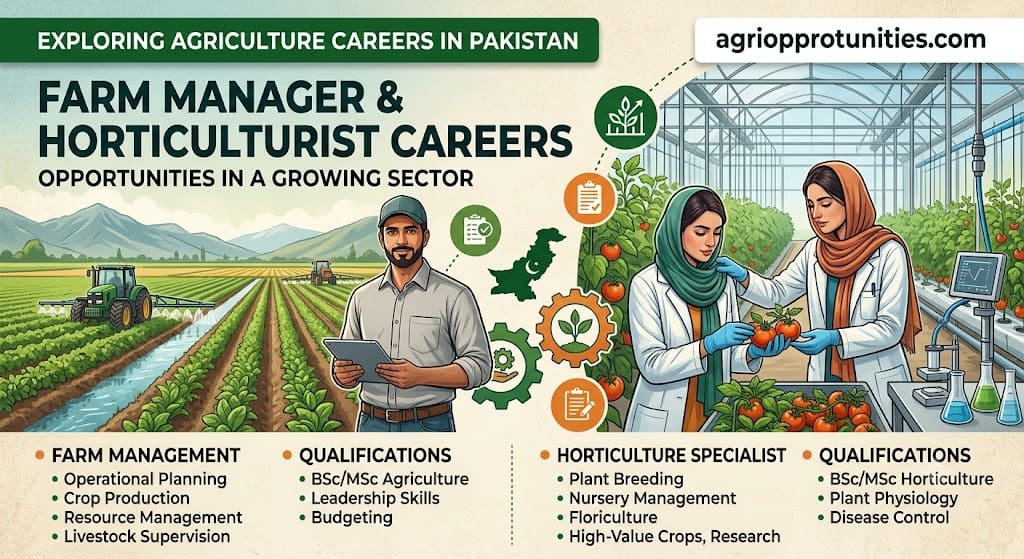
Farm Manager and Horticulturist Careers in Pakistan

Farm Manager and Horticulturist Careers in Pakistan
This guide covers Farm Manager and Horticulturist roles in Pakistan specifically, including the growing organic and export-oriented segment reshaping what these jobs actually require.

What a Farm Manager Actually Does
At its core, a Farm Manager oversees the daily operations of a farm — a genuinely broad remit covering crop planning, resource allocation, staff supervision, and ensuring the farm meets its production and quality targets. Unlike the sales and advisory roles covered elsewhere on this site, this is a hands-on operational leadership position, with real responsibility for what actually happens on the ground day to day.
The Horticulture-Specific Version of This Role
A Horticulturist, or an Assistant Manager – Horticulture, deals specifically with the cultivation of fruits, vegetables, and ornamental plants, requiring a degree in Horticulture rather than general agriculture. Given how much of Pakistan’s genuinely high-value agricultural output — citrus, mango, vegetables — falls under horticulture rather than field crops, this represents a genuinely important, distinct specialization within the broader farm management career track.
What This Role Actually Involves Day to Day
Based on current job postings, a typical Assistant Manager – Horticulture role covers planning and implementing horticultural crop production and cropping patterns, monitoring plant health and identifying and managing pests, diseases, and weeds, overseeing pre- and post-harvest handling of fruits and vegetables, managing field operations including irrigation, fertilization, and climate control, and supervising and training field staff to ensure consistent adherence to best practices.
Why Pre- and Post-Harvest Handling Gets Explicit Attention
It’s worth understanding why “pre- and post-harvest handling” appears as its own distinct responsibility rather than being folded into general crop management. For fruits and vegetables specifically, quality loss after harvest — through improper handling, storage, or transport — can genuinely erase the value of an otherwise well-managed growing season. A horticulturist who focuses purely on growing the crop well, while neglecting the handling process after harvest, can still end up with a commercially disappointing outcome.
Compliance and Certification: A Growing Part of the Job
Current postings increasingly list explicit compliance requirements as part of the role — ensuring adherence to operational standards such as IPM (Integrated Pest Management) and fertigation protocols, and for organic-focused operations, ensuring plant protection activities strictly adhere to international organic certification standards.
What IPM Actually Means for a Farm Manager
Integrated Pest Management combines multiple pest control strategies — biological controls, resistant varieties, careful monitoring and threshold-based intervention — specifically to minimize reliance on chemical pesticides while still maintaining crop health. Adherence to IPM protocols has become a genuinely standard operational requirement, particularly for farms targeting export markets or premium buyers who increasingly expect documented, responsible pest management practices rather than unrestricted chemical use.
Why Organic Certification Changes the Job Genuinely
For farms specifically pursuing organic certification, the farm manager role shifts meaningfully. Current postings for these operations explicitly require strong knowledge of sustainable organic farming and the ability to diagnose pest and disease issues and control them organically — meaning a farm manager in this segment can’t simply fall back on conventional chemical treatments when problems arise, and needs genuine technical depth in organic-compatible pest and disease management specifically.

Managing People: A Genuinely Central Part of the Role
Beyond the technical and agronomic responsibilities, farm manager roles in Pakistan explicitly require the ability to effectively manage farm labor, commonly referred to in job postings using the local term “hari” for farm workers. This isn’t a peripheral soft skill — postings list it as a core, named competency alongside technical crop knowledge, reflecting how much of a farm’s actual output depends on effective day-to-day workforce coordination, not purely on the manager’s own agronomic decisions.
Record-Keeping and Data: An Increasingly Formal Requirement
Modern postings increasingly emphasize maintaining accurate records of crop production and resource utilization, and some roles specifically call out data analysis and report preparation skills as a requirement alongside hands-on field experience. This reflects a broader shift across Pakistani commercial agriculture toward more formalized, documented farm management — genuinely useful both for the farm’s own decision-making and for meeting the documentation standards that export buyers or organic certifiers increasingly expect.
The Range of Farm Types Hiring for This Role
Postings for farm manager and horticulturist roles span a genuinely wide range of operation types: conventional commercial vegetable and fruit farms, dedicated organic operations, high-tech and controlled-environment agriculture ventures (including microgreens, herbs, and edible flower cultivation), and larger agribusiness-affiliated farms connected to broader supply chains. This range means the specific skill emphasis for any given role varies meaningfully — a high-tech controlled-environment posting will value different technical skills than a traditional open-field vegetable operation, even though both carry the “Farm Manager” title.
Qualifications and Experience Typically Required
Most postings require a degree in agriculture, or specifically Horticulture for the more specialized roles, alongside genuine hands-on field experience — postings frequently emphasize “hands-on field experience in agriculture, especially vegetables” as a distinct, valued qualification separate from academic credentials alone. For organic or export-oriented operations specifically, demonstrated knowledge of organic-compatible pest and disease management represents an additional, genuinely differentiating qualification worth building deliberately if you’re targeting this specific segment of the market.
Career Progression in This Track
Entry into this career path commonly starts through an Assistant Manager or trainee-level horticulture position, building hands-on experience across a full growing season or several seasons before advancing to a full Farm Manager role with broader operational and staff management responsibility. From there, progression can lead toward overseeing multiple farm sites for a larger agribusiness operation, or toward specialized consulting roles advising multiple farm operations on horticultural best practice, organic transition, or export-quality production standards.
Practical Advice for Building a Career in This Sector
Given how much these roles value genuine hands-on field experience alongside formal qualifications, seek out practical exposure — internships, seasonal work, or volunteer time on a working commercial farm — as early and deliberately as possible in your academic career, since postings consistently treat this kind of direct experience as a real differentiator. If you’re specifically interested in the organic and export-oriented segment of this market, invest deliberately in building genuine expertise in IPM and organic-compatible pest and disease management, since this specific technical depth is explicitly called out in postings targeting that segment and represents a genuinely valuable, differentiating skill set relative to conventional farm management alone. And don’t underestimate the people-management dimension of this role — genuine ability to lead and coordinate farm labor effectively is treated as a core, named competency in real job postings, not an assumed soft skill that comes automatically with technical expertise.
For current openings in farm management and horticulture roles in Pakistan, browse live agriculture job listings on Agri Opportunities.
From agronomic science to business management, farm manager and horticulturist roles combine hands-on field expertise with genuine operational leadership. Whether you’re managing a conventional vegetable farm, an organic operation, or a high-tech horticulture venture, the ability to lead people, manage resources, and deliver consistent quality defines success in this career track.
Explore farm management and horticulture jobs in Pakistan →Frequently Asked Questions
What does a Farm Manager actually do in Pakistan?
A Farm Manager oversees the day-to-day operations of a commercial farm, including crop planning, staff supervision, resource management, and ensuring production targets and quality standards are met, typically requiring hands-on agriculture experience and often a relevant degree.
How is a Horticulturist role different from a general Farm Manager role?
A Horticulturist specifically deals with the cultivation of fruits, vegetables, and ornamental plants, requiring a degree in Horticulture, while a general Farm Manager role can apply across a broader range of farm operation types, including field crops and livestock, with less specialization in high-value fruit and vegetable production specifically.
What is IPM and why does it matter in horticulture management roles?
IPM, or Integrated Pest Management, is an approach combining multiple pest control strategies to minimize chemical pesticide use while maintaining crop health, and adherence to IPM protocols is increasingly a standard operational requirement for horticulture managers, particularly on farms targeting export or organic certification.
Are organic farming skills increasingly required for farm manager roles in Pakistan?
Yes, for a growing segment of the market. Farms targeting organic certification or premium export markets increasingly require farm managers with specific knowledge of organic pest and disease control methods, since these operations cannot rely on conventional chemical inputs the way standard commercial farms might.
Add Agri Opportunities as a preferred source on Google to see latest guide listings first.
Agriculture specialist bsc agriculture with 3 year of experience have applied many time but you mail gafagro is not correct please see this
03067341462
Khoshki farm applied for a farm manager
Hi Ishaq
We have confirmed that the email address @gafagro is correct, and it is also clearly mentioned in the official advertisement provided by the employer.
For your further satisfaction and verification, you may also visit and apply directly through the company’s official LinkedIn profile:
linkedin.com/company/green-agritech-farms?originalSubdomain=pk