How to Calculate Agricultural Density: Formula, Examples & Expert Insights

Agricultural density is a critical metric in geography. Whether you are studying for the AP Human Geography exam, analyzing land use patterns, or evaluating farmland for investment, knowing how to calculate agricultural density helps you understand the relationship between a region’s farmers and its farmland.
This guide provides the agricultural density formula, step-by-step calculations, real-world examples, and explains why this ratio matters for food production and rural development.
What Is Agricultural Density? Definition and Core Meaning
Agricultural density is a geographic measure that compares the number of farmers (or agricultural workers) to the amount of arable land (cultivable land) in a specific area.
- Simple Definition: It is the ratio of the agricultural population to the cultivable land.
- Formula: Farmers per square kilometer (km²) or square mile.
Unlike general population density, which counts every person against total land, agricultural density zooms in on the farming pressure on land that can actually grow crops. It is a cornerstone concept in human geography and is frequently tested in AP Human Geography courses.
Why Is Agricultural Density Important?
Understanding this ratio helps different groups make informed decisions:
- For Geographers & Students: It reveals how societies interact with land. High density often indicates labor-intensive farming and subsistence agriculture, while low density suggests mechanized agriculture and higher efficiency.
- For Agri-Investors: High density may signal a need for investment in irrigation or soil health. Low density might indicate opportunities for large-scale commercial agriculture expansion.
- For Policymakers: It helps allocate resources for rural development, agricultural credit, and land reform programs.
The Agricultural Density Formula
The equation is straightforward:
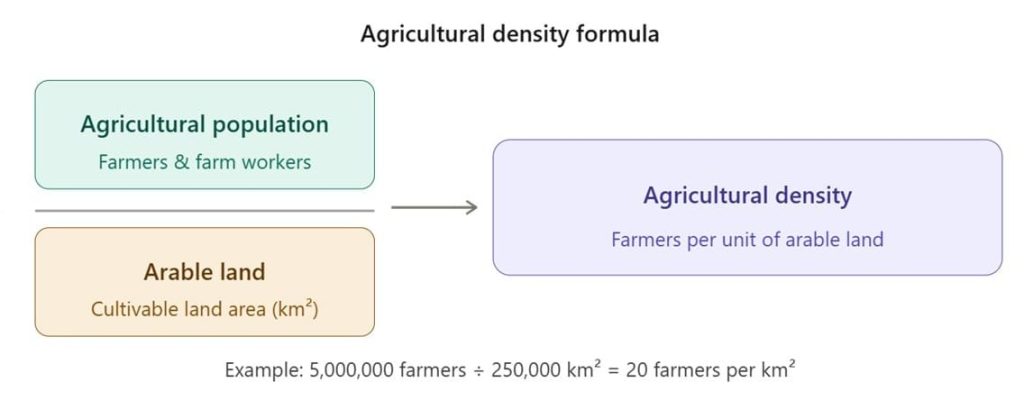
Agricultural Density = Agricultural Population ÷ Arable Land
- Agricultural Population: The number of people whose primary livelihood is farming (farmers, farm laborers, and sometimes their dependents).
- Arable Land: The total area of land that is cultivable (measured in km² or square miles). Note: Deserts, mountains, and urban areas are excluded.
Important Note: Definitions vary. Some sources count only “active farmers,” while others include the broader farm labor force. Always verify which definition is used in your specific context.
How to Calculate Agricultural Density: Step-by-Step
Follow these four steps to perform the calculation:
- Find the Agricultural Population: Locate census data or agricultural surveys detailing the number of people working in farming.
- Find the Arable Land Area: Obtain data on cultivable land. Reliable sources include national census bureaus, the FAO (Food and Agriculture Organization), or the World Bank.
- Apply the Formula: Divide the population by the land area.
- Formula: Agricultural Population ÷ Arable Land (km²)
- Interpret the Result: The result equals the number of farmers per square kilometer.
- High Number: More people farming a smaller area (labor-intensive).
- Low Number: Fewer people farming a larger area (mechanized).
Agricultural Density Example: A Worked Problem
Let’s compare two hypothetical countries to see how this works in practice.
| Scenario | Agricultural Population | Arable Land | Calculation | Agricultural Density |
|---|---|---|---|---|
| Country X | 8,000,000 farmers | 400,000 km² | 8,000,000 ÷ 400,000 | 20 farmers / km² |
| Country Y | 2,000,000 farmers | 500,000 km² | 2,000,000 ÷ 500,000 | 4 farmers / km² |
Interpretation:
Country X has a much higher agricultural density. This suggests it relies more on labor-intensive farming (small plots, manual labor). Country Y likely uses mechanized agriculture, where fewer farmers manage larger tracts of land.
High vs. Low Agricultural Density: What Does It Mean?
What Does High Agricultural Density Mean?
A high ratio indicates many farmers relative to available farmland. This is typical of:
- Subsistence farming: Small plots farmed to feed families.
- Labor-intensive systems: Heavy reliance on human labor over machinery.
- Lower land availability: Each farmer works a very small parcel.
- Examples: Bangladesh, parts of India and South Asia.
What Does Low Agricultural Density Mean?
A low ratio indicates few farmers working large areas of arable land. This typically signals:
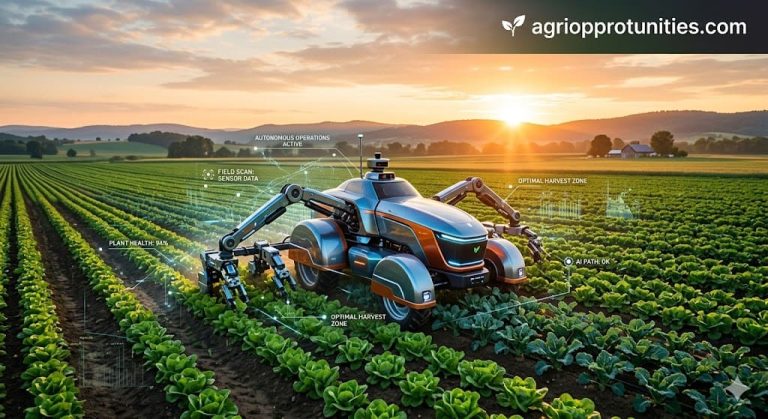
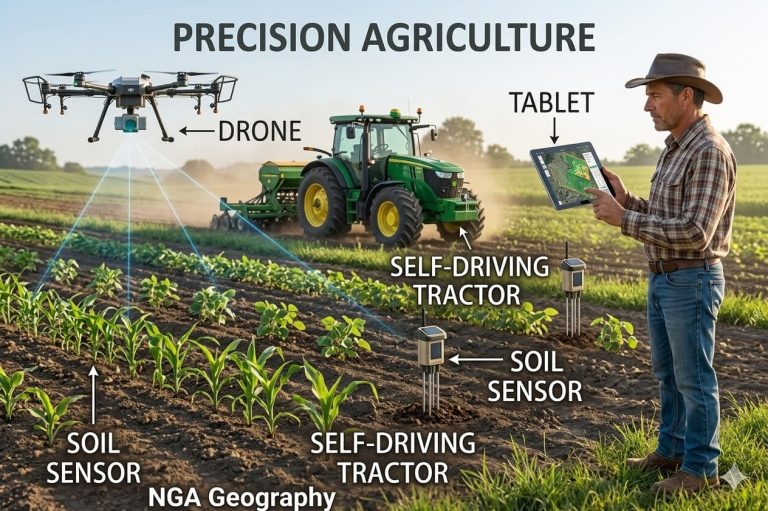
- Mechanized agriculture: Tractors and technology replace manual labor.
- Commercial agriculture: Large-scale farming for market sales.
- Higher agricultural efficiency: Greater output per farmer.
- Examples: Australia, Canada, United States.
Agricultural Density vs. Physiological vs. Arithmetic Density
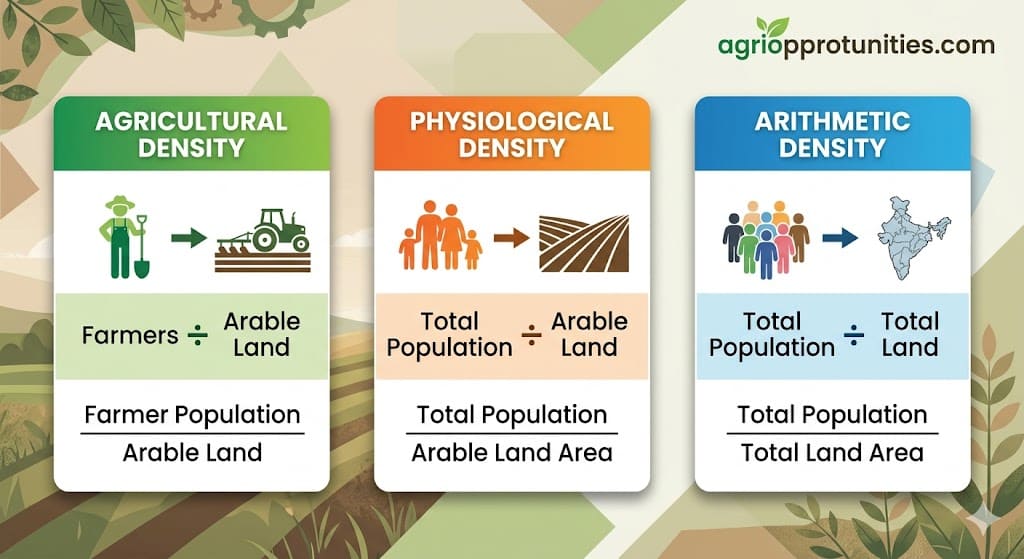
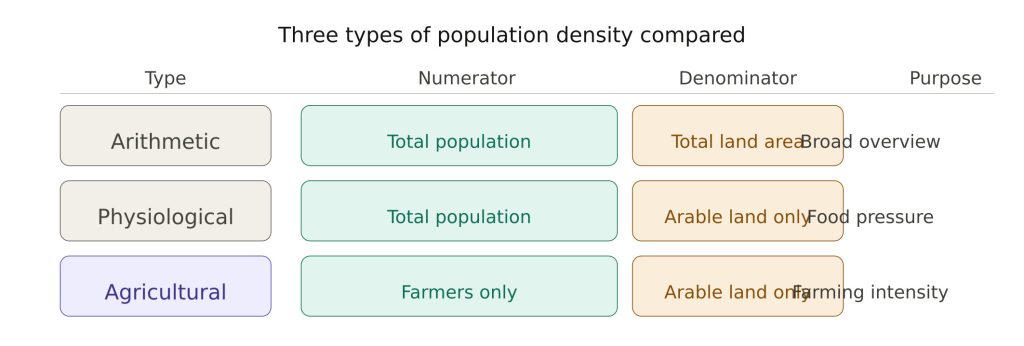
One of the most common points of confusion is distinguishing between the three types of density. Here is the breakdown:
| Type | Formula | Numerator | Denominator | Measures |
|---|---|---|---|---|
| Agricultural Density | Farmers ÷ Arable Land | Farmers Only | Arable Land | Farming pressure on cultivable land. |
| Physiological Density | Total Population ÷ Arable Land | Everyone | Arable Land | Pressure to feed the population using farmland. |
| Arithmetic Density | Total Population ÷ Total Land | Everyone | Total Land (including deserts/mountains) | General population distribution. |
- Agricultural Density is the most specific (farmers vs. farmland).
- Physiological Density is the strongest indicator of carrying capacity (can the land feed the people?).
Why Arable Land Matters
A critical nuance: Agricultural density does not use total land area.
- Arable Land: Land physically capable of growing crops.
- Non-arable Land: Deserts, mountains, frozen tundra, and urban areas.
If you used total land, a country with a vast desert (like Egypt) would appear to have a low density, even though its actual farmland is overcrowded and heavily pressured. Using arable land ensures the metric accurately reflects real-world pressure on food production systems.
Agricultural Density in AP Human Geography
If you are studying for the AP exam, you need to go beyond just memorizing the formula. You should be able to:
- Calculate density from provided data.
- Compare agricultural, physiological, and arithmetic density.
- Analyze how density reflects human-environment interaction and land use.
- Interpret whether a region likely practices subsistence or commercial agriculture based on its density score.
Practice Question:
A province has 3,000,000 agricultural workers and 150,000 km² of arable land. What is its agricultural density?
Solution: 3,000,000 ÷ 150,000 = 20 farmers per km²
Global Patterns: Agricultural Density Across Regions
Agricultural density varies dramatically across the globe, shaping economic and social structures:
- South Asia (Bangladesh, India): Very High Density. Characterized by large rural populations and small-scale, subsistence farming.
- Sub-Saharan Africa: Highly Variable. Some areas face high density and soil degradation; others have low density with underutilized land ripe for development.
- North America & Australia: Very Low Density. Highly mechanized, technology-driven farming generates large food surpluses.
- Western Europe: Moderate Density. High land productivity achieved through a mix of technology, policy, and favorable conditions.
Frequently Asked Questions (FAQs)
1. Does agricultural density only include farmers?
Definitions vary. In AP Human Geography, it typically refers to the broader agricultural population directly engaged in farming. Always confirm the source.
2. Can agricultural density change over time?
Yes. It decreases when farmers leave rural areas (urban migration), when mechanization reduces the need for labor, or when new irrigation projects expand arable land.
3. Is agricultural density the same everywhere in a country?
No. National averages can mask significant regional variation based on soil quality, climate, and local economic conditions.