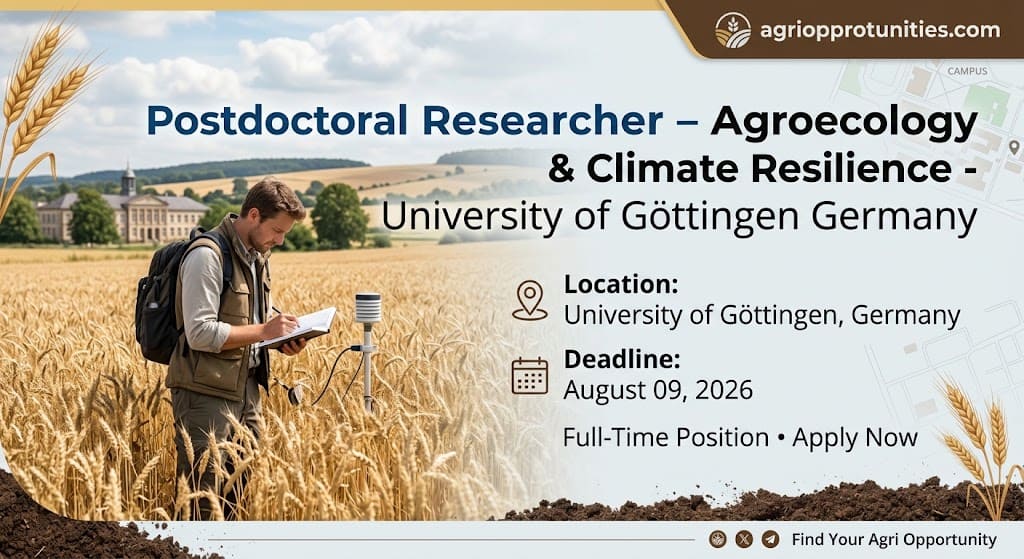
Postdoctoral Researcher – Agroecology & Climate Resilience – University of Göttingen Germany

Quick Overview
Applications are open for a Fully Funded Postdoctoral Researcher position at the University of Göttingen as part of the AgRe-Lab project. This is a 3-year position (with possible 3-year extension) focusing on building climate resilience in agricultural landscapes through social-ecological diversification, co-design, and transdisciplinary learning. You’ll coordinate Living Labs, engage with stakeholders, and contribute to high-impact research.
Experience Level: PhD in Agricultural Sciences, Sociology, Geography, Ecology, or related fields
Best Fit: Candidates with interdisciplinary research experience and German language fluency
Deadline: August 9, 2026
Key Details
| Position | Postdoctoral Researcher |
| Project | AgRe-Lab – Building climate resilience in agricultural landscapes |
| Location | University of Göttingen, Germany |
| Qualification | PhD in Agricultural Sciences, Sociology, Geography, Ecology, or related fields |
| Salary | TV-L E13 (100%) |
| Duration | 3 years (extension possible for additional 3 years) |
| Start Date | October 1, 2026 |
| Deadline | August 9, 2026 |
| Apply Via | University of Göttingen application portal |
| Contact | Prof. Dr. Catrin Westphal – catrin.westphal@uni-goettingen.de |
Fully Funded Postdoctoral Researcher – Opportunity Overview
AgRe-Lab is funded by zukunft.niedersachsen, the joint science funding program of the Lower Saxony Ministry of Science and Culture and the Volkswagen Foundation. The transdisciplinary project focuses on the adoption of climate and biodiversity measures, co-design processes, landscape governance, and transdisciplinary learning. AgRe-Lab will investigate how these measures shape the social-ecological resilience of agricultural landscapes to adapt and remain productive under climate change.
This Fully Funded Postdoctoral Researcher position provides excellent opportunities for professional development at the interface of science and practice, including project coordination, participatory research, stakeholder engagement, and co-creation of solutions.
What You’ll Actually Be Doing
- Implementation of Living Labs, including selection of study landscapes and study sites
- Coordination and support of social-ecological research within the Living Labs
- Communication with regional implementation partners, authorities, and farmers
- Active participation in different transdisciplinary subprojects (data collection, analyses, scientific publications)
- Manage the co-development of a digital tool for participatory landscape planning
- Project administration, data management, organization of meetings and workshops
- Scientific outreach, knowledge transfer, and science communication (including social media)
- Collaboration with the ZKfN Office and exchange with other Climate Future Labs
- Co-supervision of bachelor, master, and doctoral students
Fully Funded Postdoctoral Researcher – Research Environment
The Agroecology & Functional Agrobiodiversity division at the University of Göttingen offers a dynamic research environment with strong connections to the agricultural sector, non-governmental organizations, and leading research institutions. Göttingen is a vibrant university city rich in cultural life.
Who Should Apply
This position is best for candidates with a PhD in Agricultural Sciences, Sociology, Geography, Ecology, or related fields.
Strong candidates will have:
- Proven track record of interdisciplinary and transdisciplinary research using participatory approaches
- Strong conceptual understanding of agricultural landscapes as socio-ecological systems
- Fluency in written and spoken German and English
- Excellent publication record
- Proven experience in supervising Master’s and Bachelor’s theses
- Commitment to scientific outreach and communication
- Experience with spatial analyses (QGIS, participatory mapping, R) – asset
- Experience with qualitative and quantitative social science research methods – asset
- Valid Class B driving licence
- Strong willingness to travel for fieldwork and spend time at the Living Labs
Skills That Will Help You Stand Out
| Skill | Why It Matters |
|---|---|
| Interdisciplinary research | Core requirement |
| Participatory approaches | Living Lab methodology |
| German language | Required for stakeholder engagement |
| Project coordination | Managing Living Labs |
| Scientific writing | Publications |
| QGIS / R / Spatial analysis | Asset |
| Social science methods | Qualitative and quantitative |
What They Offer
| Benefit | Details |
|---|---|
| Salary | TV-L E13 (100%) |
| Duration | 3 years (extension possible for additional 3 years) |
| Location | Göttingen, Germany |
| Research Environment | Dynamic, interdisciplinary |
| Networking | Strong professional network |
| Career Development | Project coordination and leadership experience |
Application Tips
- Highlight interdisciplinary research experience – Core requirement.
- Emphasize German and English fluency – Both required.
- Show publication record – Excellent publication record required.
- Demonstrate stakeholder engagement – Living Lab experience.
- Mention supervision experience – Bachelor and Master thesis supervision.
- Apply before deadline – August 9, 2026.
How to Apply
Upload your application in English through the University of Göttingen application portal:
Required documents:
- Letter of motivation (highlighting research background and experience in scientific coordination)
- CV with publication list
- Copies of certificates
- Contact information of at least two references
Closing Date: August 9, 2026
Job Interviews: Last week of August in Göttingen
Contact: Prof. Dr. Catrin Westphal – catrin.westphal@uni-goettingen.de
Frequently Asked Questions
- What is the duration? 3 years with possible extension for an additional 3 years.
- What language skills are required? Fluency in written and spoken German and English.
- Is this a full-time position? Yes, 100% (39.8 hours/week).
- What is the start date? October 1, 2026.
- Is fieldwork required? Yes, travel to Living Labs is essential.