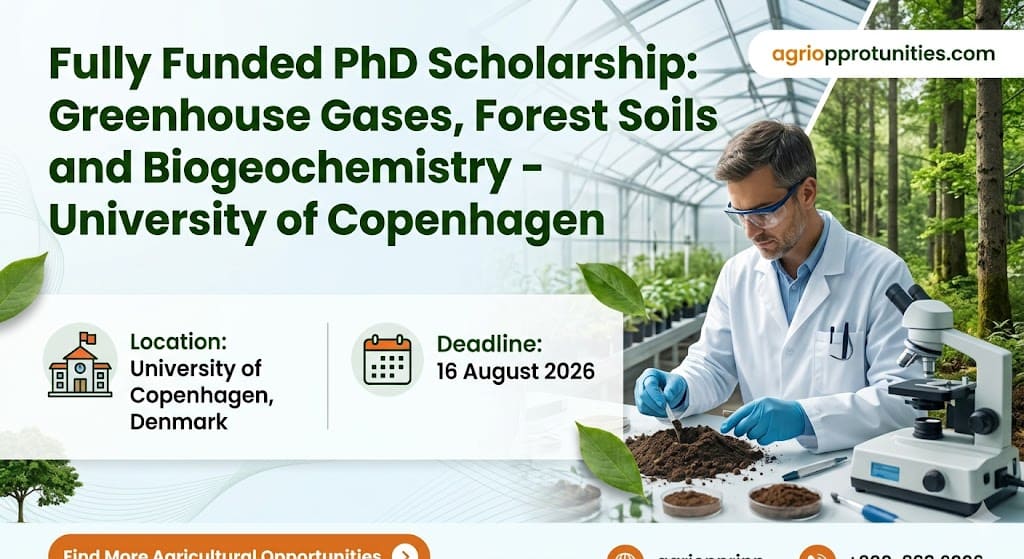
Fully Funded PhD Scholarship: Greenhouse Gases, Forest Soils and Biogeochemistry – University of Copenhagen Denmark

About the University of Copenhagen
Applications are open for a PhD Fellowship in Greenhouse Gases, Forest Soils and Biogeochemistry at the Department of Geosciences and Natural Resource Management (IGN), University of Copenhagen, Denmark. The project is funded by the Independent Research Fund Denmark and forms part of a major national initiative focused on understanding the climate change mitigation potential of Denmark’s future forest landscapes. The successful candidate will join the Biogeochemistry Research Group, which investigates ecosystem processes across forests, wetlands, grasslands, and natural ecosystems.
Scholarship Overview
Research Project Background
Denmark has set an ambitious target of achieving climate neutrality by 2045. One of the country’s key strategies is large-scale afforestation, with plans to establish approximately 250,000 hectares of new forests over the next two decades. However, converting agricultural land into forest landscapes creates complex interactions between carbon and nitrogen cycles. While new forests may increase carbon storage, they can also contribute to nitrogen losses through greenhouse gas emissions and nutrient leaching. Understanding these processes is essential for accurately assessing the climate benefits of afforestation projects.
Why This Scholarship Stands Out
This PhD is unique because it addresses a critical policy question for Denmark’s climate strategy: does converting agricultural land to forest really reduce net greenhouse gas emissions? The project investigates how tree species composition, soil characteristics, historical land-use practices, and forest management strategies influence N₂O, CH₄, and CO₂ emissions from forest soils. You will analyze unpublished greenhouse gas datasets, conduct fieldwork across Danish forests, and perform laboratory mesocosm experiments. The research includes a stay at Land-CRAFT, Aarhus University. For a student interested in soil biogeochemistry and climate change mitigation, this is an opportunity to generate evidence that directly informs national afforestation policy.
Research Focus
The PhD project will investigate how different factors influence greenhouse gas emissions from forest soils, including tree species composition, soil characteristics, historical land-use practices, and forest management strategies. The research will primarily focus on Nitrous Oxide (N₂O), Methane (CH₄), and Carbon Dioxide (CO₂). A major objective is to improve understanding of nitrogen cycling and greenhouse gas dynamics in newly established forest ecosystems.
Research Activities
- Analysis of existing unpublished greenhouse gas datasets collected from Danish forests
- Fieldwork across Denmark in coniferous forests, broadleaf forests, former agricultural land, and established forest ecosystems
- Laboratory mesocosm experiments to study greenhouse gas production and soil nitrogen processes under varying environmental conditions
- Experience with greenhouse gas chamber systems, stable isotope analysis, soil biogeochemical measurements, and environmental monitoring equipment
- Quantitative analysis using advanced statistical tools and programming languages such as R
Key Responsibilities
- Analyze greenhouse gas datasets from Danish forest ecosystems
- Design and implement field campaigns
- Conduct laboratory-based greenhouse gas studies
- Complete 30 ECTS of PhD coursework
- Publish scientific research articles
- Prepare and defend a PhD dissertation
- Present findings at scientific conferences
- Undertake a research stay at Land-CRAFT, Aarhus University
- Contribute to teaching and student supervision activities
Candidate Profile and Eligibility
| Requirement | Details |
|---|---|
| Education | Master’s degree equivalent to Danish MSc in Soil Science, Biogeochemistry, Environmental Science, Forest Ecology, Earth and Environmental Sciences, or related field |
| Experience | Experience with environmental data analysis |
| Programming | Proficiency in R or similar programming languages |
| Fieldwork | Experience conducting field research |
| Language | Strong written and spoken English skills |
| Preferred | Experience with greenhouse gas measurements, knowledge of nitrogen cycling and soil processes, familiarity with stable isotope techniques, experience handling environmental monitoring equipment |
What They Offer
| Benefit | Details |
|---|---|
| Duration | 3 years (full-time) |
| Start Date | December 1, 2026 |
| Location | Copenhagen, Denmark |
| Salary | Competitive Danish PhD salary |
| Research Environment | Biogeochemistry Research Group, modern analytical laboratories, greenhouse gas monitoring systems, advanced soil and water chemistry facilities |
| International Collaboration | Research stay at Land-CRAFT, Aarhus University |
Supervision Team
| Supervisor | Institution | Expertise |
|---|---|---|
| Dr. Jesper Riis Christiansen | University of Copenhagen (Main Supervisor) | Soil N₂O emissions, methane dynamics, forest ecosystems, wetland restoration, afforestation impacts |
| Prof. Per Gundersen | University of Copenhagen (Co-Supervisor) | – |
| Prof. Klaus Butterbach-Bahl | Aarhus University – Land-CRAFT (Co-Supervisor) | – |
My Application Tips
- Highlight your experience with environmental data analysis – Analyzing greenhouse gas datasets is core
- Emphasize R programming skills – Proficiency in R or similar languages is required
- Show field research experience – Fieldwork across Denmark is a key component
- Demonstrate knowledge of nitrogen cycling and greenhouse gas measurements – Preferred qualifications
- Keep motivation letter to one page and research proposal to one page – As specified
Who Should Apply
This PhD is perfect for a student with a background in soil science, biogeochemistry, environmental science, or forest ecology who wants to work on climate change mitigation policy. If you are interested in how afforestation affects greenhouse gas emissions from soils, and want to combine field studies, laboratory experiments, and data analysis, this project offers training across biogeochemistry, ecosystem science, and quantitative methods.
How to Apply
Submit your application through the University of Copenhagen application portal.
Required documents (in English):
- Motivation letter (maximum one page)
- Research proposal outlining ideas and methods (maximum one page)
- Updated curriculum vitae (CV)
- Bachelor’s and Master’s degree certificates
- Academic transcripts
- English translations of documents where applicable
- Publication list (if available)
- Reference letters (if available)
Application Deadline: August 16, 2026
Expected Interviews: Week 38, 2026