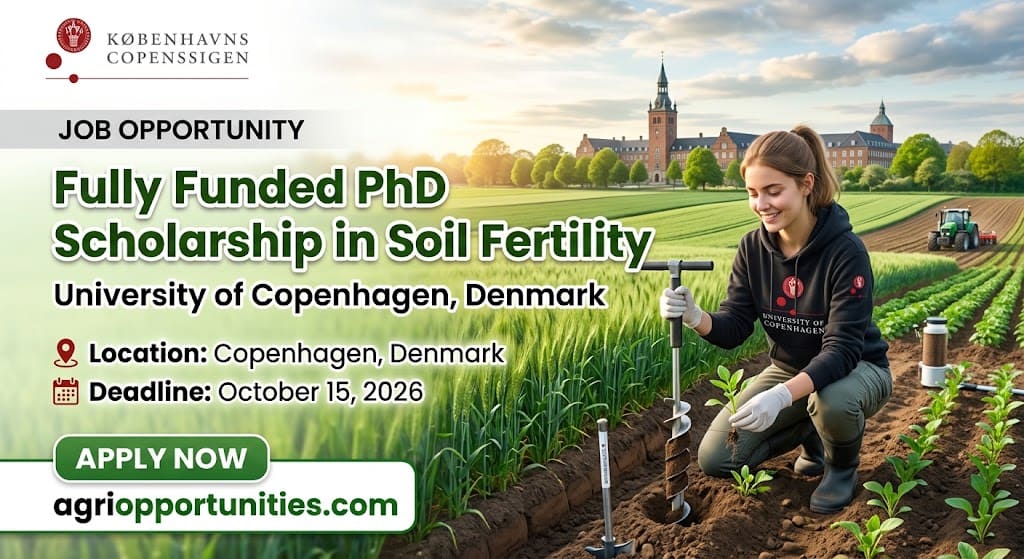
Fully Funded PhD Scholarship in Soil Fertility – University of Copenhagen, Denmark

Quick Overview
The University of Copenhagen is offering a PhD fellowship in Soil Fertility as part of the PRIME-P project, financed by the NovoNordisk Foundation. This project investigates how different forms of organic matter affect microbial phosphorus mobilization and soil organic matter dynamics. The position offers collaboration with Aarhus University, Technische Universität Berlin, ETH Zürich, and the University of Guelph.
Experience Level: MSc in Soil Science, Biogeochemistry, or related field
Best Fit: Candidates with interest in soil biogeochemistry and phosphorus cycling
Deadline: October 15, 2026
Key Details
| Position | PhD Fellow |
| Project | PRIME-P – Can microbial phosphorus mobilization be primed? |
| University | University of Copenhagen |
| Location | Frederiksberg Campus, Copenhagen, Denmark |
| Qualification | MSc in Soil Science, Biogeochemistry, or related field |
| Duration | 3 years (full-time) |
| Start Date | January 1, 2027 |
| Deadline | October 15, 2026 |
| Apply Via | University of Copenhagen application portal |
| Contact | Nelly S. Raymond – nray@plen.ku.dk |
Project Description
Biobased fertilisers (BBF) exist in many forms (sewage sludge, compost, animal manures etc.) with different chemical properties. Unlike mineral phosphate fertilisers, many BBF contain significant amounts of organic phosphorus (P) and calcium phosphate forms, which are not directly available to plants. Soil microorganisms play a crucial role in the mineralization of organic P and the solubilisation of inorganic P.
Main research questions:
- Do different forms of OM affect microbial P mobilization?
- Do the different OM fractions have similar levels of P mineralization?
- How do soil properties influence microbially mediated P cycling?
Key Responsibilities
- Soil characterization in relation to P availability
- Soil organic matter fractionation upon recent and historical BBF additions
- Soil incubation studies to investigate microbial P processing
- Use isotopic techniques (33P and 18O enriched water)
- Measurements of enzymatic activity
- Investigation of microscale mechanisms using advanced imaging techniques
- Potential implementation of a soil-plant model
Who Should Apply
This position is best for candidates with a strong background in soil biogeochemistry and phosphorus cycling.
Required:
- MSc in Soil Science, Biogeochemistry, or related field
- Strong knowledge of soil biogeochemistry processes, with special emphasis on phosphorus and soil organic matter dynamics
- Excellent experimental experience in laboratory work
- Ability to translate theoretical questions into practical experimental designs
- Ability to analyze and interpret complex datasets
- Ability to work independently and take initiative
- Proficiency in spoken and written English (C1 level)
What They Offer
| Benefit | Details |
|---|---|
| Duration | 3 years (full-time) |
| Location | Copenhagen, Denmark |
| Research Environment | Modern laboratories, climate chambers, long-term field trials |
| Collaboration | Aarhus University, TUB, ETH Zürich, University of Guelph |
| International Stay | Research visits to TUB |
Application Tips
- Highlight soil biogeochemistry experience – Core requirement.
- Show laboratory experience – Soil sampling, fractionation, isotopic techniques.
- Demonstrate analytical skills – Complex dataset interpretation.
- Prepare a reflection on research interests – One-page required.
- Apply before deadline – October 15, 2026.
How to Apply
Submit your application through the University of Copenhagen application portal.
Required documents (in English):
- Cover letter (max 1 page)
- CV (education, experience, language skills)
- Short reflection on research interests and how to approach the project (max 1 page)
- Original diplomas and transcripts (Bachelor and Master)
- Publication list (if possible)
- Contact information for two referees
- Deadline: October 15, 2026 at 23:59 GMT+2
- Interviews: Week 44-45, 2026
Frequently Asked Questions
- What is the project focus? Microbial phosphorus mobilization and soil organic matter dynamics.
- What is the duration? 3 years.
- What is the start date? January 1, 2027.
- What qualification is required? MSc in Soil Science, Biogeochemistry, or related field.
- What is the deadline? October 15, 2026.
Very good information for my career.
Usama Arshad .
MSc. Agriculture entomology
University of Agriculture Faisalabad, Pakistan.