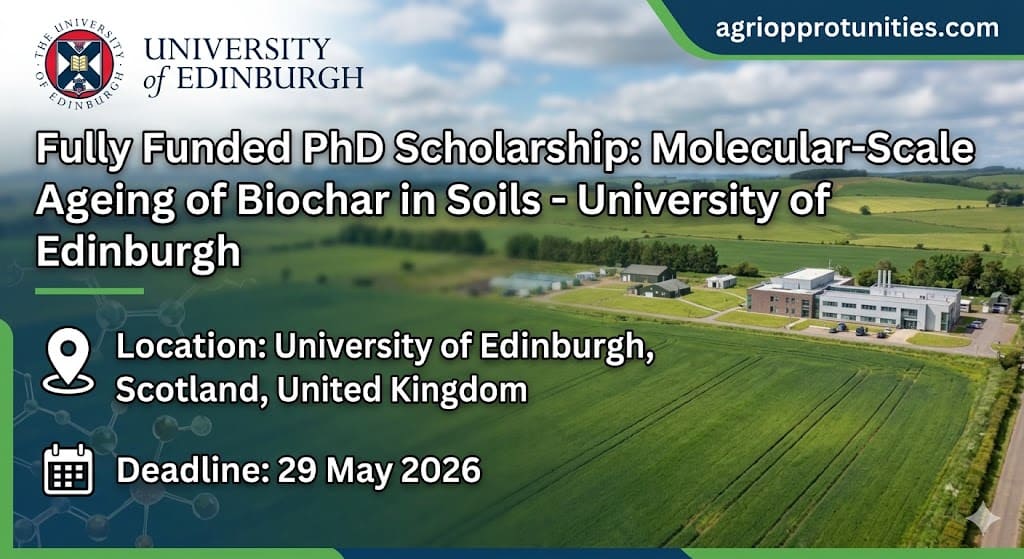
Fully Funded PhD Scholarship: Molecular-Scale Ageing of Biochar in Soils – University of Edinburgh

About the University of Edinburgh
Applications are open for a Fully Funded PhD Biochar Soil Ageing UK position at the University of Edinburgh. The project combines molecular simulations with experimental characterisation to understand how biochar functionality evolves in soils. The University of Edinburgh is one of the world’s leading research universities, located in Scotland, UK. The School of Chemistry holds a Silver Athena SWAN award in recognition of its commitment to advance gender equality in higher education. The university is a member of the Race Equality Charter and a Stonewall Scotland Diversity Champion, actively promoting LGBT equality. This PhD is co-supervised by Dr Valentina Erastova (School of Chemistry) and Prof Saran Sohi (School of Geosciences), in collaboration with Black Bull Biochar, an industrial partner.
Scholarship Overview
Project Summary
Biochar is increasingly deployed as a negative-emission technology because it can stabilise carbon in soils over decadal-to-centennial timescales. However, current carbon accounting and certification frameworks often rely on bulk proxies (e.g., elemental ratios and simple lifetime assumptions) that do not capture how biochar chemistry and surface properties evolve during real soil ageing. These molecular-scale changes are also central to biochar’s value as a soil amendment, influencing nutrient retention, water holding capacity, and interactions with dissolved organics and minerals.
This interdisciplinary PhD will combine experimental characterisation (School of GeoSciences, Prof Saran Sohi) with atomistic molecular modelling and simulation (School of Chemistry, Dr Valentina Erastova) to build a mechanistic understanding of biochar ageing in soils.
The project will:
- Characterise fresh and soil-aged biochars to quantify changes in bulk composition and surface functional groups
- Develop and validate representative atomistic models of fresh and aged biochars
- Use molecular simulations to probe how evolving functionality controls stability and interactions with key soil components, including minerals and dissolved organic matter
Working with Black Bull Biochar (industrial partner), the research will translate molecular insights into functionality-based indicators of durability and performance, supporting improved methodologies for high-integrity carbon removal credits.
Why This Scholarship Stands Out
This PhD is unique because it bridges molecular simulations with applied environmental science and industrial carbon credit markets. Biochar is one of the few scalable negative-emission technologies available today, but carbon credit frameworks rely on oversimplified assumptions about biochar longevity. This project will generate molecular-scale understanding that could improve carbon accounting methodologies. The collaboration with Black Bull Biochar means your research will have direct industrial relevance, and you will have the opportunity for a placement with the partner company. You will receive training across molecular simulation, environmental chemistry, and industry-facing carbon accounting/MRV. For a student with a strong physical chemistry background who wants to apply their skills to climate change mitigation, this is an opportunity to do fundamental science with real-world policy and market implications.
Candidate Profile and Eligibility
| Requirement | Details |
|---|---|
| Education | Strong degree in Chemistry, Materials Science, Chemical Engineering, Environmental/Geoscience, Physics, or related subject |
| Skills | Enjoy quantitative problem-solving; interest in molecular-scale surface chemistry and sustainable technologies |
| Experience | Experience in molecular simulation, programming/data analysis (e.g., Python), or HPC is advantageous but not essential |
| Personal Qualities | Ability to work across disciplines and communicate well with academic and industrial partners |
Key Research Questions
- How does biochar surface chemistry evolve during soil ageing at the molecular scale?
- How does this evolving functionality control biochar durability and long-term carbon permanence in soils?
- How do ageing-driven changes in functionality alter biochar interactions with core soil components?
- How can we translate molecular-scale descriptors into measurable, scalable indicators of biochar quality and durability?
- How does functional evolution affect biochar performance as a soil amendment/fertiliser component?
My Application Strategy
- Highlight your physical chemistry background – Be specific about coursework, research projects, or skills in thermodynamics, kinetics, or surface chemistry
- Emphasize any molecular simulation experience – Mention software (GROMACS, LAMMPS, Gaussian, VASP) or specific simulation techniques (MD, DFT, Monte Carlo)
- Show programming skills – Python or other data analysis languages are advantageous
- Demonstrate interest in environmental applications – Biochar, carbon sequestration, soil science, or climate change mitigation
- Complete the Equality, Diversity & Inclusion Form before applying – You will need the receipt number to include in your cover letter
What They Offer
| Benefit | Details |
|---|---|
| Duration | 42 months (fully funded) |
| Stipend | UKRI rate (£20,780 per annum for 2025-26) |
| Tuition Fees | Covered |
| Location | Edinburgh, Scotland, UK |
| Research Environment | World-leading university with interdisciplinary collaboration |
| Industrial Partner | Black Bull Biochar (placement opportunity) |
| Training | Molecular simulation, environmental chemistry, carbon accounting/MRV |
Who Should Apply
This PhD is perfect for a student with a strong background in chemistry, materials science, or physics who wants to apply computational methods to environmental science. If you enjoy molecular simulations and are curious about how materials evolve in complex environments like soils, this project offers training at the intersection of chemistry, materials science, and environmental science. Candidates with experience in computational chemistry, programming, or HPC are especially encouraged, but motivated students from related disciplines are also welcome. The ideal candidate is someone who wants to understand fundamental molecular processes that matter for climate change mitigation and carbon credit markets.od safety requires understanding both the microbiology and the farming system.
How to Apply
In the first instance, send a cover letter and CV to Dr Valentina Erastova: valentina.erastova@ed.ac.uk
IMPORTANT: Before submitting your cover letter and CV, complete the online School of Chemistry Equality, Diversity & Inclusion Form for 26/27 Entry. The form will automatically generate a unique ‘Receipt Number’ that you must include in your cover letter.
The position will remain open until filled. A closing date may be added at a later date.
Useful Links
Similar Posts
Fully Funded PhD Scholarship: Plastic Chemical Additives in Soil – Spain
Applications are open for a PhD Plastic Chemical Additives Soil Spain position at IMDEA Agua in Alcalá de Henares, Madrid. The research focuses on plastic chemical additive release from plastic debris and their impact on soil ecosystems.
Fully Funded PhD Scholarship: Optimizing Canopy Photosynthesis in Controlled Environment Agriculture – Wageningen University
Applications are open for a PhD Canopy Photosynthesis Controlled Environment Agriculture Netherlands position at Wageningen University. The project investigates temperature responsiveness in Snowdrops using genomics, phenomics, and citizen science.
Fully Funded PhD Scholarship: Remote Sensing for Climate-Smart Agriculture – Aarhus University Denmark
Applications are open for a PhD Remote Sensing Climate Smart Agriculture Denmark position at Aarhus University. The project develops novel remote sensing algorithms and knowledge-guided machine learning frameworks to monitor crop nitrogen, productivity, and greenhouse gas fluxes for Danish and EU wheat cropping systems.
Fully Funded PhD Scholarship: Pesticides and Human Health – Denmark
The Section for Health Data Science and AI at the Department of Public Health, University of Copenhagen, invites applications for a 3-year Fully Funded PhD Scholarshipas part of the research project “Pesticides and Human Health.” The position is fully funded through a grant from the Novo Nordisk Foundation.
Two Fully Funded PhD Scholarships: Microbial Ecology, Soil Health and Crop Disease Management – University of Western Australia
Applications are open for a PhD Microbial Ecology Soil Health Australia position at the University of Western Australia. The projects develop microbiome tools for sustainable agriculture using metagenomics, proteomics, metabolomics, RNAi, and AI-based modelling.
Fully Funded PhD Scholarship: Salmonella Risk Analysis on Poultry Farms – Ireland
Applications are open for a PhD Salmonella Poultry Risk Analysis Ireland position at Teagasc Food Research Centre, Ashtown, in collaboration with University College Dublin. The project investigates sources and dissemination of Salmonella on poultry farms.