Fully Funded PhD Position: Legumes and Nitrogen Cycling in Regenerative Arable Rotations – Cranfield University, UK

Quick Overview
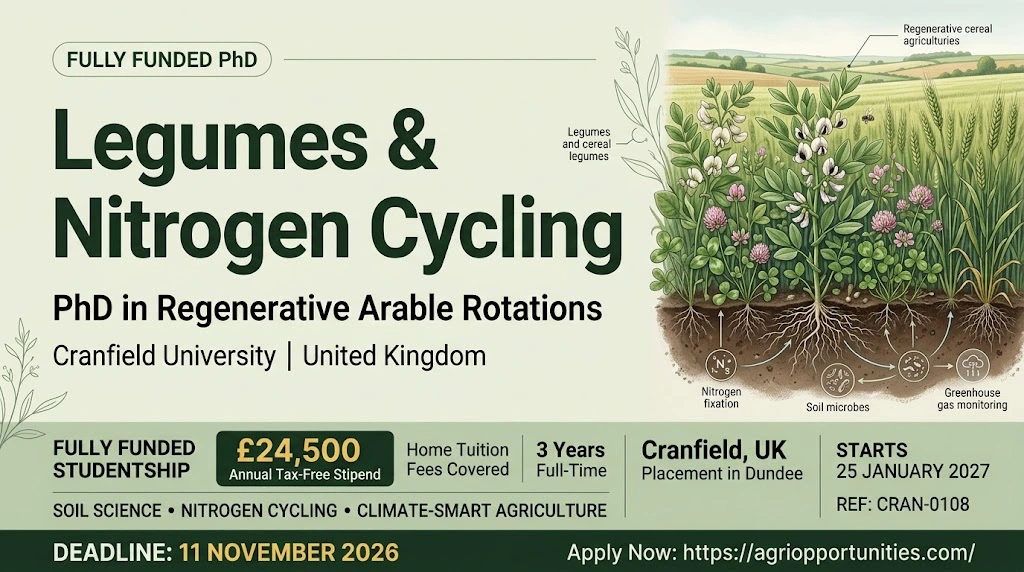
Cranfield University is recruiting a PhD student for a fully funded project on how legumes shape nitrogen cycling, crop performance, and greenhouse gas emissions in regenerative arable rotations. The studentship is supported by the EPSRC Doctoral Landscape Award and covers Home fees plus a £24,500 annual tax free stipend for three years.
The context is urgent. UK agriculture produces around 70 percent of national nitrous oxide emissions, a greenhouse gas with 273 times the global warming potential of carbon dioxide over 100 years. Much of that comes from inefficient nitrogen fertiliser use. Legumes can reduce this reliance by fixing atmospheric nitrogen, removing synthetic fertiliser requirements for themselves and potentially reducing requirements for following crops. Yet we cannot reliably predict when, where, or how much legume derived nitrogen becomes available.
This PhD addresses that gap. The student will quantify effects on subsequent cereal yield, nitrogen use efficiency, greenhouse gas emissions, and fertiliser replacement potential under contrasting arable management systems. Field, laboratory, and controlled environment experiments will determine when and where legume derived nitrogen becomes available within bulk soil and the rhizosphere.
The project is based in the Cranfield Environment Centre, with close collaboration with the James Hutton Institute in Dundee. Applications close on 11 November 2026, and the start date is 25 January 2027. The reference number is CRAN-0108.
Key Details
| Position | Fully Funded PhD, Legumes and Nitrogen Cycling in Regenerative Arable Rotations |
| Organization | Cranfield University, Cranfield Environment Centre |
| Location | Cranfield, United Kingdom, with placement in Dundee |
| Program | PhD, three years full time |
| Qualification | MSc in soil science, environmental science, agronomy, plant science, ecology, or related discipline |
| Funding | EPSRC Doctoral Landscape Award, Home fees covered, £24,500 annual tax free stipend |
| Start Date | 25 January 2027 |
| Deadline | 11 November 2026 |
| Reference Number | CRAN-0108 |
| First Supervisor | Prof Wilfred Otten |
| Second Supervisor | Dr Emily Guest |
| Contact | Emily.Guest@cranfield.ac.uk |
About the Project and Institutions
Cranfield University is a specialist postgraduate institution known for its research in agriculture, environment, engineering, and management. The Cranfield Environment Centre conducts research across soil and air quality, climate change, crop monitoring, resilience, and ecosystem services. The centre has strong links to industry and policy, and its work feeds directly into practical recommendations for farmers and land managers.
The project also involves close collaboration with the James Hutton Institute, an internationally recognised centre for sustainable cropping research based in Dundee. Hutton scientists will provide co supervision, expertise in legume agronomy and biological nitrogen fixation, and specialist training during a placement in Dundee. That placement links mechanistic science with field evidence and practical nitrogen management recommendations.
The student will work with established field trials and industry relevant datasets from Nitrogen Climate Smart, LegumES, and the James Hutton Institute’s Centre for Sustainable Cropping. These are real projects with real data, not simulated scenarios. The research will test whether deeper nitrogen accounting can deliver worthwhile financial and environmental gains over current practice.
Opportunities include UK fieldwork, engagement with farmers, agronomists, and industry through project events, Groundswell, and the Pulse Crop Genetic Improvement Network. The student will also present findings at national and international conferences, including the UK Legume Research Community and International Legume Society conferences.
Key Responsibilities
Field Research
- Work with established field trials and industry relevant datasets
- Quantify effects of legumes on subsequent cereal yield, nitrogen use efficiency, greenhouse gas emissions, and fertiliser replacement potential
- Compare contrasting arable management systems
- Conduct UK fieldwork and engage with farmers, agronomists, and industry
Laboratory and Controlled Environment Research
- Determine when and where legume derived nitrogen becomes available within bulk soil and the rhizosphere
- Compare conventional soil mineral nitrogen testing with detailed measurements of mineralisation, biological nitrogen fixation, crop nitrogen uptake, and microbial processes
- Conduct soil, plant, and microbial science experiments
Data Analysis and Synthesis
- Apply quantitative analysis methods, including R
- Integrate field, laboratory, and controlled environment data
- Assess financial and environmental gains of deeper nitrogen accounting over current practice
- Contribute findings for incorporation into farm carbon accounting tools
Training and Dissemination
- Complete the Doctoral Researchers Core Development programme
- Participate in a placement at the James Hutton Institute in Dundee
- Present findings at national and international conferences
- Contribute to scientific writing, grant development, and stakeholder engagement
- Build a professional network across Cranfield, Hutton, Nitrogen Climate Smart, and LegumES
Candidate Profile
Required:
- First or second class UK honours degree or equivalent in soil science, environmental science, agronomy, plant science, ecology, or a related discipline
- Strong interest in sustainable cropping systems and environmental research
- Willingness to undertake fieldwork, laboratory analysis, and quantitative data analysis
- Ability to work independently and as part of a team
- Strong written and spoken English
Preferred:
- Experience of fieldwork or laboratory analysis
- Experience with quantitative data analysis, such as R
- Interest in soil plant microbial science
- Familiarity with nitrogen cycling, legumes, or arable rotations
- Willingness to travel within the UK and to Dundee for placement
Note: Full training will be provided. The university warmly welcomes applications from diverse educational, cultural, and socioeconomic groups, including those currently underrepresented in soil sciences or agriculture, and those returning to research with a new direction.
What They Offer
| Benefit | Details |
|---|---|
| Position | Fully Funded PhD |
| Organization | Cranfield University, Cranfield Environment Centre |
| Location | Cranfield, United Kingdom, with placement in Dundee |
| Duration | Three years full time |
| Stipend | £24,500 per year, tax free |
| Fees | Home fees covered (£5,238 per annum) |
| Start Date | 25 January 2027 |
| Collaboration | James Hutton Institute, Nitrogen Climate Smart, LegumES |
| Training | Doctoral Researchers Core Development programme |
| Eligibility | UK and Rest of World, with limited Overseas fee status places |
| Reference Number | CRAN-0108 |
Application Tips
- Apply before 11 November 2026. This vacancy may be filled before the closing date, so early application is strongly encouraged.
- Check your fee status. The studentship covers Home fees. A limited number of studentships are available for Overseas fee status applicants. Eligibility for Home fee status is determined by UK Department for Education rules.
- Complete the online application form. Applications will not be considered unless all relevant documents have been uploaded.
- Contact Dr Emily Guest for further information. Emily.Guest@cranfield.ac.uk is the listed contact for project enquiries.
- Highlight any fieldwork or laboratory experience. Experience in these areas is beneficial, though full training is provided.
- Mention quantitative skills. Experience with R or similar tools is beneficial. The project involves detailed data analysis.
- Show interest in the policy context. UK Net Zero goals, farm carbon accounting, and fertiliser recommendations are all part of the project’s impact pathway.
- Prepare for a placement in Dundee. The James Hutton Institute placement is a core part of the PhD. Mention your willingness to travel and engage.
Editor’s Analysis, What Makes This Opportunity Stand Out
Nitrogen is one of the biggest environmental problems in agriculture, and legumes are one of the most promising solutions. This PhD sits right at that intersection, and that is what makes it worth attention.
The Policy Relevance
UK agriculture produces around 70 percent of national nitrous oxide emissions. That is a striking number. Nitrous oxide has 273 times the global warming potential of carbon dioxide over 100 years. Reducing agricultural nitrogen emissions is not optional if the UK is serious about Net Zero. This project directly addresses the evidence gap that prevents farmers from adjusting fertiliser applications after legumes. The work has a clear line to policy and practice.
The Two Institution Model
Cranfield Environment Centre for the main research base. James Hutton Institute for legume agronomy, biological nitrogen fixation expertise, and long term cropping system research. That combination is deliberate. Cranfield brings the environmental and soil science framing. Hutton brings the legume and cropping systems depth. The student gets both, plus a placement in Dundee that adds hands on experience with long term trials.
The Dataset Access
The student will work with established field trials and industry relevant datasets from Nitrogen Climate Smart, LegumES, and the Centre for Sustainable Cropping. That means the project is not starting from scratch. It is building on existing infrastructure and data, which accelerates the research and increases the likelihood of publishable results.
The Financial Package
£24,500 per year tax free for three years, plus Home fees covered. That stipend is competitive by UK PhD standards. The tax free status makes it more valuable than the headline number suggests. For an early career researcher, that is a meaningful package.
The Training Breadth
Field experimentation, laboratory and controlled environment research, soil plant microbial science, greenhouse gas assessment, and quantitative analysis. That is a broad technical skill set. Add project management, scientific writing, grant development, and stakeholder engagement, and you have a training programme that prepares the student for multiple career paths.
The Trade Offs
The start date is 25 January 2027, which is soon after the application deadline. International applicants with Overseas fee status face a limited number of places. The placement in Dundee means time away from Cranfield. The project involves fieldwork, laboratory work, and data analysis, so it is not a desk based PhD.
The Bottom Line
For a life science graduate with an interest in soil science, sustainable cropping, or environmental research, this is a strong, well funded PhD with real policy relevance and credible institutional backing. The legume nitrogen question is fundamental to lower input farming, and the project has the data, partners, and training to make a real contribution. The deadline is 11 November 2026. Apply early.
Apply Now
Reference Number: CRAN-0108
Contact for Further Information: Dr Emily Guest, Emily.Guest@cranfield.ac.uk
- Location: Cranfield, United Kingdom, with placement at James Hutton Institute, Dundee
- Start Date: 25 January 2027
- Deadline: 11 November 2026
- Funding: EPSRC Doctoral Landscape Award, Home fees covered, £24,500 annual tax-free stipend
Frequently Asked Questions
- What is the position? A fully funded PhD on legumes and nitrogen cycling in regenerative arable rotations at Cranfield University.
- Where is the job located? Cranfield, United Kingdom, with a placement at the James Hutton Institute in Dundee.
- What is the qualification requirement? A first or second class UK honours degree or equivalent in soil science, environmental science, agronomy, plant science, ecology, or a related discipline.
- What is the funding? The EPSRC Doctoral Landscape Award covers Home fees and provides a £24,500 annual tax free stipend for three years.
- When does the PhD start? 25 January 2027.
- What is the application deadline? 11 November 2026.
- What is the reference number? CRAN-0108.
- Who are the supervisors? Prof Wilfred Otten as first supervisor and Dr Emily Guest as second supervisor.
- Can international applicants apply? Yes, the studentship is open to both Home and Overseas fee status students. However, only a limited number of studentships are available for Overseas fee status applicants.
- What research will I do? Quantify how legumes shape nitrogen cycling, crop performance, and greenhouse gas emissions in regenerative arable rotations, using field, laboratory, and controlled environment experiments.
- What training is provided? Integrated training in field experimentation, laboratory and controlled environment research, soil plant microbial science, greenhouse gas assessment, and quantitative analysis, plus project management, scientific writing, and stakeholder engagement.
- How do I apply? Complete the online application form on the Cranfield University website. Applications will not be considered unless all relevant documents have been uploaded.
- Who can I contact for more information? Dr Emily Guest at Emily.Guest@cranfield.ac.uk
Related Opportunities
- Fully Funded PhD, Root Symbiotic Fungi Genomics, Earlham Institute UK
- Postdoctoral Research Fellow, Agricultural Systems Assessment, University of Queensland Australia
- PhD Offer, Soil Biogeochemical Responses to Agrivoltaic Grazing, INRAE and Sorbonne
Add Agri Opportunities as a preferred source on Google to see latest agriculture Scholarship listings first.





I am interested in the PhD position in Resilient Forage Production Systems at SLU. I hold an MSc in Forage Crops Management from Salahaddin University-Erbil, Iraq. Could you please confirm whether the position is still open and whether international applicants from Iraq are eligible to apply? Thank you for your time and assistance.