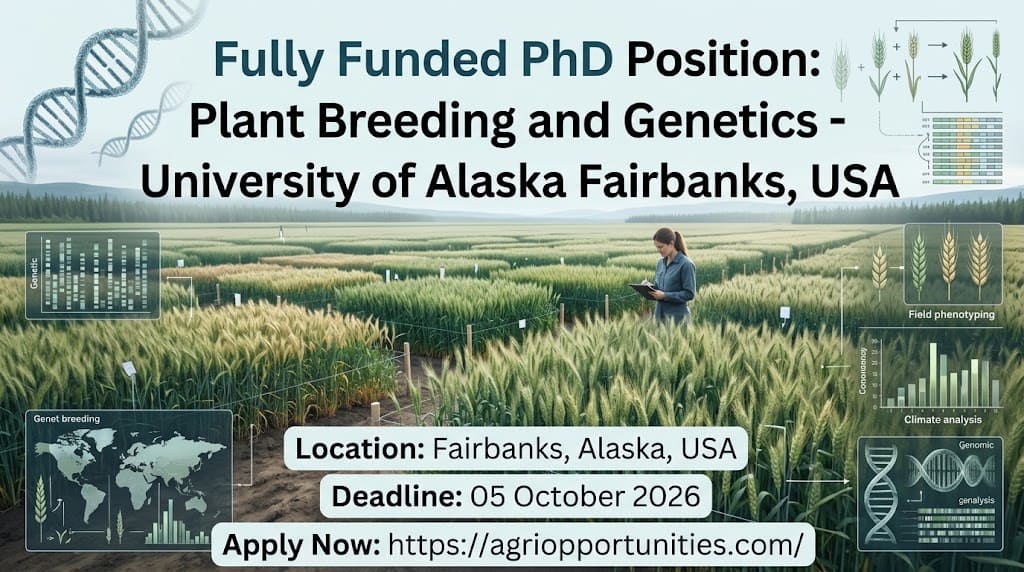
Fully Funded PhD Position: Plant Breeding and Genetics – University of Alaska Fairbanks, USA

Quick Overview
The University of Alaska Fairbanks (UAF) is offering a fully funded PhD position in Plant Breeding and Genetics, beginning in Spring 2027. This opportunity is hosted by the Institute of Agriculture, Natural Resources and Extension (IANRE) within the Department of Natural Resources and Environment. The Small Grain Breeding and Research Program is seeking a highly motivated PhD student to conduct research in wheat breeding, genetics, and adaptation to subarctic environments — a research area of growing importance as climate change reshapes agricultural production zones worldwide.
The research will focus on understanding the genetic basis of wheat adaptation, stress tolerance, and grain yield under Alaska’s unique growing conditions. The successful candidate will work with diverse wheat germplasm and breeding populations, combining multi-location field phenotyping, germplasm characterization, controlled hybridization, quantitative and molecular genetic approaches, genome-wide association studies (GWAS), and statistical analysis of genotype, environment, and genotype × environment interactions. This project provides exceptional hands-on training in applied plant breeding, field experimentation, quantitative genetics, genomics, and data analysis — preparing the candidate for a career in crop improvement, research, or academia.
Key Details
| Position | PhD Position in Plant Breeding and Genetics |
| Organization | University of Alaska Fairbanks (UAF) |
| Location | Fairbanks, Alaska, USA |
| Department | Institute of Agriculture, Natural Resources and Extension (IANRE), Department of Natural Resources and Environment |
| Program | PhD |
| Qualification | BSc/Msc in Plant Science, Plant Breeding, Agronomy, Plant Biology, Genetics, or closely related field |
| Funding | Fully funded |
| Start Date | Spring 2027 |
| Deadline | 05 October 2026 |
| Apply Via | UA Career portal (subject line: Spring 2027 PhD Application) |
About the Program and University
The University of Alaska Fairbanks is a land-, sea-, and space-grant institution and one of the leading research universities in the Arctic region. The Institute of Agriculture, Natural Resources and Extension (IANRE) advances agricultural research, natural resource management, and extension services that support Alaska’s communities and industries. The Department of Natural Resources and Environment (DNRE) offers graduate programs that focus on sustainable resource management, environmental science, and agricultural systems.
The Small Grain Breeding and Research Program at UAF provides a unique setting for studying wheat adaptation in subarctic environments. Alaska’s distinctive growing conditions, including long summer days, short growing seasons, and cool temperatures, create a natural laboratory for studying stress tolerance and adaptation in cereal crops. As climate change expands agricultural opportunities into northern regions, understanding the genetic basis of wheat adaptation to these environments has become increasingly important for global food security.
The research program integrates field-based phenotyping with modern genomic tools, offering the successful candidate exposure to both traditional breeding methods and cutting-edge molecular approaches. Collaborations within UAF and with external partners provide access to diverse germplasm, advanced statistical and genomic resources, and a network of researchers dedicated to crop improvement. The university is committed to equal opportunity, nondiscrimination, and creating an inclusive environment for all students.
Key Responsibilities
Field Research and Phenotyping
- Conduct multi-location field phenotyping of wheat germplasm and breeding populations.
- Manage field experiments, including planting, data collection, and harvest.
- Evaluate germplasm for adaptation, stress tolerance, and grain yield under Alaska’s growing conditions.
Breeding and Population Development
- Perform controlled hybridization and population development.
- Characterize and evaluate diverse wheat germplasm.
- Maintain breeding populations and experimental lines.
Genetics and Genomics
- Apply quantitative and molecular genetic approaches to study wheat adaptation.
- Conduct genome-wide association studies (GWAS) and related genomic analyses.
- Analyse genotype, environment, and genotype × environment interactions.
Data Analysis and Communication
- Perform statistical analysis of experimental data using tools such as R and/or Python.
- Prepare manuscripts for peer-reviewed publication.
- Present research findings at scientific meetings and to stakeholders.
- Complete coursework and doctoral requirements.
Candidate Profile
Required:
- M.S. degree in Plant Science, Plant Breeding, Agronomy, Plant Biology, Genetics, or a closely related field.
- Strong foundation in plant genetics and experimental design.
- Experience with field, greenhouse, laboratory, or molecular research.
- Strong written and oral communication skills in English.
- Ability to meet the admission requirements of the University of Alaska Fairbanks Graduate School.
Preferred:
- Previous experience in plant breeding or crop improvement.
- Experience with molecular markers, genomic data, GWAS, or quantitative genetics.
- Experience with statistical analysis using R and/or Python.
- Experience with field phenotyping, breeding populations, or multi-environment trials.
What They Offer
| Benefit | Details |
|---|---|
| Position | PhD in Plant Breeding and Genetics |
| Organization | University of Alaska Fairbanks |
| Department | Institute of Agriculture, Natural Resources and Extension |
| Location | Fairbanks, Alaska, USA |
| Funding | Fully funded |
| Start Date | Spring 2027 |
| Research Focus | Wheat breeding, genetics, adaptation to subarctic environments |
| Training | Applied plant breeding, field experimentation, quantitative genetics, genomics, data analysis |
| Collaboration | Diverse germplasm, advanced statistical and genomic resources, research network |
Application Tips
- Apply through the UA Career portal – Use the subject line “Spring 2027 PhD Application” to ensure your application is properly directed.
- Prepare a detailed CV – Include your academic history, research experience, and relevant skills.
- Write a strong cover letter – Describe your research experience, future interests, and career goals, and explain how they align with the Small Grain Breeding and Research Program.
- Submit unofficial transcripts – Unofficial academic transcripts are acceptable for initial review.
- Include optional writing samples – You may submit up to three publications, thesis chapters, posters, or other writing samples.
- Submit official transcripts separately – Ask each collegiate institution you attended to send your official transcripts directly to the Office of Admissions and the Registrar. International applicants must also provide certified English translations.
- Arrange three letters of recommendation – At least three letters are required. Your UAF admissions application will request names and email addresses of recommenders.
- Submit a statement of goals – Indicate why you want to study Natural Resources and Environment, mention any faculty you have corresponded with, and include your qualifications and educational experience.
- Check English proficiency requirements – International students may need to provide TOEFL or IELTS scores as proof of English proficiency.
- Apply early – The selection team reviews applications as they arrive and contacts shortlisted applicants for a virtual interview.
Why This PhD Matters (My Analysis)
Wheat is one of the world’s most important staple crops, providing a significant portion of calories and protein for billions of people. As climate change alters growing conditions globally, the need for wheat varieties that can adapt to new environments — including northern latitudes and subarctic regions — has become increasingly urgent. Alaska’s unique growing conditions, characterized by long photoperiods, short seasons, and cool temperatures, offer a valuable opportunity to study the genetic basis of wheat adaptation and stress tolerance. This PhD position at the University of Alaska Fairbanks places the successful candidate at the forefront of this important research.
The Small Grain Breeding and Research Program takes an integrated approach that combines field phenotyping, germplasm characterization, controlled hybridization, quantitative genetics, and genomic analysis. This approach helps PhD students build a comprehensive skill set that public and private-sector crop improvement programs value.
The program provides hands-on training in applied plant breeding and field experimentation, preparing students to tackle real-world breeding challenges. Its focus on genome-wide association studies and statistical analysis of genotype × environment interactions also demonstrates the advanced nature of the research. For the successful candidate, this fully funded PhD offers exceptional benefits: the opportunity to work in a unique subarctic environment, access to diverse wheat germplasm and advanced genomic tools, and training under experienced faculty in a supportive research environment. The University of Alaska Fairbanks is committed to equal opportunity and nondiscrimination, ensuring an inclusive environment for all students. As climate change continues to reshape agricultural landscapes, graduates with expertise in plant breeding, genetics, and adaptation will be in high demand. This PhD represents an outstanding opportunity for a motivated candidate to build a research career while contributing to global food security and climate-resilient agriculture.
Apply Now
Application: Through the UA Career portal:
Application Materials:
- Detailed CV
- Cover letter (research experience, future interests, career goals)
- Unofficial academic transcripts
- Up to three publications, thesis chapters, posters, or writing samples (optional)
Official Transcripts: Send to University of Alaska Fairbanks, Office of Admissions, P.O. Box 757480, Fairbanks, AK 99775-7480
Unofficial Transcripts: May be sent as email attachments to uaf-snre@alaska.edu
Letters of Recommendation: At least three required; requested through the UAF admissions application
Statement of Goals: Submit through the UAF Admissions Application portal
Start Date: Spring 2027
Review Process: Applications reviewed as received; selected applicants contacted for virtual interview
Equal Opportunity: The University of Alaska is an equal opportunity/equal access employer and educational institution.
Frequently Asked Questions
- What is the position? A fully funded PhD position in Plant Breeding and Genetics at the University of Alaska Fairbanks.
- Where is the position located? Fairbanks, Alaska, USA.
- What is the qualification requirement? An M.S. degree in Plant Science, Plant Breeding, Agronomy, Plant Biology, Genetics, or a closely related field.
- What is the research focus? Wheat breeding, genetics, and adaptation to subarctic environments, including stress tolerance and grain yield.
- When does the position start? Spring 2027.
- Is the position fully funded? Yes, the position is fully funded.
- What is the application deadline? 05 October 2026
- How do I apply? Through the UA Career portal with the subject line “Spring 2027 PhD Application.”
- What documents do I need? A detailed CV, cover letter, unofficial academic transcripts, and optional writing samples (up to three).
- Are GRE scores required? No. The program does not require GRE scores, but it will consider them if you submit them.
- What are the English proficiency requirements? International students may need to provide official TOEFL or IELTS scores as proof of English proficiency.
- Do I need to submit official transcripts? Yes. Ask each collegiate institution you attended to send your official transcripts. International applicants must also provide certified English translations.
- How many letters of recommendation are required? You must submit at least three letters of recommendation.
- What is the statement of goals? Write a statement explaining why you want to study Natural Resources and Environment and highlighting your qualifications and educational experience.
Related Opportunities
- PhD Student in Resilient Forage Production Systems | SLU Sweden
- PhD Position: Symbiotic Nitrogen Fixation in Legumes | University of Seville
- PhD Assistantship in Environmental Soil Physics | Penn State University
Add Agri Opportunities as a preferred source on Google to see latest agricultural academic job listings first.
Hello sir,
I’m highly recommend for this position but late after deadline. Please review my documents and CV for this position.