Postdoctoral Research Position: Digital Plant Phenotyping – University of Bern, Switzerland

Quick Overview
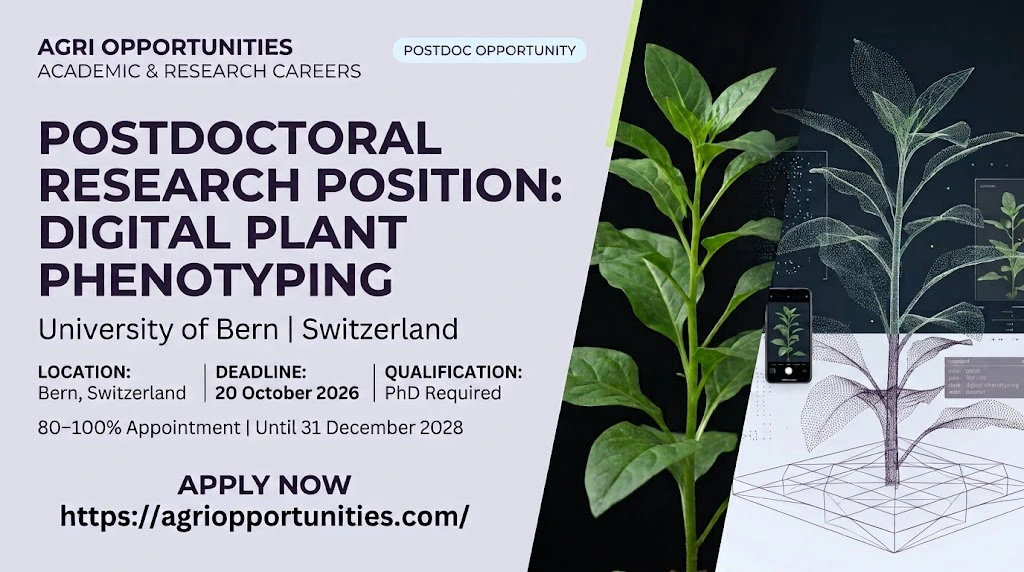
The University of Bern is hiring a postdoc in digital plant phenotyping at the Institute of Plant Sciences, Research Section Biotic Interactions. This is an 80 to 100 percent appointment running until 31 December 2028. The work sits at the intersection of plant science and computer vision, and that combination is what makes it unusual.
You will split your time equally between growing plants and running computational analysis. Half the week in the growth facility, half at the computer. The project, called Plant 3D Reconstruction, develops methods to measure plant growth and traits from 3D models generated from smartphone videos. It links digital phenotyping with chemical ecology.
The role is supervised by Prof. Matthias Erb, with collaboration from Prof. Paolo Favaro in the Computer Vision Group. You will work on volatile dynamics as well, studying links between plant architecture and chemical signalling.
Key Details
| Position | Postdoc in Digital Plant Phenotyping |
| Organization | University of Bern, Institute of Plant Sciences |
| Location | Bern, Switzerland |
| Research Section | Biotic Interactions |
| Appointment | 80 to 100 percent, until 31 December 2028 |
| Qualification | PhD in plant sciences, biology, or a related field, completed by start date |
| Salary | According to University of Bern regulations |
| Start Date | By agreement |
| Deadline | 20 October 2026 |
| Apply Via | Online application portal |
| Contact | matthias.erb@unibe.ch |
About the Project and Research Groups
The University of Bern is one of Switzerland’s leading research universities, and the Institute of Plant Sciences has a strong reputation in plant biology, ecology, and biotic interactions. The Biotic Interactions Group, led by Prof. Matthias Erb, studies how plants interact with other organisms, including pests, pathogens, and beneficial microbes. The group is known for work on plant chemical ecology, particularly volatile organic compounds and their role in plant defence and signalling.
The Plant 3D Reconstruction project is a collaboration between the Biotic Interactions Group and the Computer Vision Group led by Prof. Paolo Favaro. The goal is practical. Develop methods to measure plant growth and traits from 3D models generated from smartphone videos. If it works, it lowers the barrier to digital phenotyping. Researchers and breeders could capture useful trait data using equipment everyone already has, rather than expensive specialised scanners.
The project also connects to chemical ecology. The postdoc will integrate phenotyping work with research on volatile dynamics, studying how plant architecture relates to chemical signalling. This link between physical form and chemical output is not well understood, and the project offers a chance to work on it with both experimental and computational tools.
The postdoc will receive support from computer vision and data science specialists. That matters. The role expects interest in computational biology, not existing expertise at an advanced level. The group is structured so that a plant scientist can learn the computational side with guidance.
Key Responsibilities
Plant Experiments
- Grow plants in controlled conditions
- Collect images and measure plant traits
- Run controlled experiments on plant growth and architecture
- Support research on volatile dynamics and chemical signalling
Computational Analysis
- Develop and test models that estimate traits from 3D plant models
- Work with 3D reconstruction methods using smartphone video data
- Integrate phenotyping data with volatile and chemical ecology datasets
- Use statistical analysis and data management tools
Collaboration and Dissemination
- Work with the Computer Vision Group on model development
- Collaborate with data science specialists
- Analyse results and contribute to scientific publications
- Present findings internally and at conferences
- Help lead publications where appropriate
Project Contribution
- Contribute to the Plant 3D Reconstruction project
- Help refine methods for measuring plant traits from 3D models
- Support the integration of digital phenotyping with chemical ecology research
Candidate Profile
Required:
- PhD in plant sciences, biology, or a related field, completed by the start date
- Research background in plant science
- Experience growing plants, running controlled experiments, and measuring plant traits
- Skills in experimental design, data management, and statistical analysis
- Interest in computational biology and willingness to learn methods for estimating plant traits from 3D models
- Evidence of original scientific work
- Clear writing and communication in English
- Ability to organise work, work independently, and collaborate across fields
Preferred:
- Some exposure to programming or computational methods
- Experience with image analysis or 3D modelling
- Background in chemical ecology or volatile analysis
- Publication record in plant science or related fields
- Experience working in interdisciplinary teams
What They Offer
| Benefit | Details |
|---|---|
| Position | Postdoc in Digital Plant Phenotyping |
| Organization | University of Bern, Institute of Plant Sciences |
| Location | Bern, Switzerland |
| Appointment | 80 to 100 percent |
| Duration | Until 31 December 2028 |
| Salary | According to University of Bern regulations |
| Research Split | Equal between plant experiments and computational work |
| Facilities | Access to plant growth facilities |
| Support | Computer vision and data analysis specialists |
| Mentoring | Scientific mentoring and publication opportunities |
Application Tips
- Submit one PDF, maximum 10 MB. Include CV, short motivation letter, your three main achievements, and contact details for two academic references.
- Describe your plant science experience clearly. The letter should cover what you have grown, measured, and analysed.
- Explain your interest in computational biology. You do not need to be an expert, but show genuine willingness to learn.
- Connect your background to the project. Reference the Plant 3D Reconstruction project and the link between phenotyping and chemical ecology.
- Highlight your three main achievements. Choose ones that show research independence, technical skill, and publication output.
- Confirm your PhD completion date. The PhD must be completed by the start date. State this clearly.
- Show interdisciplinary capability. The role involves collaboration with computer vision specialists. Mention any cross disciplinary experience.
- Apply early. The position is open until 20, Oct 2026.
Editor’s Analysis, What Makes This Opportunity Stand Out
Digital phenotyping is one of the fastest moving areas in plant science. Most postdoc roles in the field focus on either the biology or the computational side. This one deliberately combines both, and that split is the core of its appeal.
The Fifty Fifty Structure
The appointment splits time equally between plant experiments and computational work. That is unusual. Many roles claim to be interdisciplinary but end up weighted heavily toward one side. This one is structured to keep both active. For a plant scientist who wants to build computational skills without abandoning bench work, that balance is a real advantage.
The Smartphone Angle
The Plant 3D Reconstruction project uses smartphone videos to generate 3D plant models. That is a deliberately accessible approach. High end phenotyping platforms cost hundreds of thousands of dollars and are limited to well funded institutions. Smartphone based methods could democratise trait measurement for smaller research groups, breeders, and institutions in lower income countries. Working on that problem has practical significance beyond the lab.
The Chemical Ecology Link
The integration with volatile dynamics research is what makes this project distinctive. Plant architecture and chemical signalling are usually studied separately. Linking them requires both phenotyping and analytical chemistry. The postdoc will work at that intersection, which is a relatively open research space.
The Supervision
Prof. Matthias Erb is a well established researcher in plant biotic interactions, and the collaboration with Prof. Paolo Favaro brings genuine computer vision expertise. The postdoc will have support from specialists in both domains. That reduces the risk of being isolated on the computational side.
The Duration and Location
The appointment runs until 31 December 2028, which gives roughly two to three years depending on start date. Bern is a well connected Swiss city with a strong research environment and a high quality of life. The University of Bern salary scale is competitive by European standards.
The Trade Offs
The role expects a plant science background, not a computational one. If you are a computational scientist, this is probably not the right fit. The reverse is also true. A plant scientist without any interest in coding will struggle. The position also ends on a fixed date, so there is no extension beyond December 2028.
The Bottom Line
For a plant scientist who wants to build computational skills while staying close to experimental work, this is a strong postdoc. The project has practical relevance, the supervision is credible, and the structure supports genuine interdisciplinary development.
Apply Now
Application Format: One PDF, maximum 10 MB, containing CV, motivation letter, three main achievements, and two academic references
- Position: Postdoc in Digital Plant Phenotyping
- Location: Bern, Switzerland
- Appointment: 80 to 100 percent, until 31 December 2028
- Contact: matthias.erb@unibe.ch
Frequently Asked Questions
- What is the position? A postdoc in digital plant phenotyping at the University of Bern.
- Where is the job located? Bern, Switzerland.
- What is the qualification requirement? A PhD in plant sciences, biology, or a related field, completed by the start date.
- What is the appointment level? 80 to 100 percent.
- How long is the appointment? Until 31 December 2028.
- What is the research focus? Digital plant phenotyping using 3D models from smartphone videos, linked with chemical ecology and volatile dynamics.
- What is the split between lab and computational work? Approximately equal, with support from computer vision and data science specialists.
- Do I need programming experience? Not at an advanced level. Interest and willingness to learn are required.
- How do I apply? Submit one PDF, maximum 10 MB, containing CV, motivation letter, three main achievements, and two academic references.
- Who can I contact for questions? matthias.erb@unibe.ch
- What is the salary? According to University of Bern regulations.
Related Opportunities
- Postdoctoral Opportunity, Soil Microbial Ecology, University of Bologna
- PhD Student in Silviculture of Planted Birch, SLU Alnarp Sweden
- PhD Offer, Soil Biogeochemical Responses to Agrivoltaic Grazing, INRAE and Sorbonne
Add Agri Opportunities as a preferred source on Google to see latest agricultural academic job listings first.