Fully Funded PhD & MS Positions: Soil Biogeochemical Responses to Agrivoltaic Grazing – INRAE & Sorbonne University, France

Quick Overview
INRAE (French National Research Institute for Agriculture, Food and Environment) and Sorbonne University are jointly offering a fully funded PhD position investigating soil biogeochemical responses to agrivoltaic grazing, focusing on the effects of photovoltaic shading, microclimate, and grazing on carbon, nitrogen, and phosphorus cycling. This interdisciplinary project is part of the SAGE project, a European initiative that aims to assess multifunctional land-use systems by integrating photovoltaic (PV) production, grazing, biodiversity, animal welfare, ecosystem functioning, economics, and social acceptance across different European environments.
The successful candidate will join a cutting-edge research effort at the intersection of renewable energy, sustainable agriculture, and soil science. Agrivoltaics — the combination of renewable energy production with agricultural land use — represents a promising approach to addressing the twin challenges of climate change mitigation and food security. In grassland systems, photovoltaic modules provide shade and modify microclimatic conditions while allowing ruminant grazing to continue underneath and between the panels. Understanding how these changes affect soil organic matter dynamics and nutrient cycling is critical for assessing the long-term sustainability of agrivoltaic systems. This PhD offers a unique opportunity to contribute to this emerging field while working within an international network of leading researchers.
Key Details
| Position | PhD in Soil Biogeochemical Responses to Agrivoltaic Grazing |
| Organization | INRAE & Sorbonne University (CNRS/iEES-Paris) |
| Location | Lusignan, western France & Paris, France |
| Program | PhD (French employment conditions for PhD students) |
| Qualification | MSc soil science, biogeochemistry, environmental sciences, ecology, agronomy, or related discipline |
| Research Focus | Soil organic matter dynamics, C, N, P cycling, photovoltaic shading, microclimate, grazing |
| Supervisors | Abad Chabbi (INRAE) & Cornelia Rumpel (CNRS/iEES-Paris, Sorbonne University) |
| Project | SAGE Project (European Living Labs) |
| Start Date | Not specified (reviewing applications until filled) |
| Deadline | 15 October 2026 |
| Apply Via | CV and motivation letter to abad.chabbi@inrae.fr and cornelia.rumpel@inrae.fr |
About the Project and Research
The SAGE project is a European initiative that aims to assess multifunctional land-use systems by integrating PV production, grazing, biodiversity, animal welfare, ecosystem functioning, economics, and social acceptance across different European environments. One of the project’s key components focuses on understanding how PV systems affect soil, vegetation, microclimate, and biogeochemical processes. Agrivoltaics offers a promising approach for combining renewable energy production with agricultural land use, and this PhD project will place soil biogeochemistry at the centre of the SAGE agroecosystem approach.
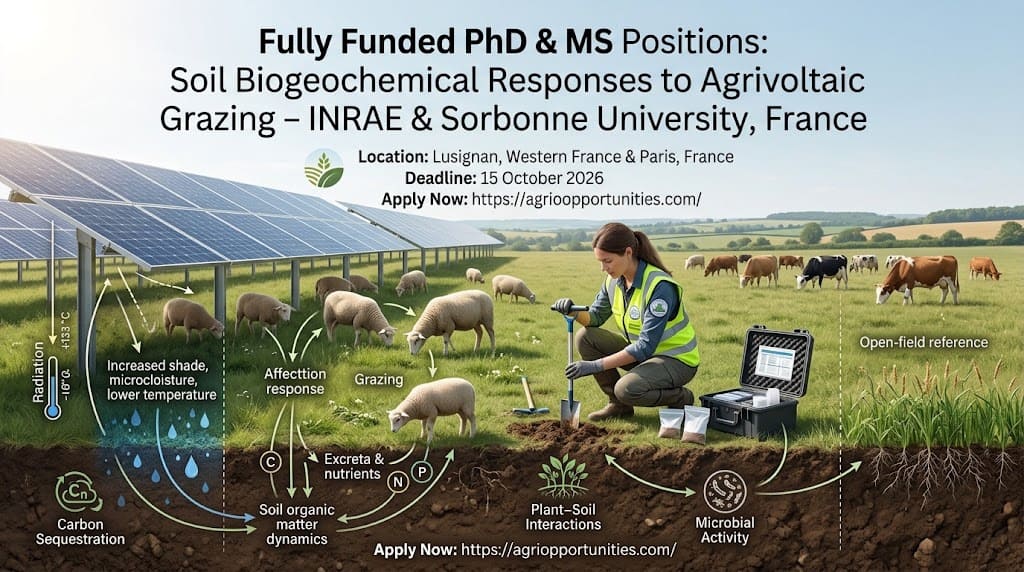
Photovoltaic modules modify the distribution of radiation and potentially temperature, soil moisture, and evapotranspiration. These changes can alter plant growth, species composition, litter production, and forage quality, and consequently modify the quantity and quality of organic matter entering the soil. At the same time, grazing changes the distribution and timing of organic matter and nutrients through biomass removal, trampling, and the return of animal excreta. Recent work by the research team (Gilmulina et al., 2020, 2024) has shown that the resulting changes in plant–soil interactions may have important consequences for soil organic matter dynamics and nutrient cycling.
The SAGE project specifically proposes to compare PV-induced shading with natural open-field conditions and to investigate how plant responses to contrasting shading levels and animal exposure influence the biogeochemical cycles of carbon (C), nitrogen (N), and phosphorus (P), with particular attention to stoichiometric relationships between these elements. However, the mechanisms linking PV-induced microclimatic changes, vegetation responses, grazing, and soil functioning remain poorly understood. This PhD will address this knowledge gap by placing the processes affecting soil biogeochemistry at the centre of the SAGE agroecosystem approach.
Key Objectives
Primary Objective
- Determine how photovoltaic-induced shading and associated changes in microclimate and grazing modify soil organic matter dynamics and C, N, and P cycling in grassland agrivoltaic systems.
Specific Objectives
- Determine how PV-induced changes in soil temperature and moisture affect soil biogeochemical processes.
- Determine how changes in vegetation and grazing modify the quantity and quality of organic matter returned to the soil.
- Determine how these changes affect C, N, and P cycling and their stoichiometric relationships.
- Assess whether agrivoltaic grazing affects soil organic carbon storage and stabilization.
Special Focus
- Investigate the interaction between PV-induced vegetation changes and grazing.
- Examine spatial gradients in soil properties and processes within PV installations, from areas directly affected by the panels to inter-row and open-field conditions.
Research Approach
Field Observations and Experiments
- Conduct soil and vegetation sampling along spatial gradients of PV-induced shading.
- Compare with open-field reference conditions at selected SAGE Living Labs.
- Measure soil organic carbon and nitrogen, nutrient availability, C:N:P stoichiometry, and indicators of microbial activity and nutrient cycling.
- Pay particular attention to soil organic matter quantity, quality, and macrofauna activity.
Laboratory Analyses
- Analyse soils and plants for biogeochemical parameters.
- Perform statistical data analysis to identify main pathways linking PV shading, microclimate, vegetation, and grazing to soil biogeochemical functioning.
- Determine whether these effects are consistent across contrasting European pedoclimatic conditions.
European Living Labs
- Take advantage of the European Living Labs established by SAGE, representing contrasting grassland environments and climatic conditions.
- Participate in standardized sampling across sites and comparison of different PV layouts and management strategies.
- Collaborate closely within the European network of SAGE partners.
Candidate Profile
Required:
- Master’s degree in soil science, biogeochemistry, environmental sciences, ecology, agronomy, or a related discipline.
- Strong interest in soil organic matter, plant–soil interactions, and biogeochemical cycling.
- Good quantitative skills.
- Ability to work both independently and within an interdisciplinary and international research team.
- Willingness to participate in field campaigns in different European countries.
- Good written and spoken English.
Preferred:
- Experience with field experimentation.
- Experience with soil and plant analyses.
- Experience with statistical data analysis.
- Background in soil science or biogeochemistry.
What They Offer
| Benefit | Details |
|---|---|
| Position | PhD in Soil Biogeochemical Responses to Agrivoltaic Grazing |
| Organization | INRAE & Sorbonne University (CNRS/iEES-Paris) |
| Location | Lusignan, western France & Paris, France |
| Employment | French employment conditions for PhD students |
| Project | SAGE Project (European Living Labs) |
| Supervisors | Abad Chabbi (INRAE) & Cornelia Rumpel (CNRS/iEES-Paris, Sorbonne University) |
| Collaboration | European network of SAGE partners |
| Research Stays | Field campaigns at selected European Living Labs |
| Interdisciplinary | Soil science, biogeochemistry, ecology, agronomy, renewable energy |
Application Tips
- Check your eligibility first – A Master’s degree in soil science, biogeochemistry, environmental sciences, ecology, agronomy, or a related discipline is required.
- Highlight your interest in soil science – The project seeks a highly motivated candidate interested in soil organic matter, plant–soil interactions, and biogeochemical cycling.
- Showcase quantitative skills – Good quantitative skills and experience with statistical data analysis are important.
- Mention field experience – Experience with field experimentation and soil/plant analyses is an advantage.
- Demonstrate teamwork and independence – The candidate should be able to work both independently and within an interdisciplinary and international research team.
- Express willingness to travel – The project involves field campaigns in different European countries.
- Prepare a strong CV and motivation letter – Send both documents to Abad Chabbi (abad.chabbi@inrae.fr) and Cornelia Rumpel (cornelia.rumpel@inrae.fr).
- Apply before 15 October 2026 – Applications will be reviewed until the position is filled.
Why This PhD Matters (My Analysis)
Agrivoltaics represents a promising solution to one of the most pressing challenges of our time: how to produce renewable energy and food simultaneously on the same land. As the global demand for clean energy and sustainable food production grows, agrivoltaic systems — which combine photovoltaic panels with agricultural activities — are gaining increasing attention. However, the environmental and biogeochemical implications of these systems remain poorly understood. This PhD project addresses a critical knowledge gap by investigating how photovoltaic-induced shading, microclimatic changes, and grazing affect soil organic matter dynamics and carbon, nitrogen, and phosphorus cycling in grassland systems.
The research is particularly timely because agrivoltaics is expanding rapidly across Europe and beyond, yet the long-term effects on soil health and ecosystem functioning are largely unknown. Soil organic matter is a key indicator of soil health and plays a crucial role in carbon sequestration, nutrient cycling, and water retention. Understanding how agrivoltaic systems affect soil organic matter dynamics is essential for assessing their sustainability and for developing management practices that maximize both energy production and soil health. The focus on C:N:P stoichiometry and spatial heterogeneity within PV installations adds further depth to the research, addressing questions that are both scientifically interesting and practically relevant.
The joint supervision by Abad Chabbi (INRAE) and Cornelia Rumpel (CNRS/iEES-Paris, Sorbonne University) ensures high-quality mentorship from leading researchers in soil biogeochemistry. The collaboration with the European SAGE project provides access to a network of Living Labs across contrasting European environments, offering invaluable field experience and international networking opportunities. The opportunity to conduct part of the research at Sorbonne University in Paris adds further prestige to the position. With a deadline of 15 October 2026 and applications reviewed until the position is filled, interested candidates are encouraged to apply promptly.
Apply Now
Email your application to:
📧 Abad Chabbi — abad.chabbi@inrae.fr
📧 Cornelia Rumpel — cornelia.rumpel@inrae.fr
Application Materials:
- CV
- Motivation letter
Deadline: 15 October 2026 (applications reviewed until the position is filled)
- Location: Lusignan, western France & Paris, France
- Organization: INRAE & Sorbonne University (CNRS/iEES-Paris)
- Project: SAGE Project
- Supervisors: Abad Chabbi (INRAE) & Cornelia Rumpel (CNRS/iEES-Paris, Sorbonne University)
Frequently Asked Questions
- What is the position? A PhD position investigating soil biogeochemical responses to agrivoltaic grazing.
- Where is the position located? The PhD will be based at INRAE in Lusignan, western France, with part of the work carried out at the Institute of Ecology and Environmental Science at Sorbonne University in Paris, France.
- What is the qualification requirement? A Master’s degree in soil science, biogeochemistry, environmental sciences, ecology, agronomy, or a related discipline.
- What is the research focus? Effects of photovoltaic shading, microclimate, and grazing on carbon, nitrogen, and phosphorus cycling in grassland agrivoltaic systems.
- Who are the supervisors? Abad Chabbi (INRAE) and Cornelia Rumpel (CNRS/iEES-Paris, Sorbonne University).
- What is the SAGE project? A European project assessing multifunctional land-use systems by integrating PV production, grazing, biodiversity, animal welfare, ecosystem functioning, economics, and social acceptance.
- What is the application deadline? 15 October 2026. Applications will be reviewed until the position is filled.
- How do I apply? Send your CV and motivation letter to abad.chabbi@inrae.fr and cornelia.rumpel@inrae.fr.
- Is field work required? Yes, the project involves field campaigns in different European countries.
- What skills are preferred? Experience with field experimentation, soil and plant analyses, and/or statistical data analysis.
- What language skills are required? Good written and spoken English is required.
Related Opportunities
- Postdoctoral Opportunity – Soil Microbial Ecology / Biogeochemistry | University of Bologna
- Funded PhD & MS Positions in Soil Biogeochemistry | University of Wyoming
- PhD Student in Resilient Forage Production Systems | SLU Sweden
Add Agri Opportunities as a preferred source on Google to see latest agricultural Scholarship listings first.