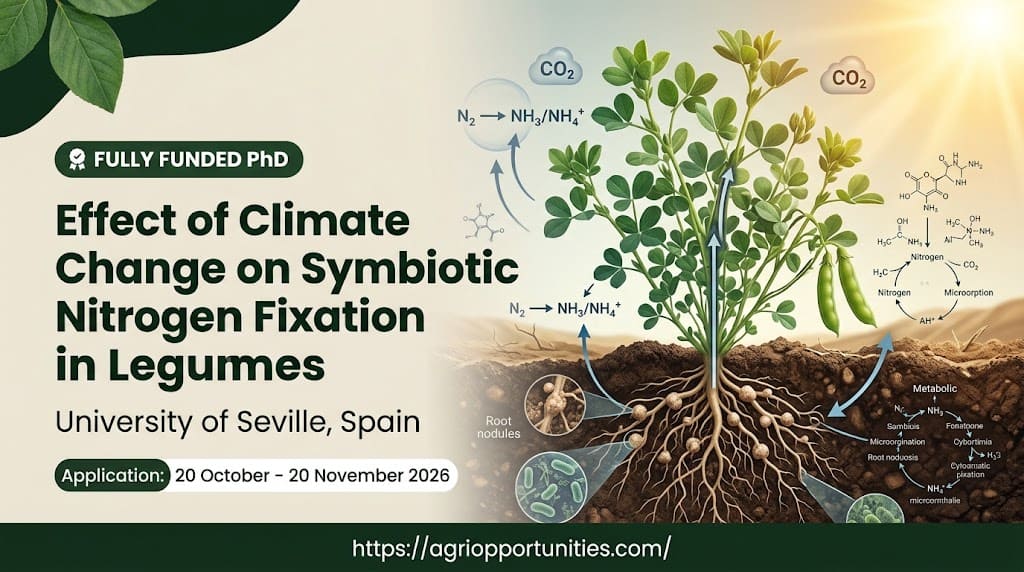
Fully Funded PhD – Effect of Climate Change on Symbiotic Nitrogen Fixation in Legumes – University of Seville, Spain

Quick Overview
The University of Seville is seeking a highly motivated candidate to pursue a PhD investigating the effect of climate change on symbiotic nitrogen fixation in legumes. This fully funded predoctoral position is offered through the FPU 2026 (AEI) grant programme and is based in a research laboratory focused on plant biology, plant metabolism, and plant–microorganism symbiosis. The successful candidate will join a collaborative and inclusive research environment committed to scientific curiosity, equity, and the development of independent researchers.
The research project, funded under the current knowledge-generation projects call (PID2025-173182NA-I00), investigates how photorespiration regulates nitrogen and sulfur assimilation in plants, and how this process conditions symbiotic N₂ fixation in legume nodules. Using the model organism Lotus japonicus, the project aims to understand this metabolic network and contribute to improving crop productivity and nutritional value in the face of climate change. The position involves collaboration with internationally renowned research groups, including the Max Planck Institute of Molecular Plant Physiology in Germany and the University of Valencia (BIOTECMED), with the possibility of mobility stays during the PhD.
Key Details
| Position | PhD Predoctoral Researcher – Symbiotic Nitrogen Fixation in Legumes |
| Organization | University of Seville |
| Location | Seville, Spain |
| Program | PhD (FPU 2026 predoctoral contract) |
| Qualification | MSc in Agriculture, Biology, Biotechnology, Biochemistry, or related fields |
| Salary | €32,500/year + end-of-contract compensation |
| Additional Funding | €10,000 for research stays and PhD programme fees |
| Contract Length | 4 years |
| Start Date | 2026–2027 academic year (following FPU call timeline) |
| Deadline | November 20, 2026 |
| Apply Via | Email CV and academic transcript to srosa@us.es or sara.rosa@uv.es |
About the FPU Programme and Research Group
The grants for the Training of University Academic Staff (FPU) aim to train doctoral researchers by funding predoctoral contracts, enabling recipients to carry out the research needed to submit a doctoral thesis while acquiring the university teaching competences required to join the higher education system. Launched in the 1990s by the Ministry of Education, the FPU programme is managed from 2026 by the State Research Agency (AEI), under Royal Decree 265/2026 of 1 April. The integration aims to unify the management of doctoral training grants from the Ministry of Science, Innovation and Universities, simplify the procedure, and align FPU programme management with the AEI’s standard processes.
The research group at the University of Seville investigates how photorespiration regulates nitrogen and sulfur assimilation in plants, and how this process conditions symbiotic N₂ fixation in legume nodules. By working with the model organism Lotus japonicus, the team seeks to understand this metabolic network and contribute to improving crop productivity and nutritional value under climate change. The project involves collaboration with internationally renowned research groups — the Max Planck Institute of Molecular Plant Physiology (Germany) and the University of Valencia (BIOTECMED, Spain) — providing the successful candidate with opportunities for mobility stays and international scientific exchange.
The laboratory is committed to equity, inclusion, and building a collaborative work environment. The team values scientific curiosity, a desire to learn, and the development of independent research skills. The FPU grant evaluation is based on 75% academic transcript and 25% group track record, making academic excellence the primary criterion for selection.
Key Responsibilities
Research Activities
- Investigate the effect of climate change on symbiotic nitrogen fixation in legumes.
- Study how photorespiration regulates nitrogen and sulfur assimilation in plants.
- Examine how photorespiration conditions symbiotic N₂ fixation in legume nodules.
- Work with the model organism Lotus japonicus to understand the metabolic network.
- Contribute to improving crop productivity and nutritional value under climate change.
Laboratory and Experimental Work
- Conduct plant biology and plant metabolism experiments.
- Perform molecular biology, biochemistry, and biotechnology techniques.
- Maintain plant cultures and experimental setups.
- Collect, analyse, and interpret experimental data.
Collaboration and Mobility
- Collaborate with researchers at the Max Planck Institute of Molecular Plant Physiology (Germany).
- Collaborate with researchers at the University of Valencia (BIOTECMED, Spain).
- Participate in mobility stays during the PhD.
- Engage in scientific meetings and present research findings.
Doctoral Training
- Complete the doctoral thesis research programme.
- Acquire university teaching competences as part of the FPU programme.
- Participate in training activities and professional development.
- Contribute to peer-reviewed publications.
Candidate Profile
Required:
- Bachelor’s or Master’s degree in Biology, Biotechnology, Biochemistry, or related fields.
- Highly competitive academic record (recommended average grade 8.5/10).
- Interest in plant metabolism and plant–microorganism symbiosis.
- Scientific curiosity and a desire to learn.
- Strong commitment to research and doctoral training.
Preferred:
- Previous laboratory experience in plant biology, molecular biology, or biochemistry.
- Familiarity with plant–microorganism symbiosis or nitrogen fixation.
- Experience with model organisms such as Lotus japonicus.
- Strong academic performance and research potential.
- Collaborative mindset and ability to work in a team.
Note for International Applicants:
- Applicants with degrees from foreign institutions need an Equivalence of the Average Grade of studies carried out in foreign centres, obtainable from the Ministry’s website.
What They Offer
| Benefit | Details |
|---|---|
| Position | FPU 2026 Predoctoral Contract |
| Organization | University of Seville |
| Location | Seville, Spain |
| Salary | €32,500/year |
| End-of-Contract Compensation | Included |
| Research Stays and Fees | Additional €10,000 for research stays and PhD programme fees |
| Postdoctoral Orientation Period | Up to 12 months |
| Contract Length | 4 years |
| Collaboration | Max Planck Institute (Germany), University of Valencia (BIOTECMED, Spain) |
| Mobility | Possibility of mobility stays during the PhD |
| Work Environment | Collaborative, equitable, and inclusive |
Application Tips
- Check your eligibility first – Ensure you hold a Bachelor’s or Master’s degree in Biology, Biotechnology, Biochemistry, or a related field, with a highly competitive academic record (recommended average grade 8.5/10).
- Prepare your CV and academic transcript – Send both documents to srosa@us.es or sara.rosa@uv.es before the application period opens.
- Obtain your grade equivalence if needed – Applicants with degrees from foreign institutions must obtain an Equivalence of the Average Grade from the Ministry’s website.
- Highlight your academic excellence – The FPU evaluation is 75% academic transcript, so your grades are the most important factor.
- Show your interest in plant metabolism – Demonstrate genuine curiosity about plant metabolism, photorespiration, and plant–microorganism symbiosis.
- Mention any laboratory experience – Previous experience with plant biology, molecular biology, or biochemistry will strengthen your application.
- Express willingness to travel – The project involves collaboration with international partners, with the possibility of mobility stays.
- Apply between October 20 and November 20, 2026 – The official application period opens on October 20, 2026.
Why This PhD Matters
Climate Change and Symbiotic Nitrogen Fixation
Climate change poses a significant threat to agricultural productivity and food security worldwide. Legumes, which form symbiotic relationships with nitrogen-fixing bacteria, are critical for sustainable agriculture because they can fix atmospheric nitrogen and reduce the need for synthetic fertilizers. However, environmental stresses associated with climate change, including drought, heat, and elevated CO₂, can disrupt symbiotic nitrogen fixation, reducing legume productivity and the sustainability benefits they provide.
Understanding how photorespiration regulates nitrogen and sulfur assimilation, and how this process conditions symbiotic N₂ fixation, is therefore of fundamental importance for developing climate-resilient crops.
A Collaborative Research Environment
This PhD position at the University of Seville offers a unique opportunity to contribute to this critical research area. The use of Lotus japonicus as a model organism provides a powerful experimental system for dissecting the metabolic network involved in symbiotic nitrogen fixation.
The collaboration with the Max Planck Institute of Molecular Plant Physiology and the University of Valencia (BIOTECMED) provides access to complementary expertise and research facilities. The possibility of mobility stays also strengthens the international dimension of the doctoral training.
Training, Funding, and Career Development
The FPU programme’s emphasis on developing both research and teaching competences can prepare the successful candidate for a career in higher education and research.
For the successful candidate, the position offers substantial financial support, including a 4-year predoctoral contract with a salary of €32,500 per year, end-of-contract compensation, an additional €10,000 for research stays and PhD programme fees, and up to 12 months of Postdoctoral Orientation Period (POP).
Who This PhD Is Suited For
The laboratory’s commitment to equity, inclusion, and a collaborative work environment makes this an attractive destination for researchers from diverse backgrounds. The focus on plant metabolism and plant–microorganism symbiosis positions the project within important research areas related to sustainable agriculture and climate change adaptation.
This PhD is particularly relevant for candidates with scientific curiosity, a strong academic record, and a genuine interest in plant biology, plant metabolism, and symbiotic nitrogen fixation.
Apply Now
Email your application to:
📧 srosa@us.es or sara.rosa@uv.es
Application Materials:
- CV
- Full academic transcript
- Application Period: October 20 – November 20, 2026
- Location: Seville, Spain
- Organization: University of Seville
- Programme: FPU 2026 (AEI) Predoctoral Contract
Equivalence of Average Grade (for foreign degrees): https://lnkd.in/e5kgjFk6
Frequently Asked Questions
- What is the position? A PhD predoctoral position studying the effect of climate change on symbiotic nitrogen fixation in legumes.
- Where is the position located? Seville, Spain.
- What is the qualification requirement? A Bachelor’s or Master’s degree in Biology, Biotechnology, Biochemistry, or related fields.
- What is the academic record requirement? A highly competitive academic record is recommended (average grade 8.5/10).
- What is the salary? €32,500/year plus end-of-contract compensation.
- How long is the contract? A 4-year predoctoral contract.
- What additional funding is offered? €10,000 for research stays and PhD programme fees, plus up to 12 months of Postdoctoral Orientation Period (POP).
- What is the research focus? How photorespiration regulates nitrogen and sulfur assimilation and conditions symbiotic N₂ fixation in legume nodules, using Lotus japonicus as a model organism.
- Who are the collaborators? Max Planck Institute of Molecular Plant Physiology (Germany) and University of Valencia, BIOTECMED (Spain).
- What is the application deadline? The application period runs from October 20 to November 20, 2026.
- How do I apply? Send your CV and full academic transcript to srosa@us.es or sara.rosa@uv.es before the application period opens.
- What if my degree is from a foreign institution? You need an Equivalence of the Average Grade of studies carried out in foreign centres, obtainable from the Ministry’s website.
- What is the FPU programme? The FPU programme trains doctoral researchers by funding predoctoral contracts, enabling recipients to carry out research for a doctoral thesis while acquiring university teaching competences.
Related Opportunities
- PhD: Modelling Non-CO2 Greenhouse Gas Emissions from Agriculture | Wageningen University
- PhD Student in Resilient Forage Production Systems | SLU Sweden
- PhD Position – Soil–Plant Hydraulics and Drought | Forschungszentrum Jülich
Add Agri Opportunities as a preferred source on Google to see latest agriculture scholarship listings first.