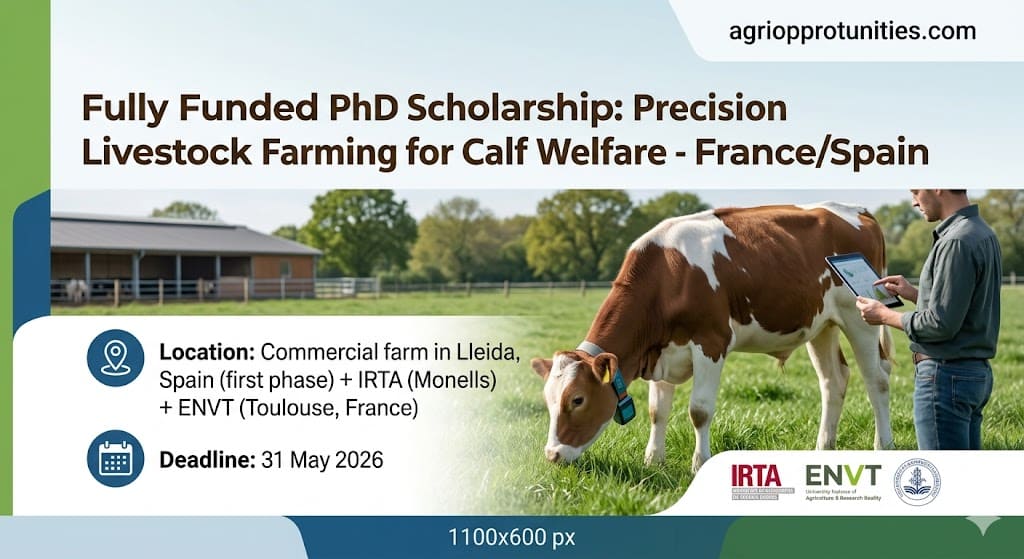
🎓Fully Funded PhD Scholarship: Precision Livestock Farming for Calf Welfare – France/Spain

🏛️ About INRAE & UMR IHAP
Applications are open for a PhD Precision Livestock Farming Calf Welfare Europe position at INRAE’s UMR IHAP in Toulouse, France, with fieldwork in Lleida, Spain. The project uses AI-driven acoustic analysis, accelerometers, and ruminal boluses to assess calf health and welfare. The French National Research Institute for Agriculture, Food and Environment (INRAE) is a world-leading research institute. The Joint Research Unit Interactions Hôtes–Agents Pathogènes (UMR IHAP) is located on the campus of the National Veterinary School of Toulouse (ENVT). Affiliated with the Animal Health Department of INRAE, UMR IHAP is a multidisciplinary research structure in animal infectiology that brings together a large community of researchers, engineers, technicians, and support staff.
🎯 Scholarship Overview
🔗 Project Summary
This PhD project aims to enhance the sustainability of cattle production systems by developing innovative approaches to assess and protect calf health and welfare under real commercial conditions. Using precision livestock farming technologies, the student will analyse behavioural patterns, microphone‑based acoustic signals (including AI‑driven cough detection), and physiological sensor data such as accelerometers and ruminal boluses.
The research will take place in a fully equipped commercial farm in Lleida, Spain, housing more than 10,000 animals, with secure containment systems for safe handling of calves and adult cattle.
🌟 Why This Scholarship Stands Out
This Fully Funded PhD: Precision Livestock Farming for Calf Welfare is unique because it combines cutting-edge digital technologies (AI-driven cough detection, accelerometers, ruminal boluses) with animal welfare science in a real commercial farm setting – not a controlled research station. You will work with over 10,000 animals, generating massive datasets that can train robust AI models. The project is intrinsically international, involving leading institutions across Europe: INRAE and ENVT (France), IRTA, CSIC and UAB (Spain), UNITUS (Italy), Wageningen University (Netherlands), Aarhus University (Denmark), and La Salle University (Spain). The first phase in Lleida, Spain, means you will be immersed in a large-scale commercial operation, then spend time at IRTA in Monells and ENVT in Toulouse. For someone passionate about animal welfare and digital farming, this is a rare opportunity to develop AI-based acoustic models for early disease detection – potentially reducing antibiotic use and improving calf survival.
✅ Candidate Profile and Eligibility
| Requirement | Details |
|---|---|
| Education | Master/Ingénieur (Bac+5) in Animal Science, Biology, Ethology, or related fields |
| Language | Proficiency in scientific English |
| Interest | Clear interest in animal welfare and innovative digital farming approaches |
| Experience | Experience or interest in digital breeding technologies (accelerometers, ruminal bolus, microphones) |
| Personal Qualities | Curious, rigorous, comfortable working in controlled research settings AND commercial farms |
| Motivation | Genuine motivation for sustainability and ethical livestock production |
| Teamwork | Ability to collaborate within an international consortium |
Desirable Skills:
- Skills in data analysis, statistics, or modelling (R, Python, or similar)
- Experience or interest in precision livestock technologies
- Ability to work with behavioral and acoustic data
- Understanding of multidisciplinary approaches (health, microbiota, behavior, environment)
- Autonomy, critical sense, organization, and motivation for longitudinal follow-up
📝 My Application Strategy
- Highlight any experience with animal behavior or welfare assessment – Mention ethograms, behavioral scoring, or welfare assessment protocols (e.g., Welfare Quality)
- Emphasize data analysis skills – R or Python experience is highly desirable. Mention specific packages (lme4, caret, tidyverse) or projects
- Show interest in acoustic analysis – AI-driven cough detection is novel. Mention any experience with sound analysis, signal processing, or machine learning
- Demonstrate your ability to work in commercial farm conditions – Large-scale farms are noisy, messy, and unpredictable. Show you can handle that environment
- Acknowledge the international consortium – Mention specific partners (Wageningen, Aarhus, UNITUS) and why collaborating across countries excites you
💼 What They Offer
| Benefit | Details |
|---|---|
| Research Environment | INRAE’s UMR IHAP (multidisciplinary animal infectiology) |
| Facilities | Commercial farm with 10,000+ animals + secure containment systems |
| International Network | 8+ institutions across Europe |
| Technologies | Accelerometers, ruminal boluses, microphones, AI-based cough detection |
| Locations | Lleida (Spain) → Monells (IRTA) → Toulouse (ENVT) |
🎓 Who Should Apply
This Fully Funded PhD: Precision Livestock Farming for Calf Welfare is perfect for a Master’s graduate in animal science, veterinary medicine, or ethology who is equally comfortable with data analysis and working in commercial farm conditions. If you are excited by the idea of using AI to detect coughs in a barn with 10,000 animals, and want to reduce antibiotic use through early disease detection, this project offers training at the intersection of animal welfare, digital farming, and data science. Candidates with experience in R or Python, or with interest in acoustic analysis, are especially encouraged. The ideal candidate is someone who wants their research to have direct practical impact on farm animal welfare and sustainability.
📝 How to Apply
📧 For inquiries:
- Núria Mach – nuria.mach@inrae.fr
- Antonio Velarde – Antonio.velarde@irta.cat
📅 Deadline: May 31, 2026
Useful Links
Similar Posts
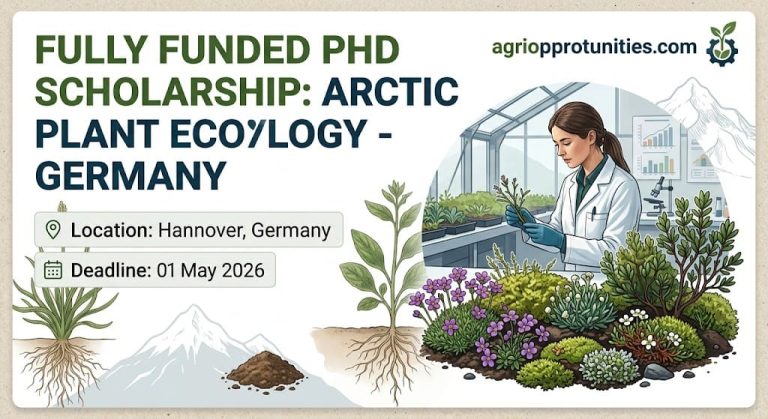
🎓Fully Funded PhD Scholarship: Arctic Plant Ecology – Germany
Applications are open for a Fully Funded PhD Arctic Plant Ecology Germany position at Leibniz University Hannover, Institute of Earth System Sciences. This PhD project is part of the research initiative “Nuolja muorji observatory: drivers of Arctic wild berry yield and quality under climate and land-use change”.
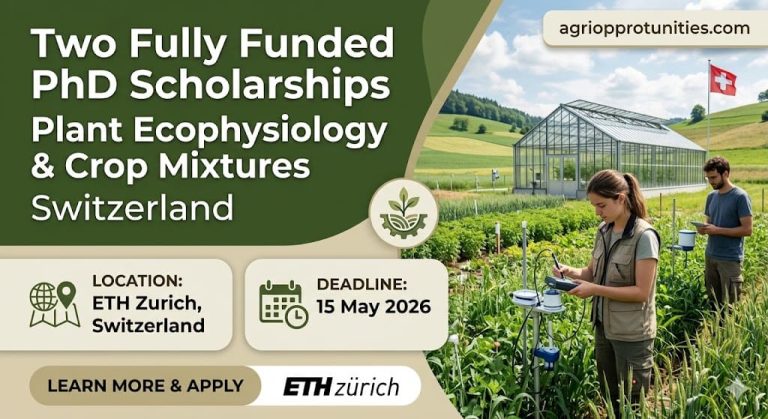
🎓Two Fully Funded PhD Scholarship: Plant Ecophysiology & Crop Mixtures – Switzerland
Applications are open for a PhD Plant Ecophysiology Crop Mixtures Switzerland position at ETH Zurich’s Grassland Sciences group. The project assesses canopy microclimate, plant traits, and ecosystem services in legume-cereal crop mixtures using stable isotope applications.
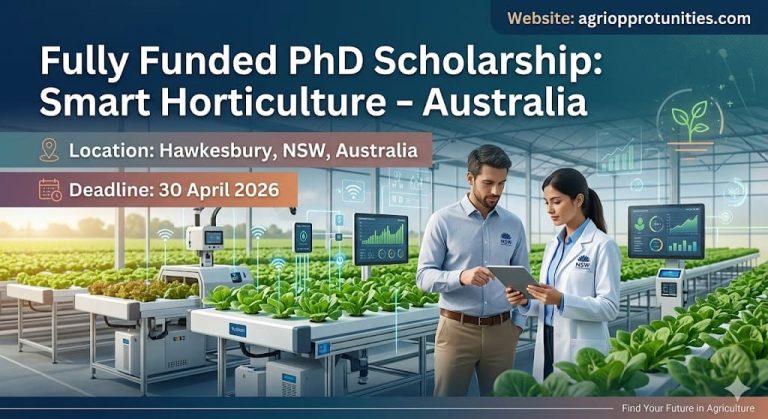
🎓Fully Funded PhD Scholarship: Smart Horticulture – Australia
Applications are open for a Fully Funded PhD Smart Horticulture Australia position at Western Sydney University (WSU), Hawkesbury campus, where the National Vegetable Protected Cropping Centre and the School of Science are located. This PhD project focuses on improving energy, water, and nutrient efficiencies in high-tech greenhouse systems.
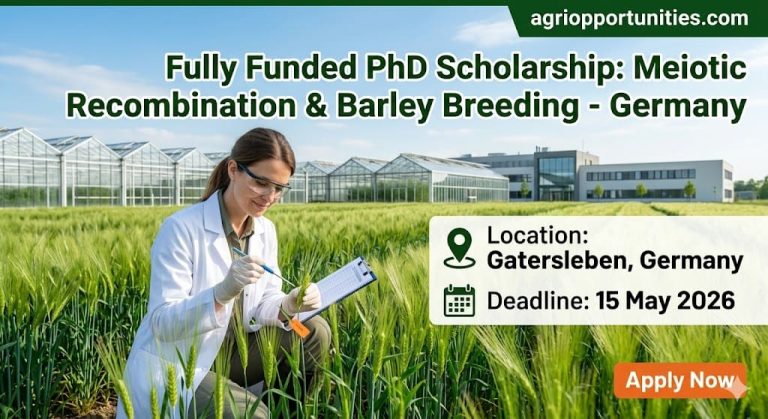
🎓Fully Funded PhD Scholarship: Meiotic Recombination & Barley Breeding – Germany
Applications are open for a PhD Meiotic Recombination Barley Germany position at the Leibniz-Institute for Plant Genetics and Crop Plant Research (IPK) in Gatersleben. The project exploits natural genetic variation in meiotic recombination to overcome breeding barriers in barley.
🎓Fully Funded Master’s Scholarship: Pasture Irrigation with Treated Wastewater – Ireland
The Fully Funded Master’s Scholarship is available to investigate pasture irrigation with treated wastewater in Ireland
🎓Fully Funded PhD Scholarship: Biogeochemistry & Plant Physiology of Rare Earth Elements – USA
Applications are open for a Fully Funded PhD Biogeochemistry Rare Earth Elements USA position at the University of Kentucky’s Department of Plant and Soil Sciences. The project investigates the mechanisms by which plants take up and process rare earth elements from soil.