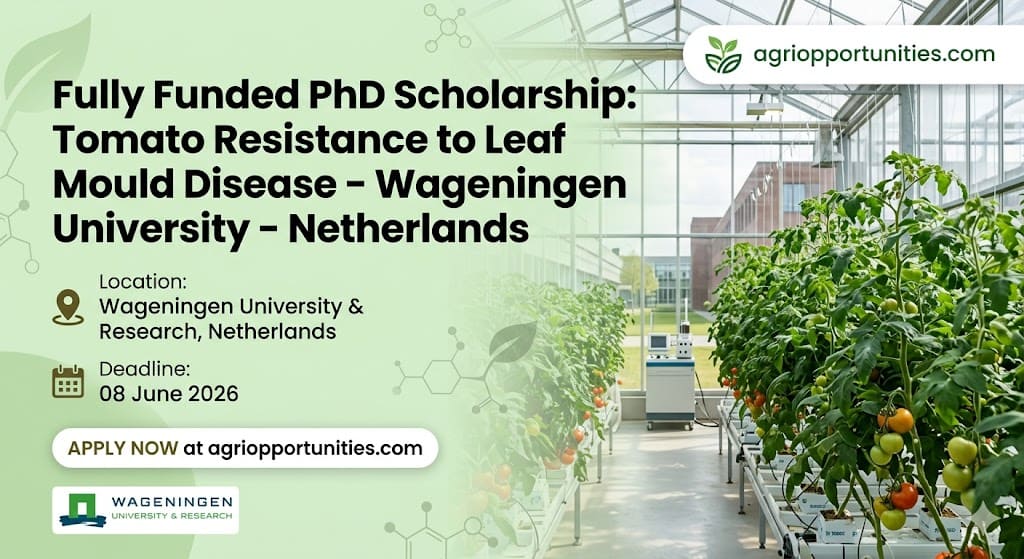
Fully Funded PhD Scholarship: Tomato Resistance to Leaf Mould Disease – Wageningen University – Netherlands

About Wageningen University & Research
Applications are open for a PhD Tomato Resistance Leaf Mould Netherlands position at Wageningen University. The project aims to discover novel tomato genes for durable resistance to Fulvia fulva and develop next-generation predictive breeding strategies. Wageningen University & Research is one of the leading organisations in its domain, focusing on healthy food and living environment. Plant Breeding is a merged unit of Wageningen Research and Wageningen University composed of around 200 people including MSc and PhD students and guest workers, with more than 30 nationalities. Phytopathology conducts fundamental, strategic and applied research on the biology of fungi, oomycetes and bacteria.
Scholarship Overview
Project Description
Leaf mould disease, caused by the fungus Fulvia fulva, increasingly threatens tomato production worldwide. Pathogen evolution frequently overcomes current resistance strategies. This PhD project aims to identify novel tomato genes that confer durable resistance to leaf mould disease and to develop next-generation predictive breeding strategies.
This PhD project is embedded in a large public-private partnership consortium with multiple breeding companies. You will work closely together with a (post-doctoral) researcher and technicians on uncovering and characterizing novel tomato immune receptors (encoded by Cf resistance genes) that recognize fungal effector proteins (extracellular proteins, Ecps), and will contribute to building a predictive framework for durable resistance.
Why This Scholarship Stands Out
This PhD uniquely integrates wet-lab biology and computational biology, with a strong emphasis on data-driven discovery. You will contribute to AI-driven prediction pipelines for receptor-effector interactions by combining molecular biology, proteomics, and bioinformatics. A large public-private partnership involving multiple breeding companies supports the project, giving your research direct industrial relevance. Wageningen University, a world leader in plant sciences, will provide co-supervision through experts from both the Plant Breeding and Phytopathology groups. If you are interested in plant-pathogen interactions, resistance breeding, and data-driven approaches, this project allows you to work on a crop of global economic importance and develop applications for sustainable agriculture.
Duties and Responsibilities
- Cloning and functional validation of candidate immune receptors
- Contributing to AI-driven prediction pipelines for receptor-effector interactions
- Experimental validation of computational predictions
- Interfacing with breeding partners to translate findings into applications
- Writing and defending a PhD thesis
Candidate Profile and Eligibility
| Requirement | Details |
|---|---|
| Education | Completed MSc degree in Plant Sciences, Plant Breeding, Bioinformatics, Computational Biology or related field |
| Techniques | Experience with molecular techniques and proteomics |
| Interest | Strong interest in plant-microbe interactions |
| Bioinformatics | Demonstrated affinity with bioinformatics and data analysis |
| Programming | Basic experience with scripting (Python, R, or similar) |
| Communication | Excellent writing and oral communication skills in English |
| Teamwork | Team player who can also work independently |
My Application Strategy
- Highlight your molecular biology experience – Cloning, protein analysis, and molecular techniques are core to this project
- Emphasize bioinformatics and data analysis skills – AI-driven prediction pipelines and computational biology are key components
- Show interest in plant-pathogen interactions – Understanding of plant immunity and fungal effectors is valuable
- Demonstrate programming ability – Python, R, or similar scripting experience is preferred
- Mention collaborative experience – You will work with breeding companies and multiple research groups
What They Offer
| Benefit | Details |
|---|---|
| First Year Salary | €3,059 per month |
| Fourth Year Salary | €3,881 per month |
| Working Hours | 38 hours per week |
| Contract | 18 months (temporary), extended for project duration upon satisfactory performance |
| Year-end Bonus | 8.3% |
| Pension Scheme | Excellent |
| Parental Leave | Partially paid |
| International Support | Visa assistance, housing support, tax exemption eligibility for certain categories |
Who Should Apply
This PhD is perfect for a student with a background in plant sciences, plant breeding, or bioinformatics who is excited about the interface of wet-lab biology and computational biology. If you enjoy molecular techniques (cloning, proteomics) and also have experience with bioinformatics and programming, this project offers training across both disciplines. The ideal candidate is someone who wants to contribute to sustainable agriculture through genetic solutions for disease resistance.
How to Apply
Click on the application button next to the vacancy on the Wageningen University website. Only applications submitted through the website will be considered.
For more information about the position, contact:
Dr. Matthieu Joosten – matthieu.joosten@wur.nl
Prof. Dr. Yuling Bai – bai.yuling@wur.nl (Plant Breeding)
Christiaan Schol – christiaan.schol@wur.nl
Useful Links
Similar Posts
Fully Funded PhD Scholarship: Microbial Inoculants for Agriculture – DTU Denmark
Applications are open for a PhD Microbial Inoculants Agriculture Denmark position at DTU Bioengineering. The Lab2Field project investigates why promising microbial bioinoculants fail in the field and how to develop more robust, climate-resilient plant biologicals.
Fully Funded PhD Scholarship: Grain Science & Food Structure – University of Guelph – Canada
Applications are open for a PhD Grain Science Food Structure Canada position at the University of Guelph. The NSERC CREATE program investigates how grain architecture influences food quality using data science and AI.
Fully Funded PhD Scholarship: Nitrogen Management Strategies for Perennial Ryegrass/White Clover Swards – Teagasc / Munster Technological University
Applications are open for a PhD Nitrogen Management Grassland Ireland position at Teagasc Moorepark in collaboration with Munster Technological University. The project optimises nitrogen management strategies for perennial ryegrass/white clover swards in grazing dairy systems.
Two Fully Funded PhD Scholarships: Greenhouse Gas Mitigation in Agriculture – Denmark
Applications are open for Two PhD Scholarships in Greenhouse Gas Mitigation Agriculture Denmark at DTU Sustain. The projects focus on documenting methane emission reduction technologies from manure storage, including anaerobic digestion, acidification, flaring, and biofilters.
Fully Funded MSc & PhD Scholarship: the Chinese Academy of Agricultural Sciences (CAAS), China
Fully funded 51 Master’s & 47 Doctoral scholarships are open in the Chinese Academy of Agricultural Sciences (CAAS)
Fully Funded PhD Scholarship: Detecting Change in Carbon Stocks and Soil Biodiversity Across Irish Forests – South East Technological University – Ireland
Applications are open for a PhD Forest Soil Biodiversity Ireland position at South East Technological University in Waterford. The C-BioStock project investigates how clear-felling affects soil biodiversity and carbon stocks in native and commercial Irish forests.