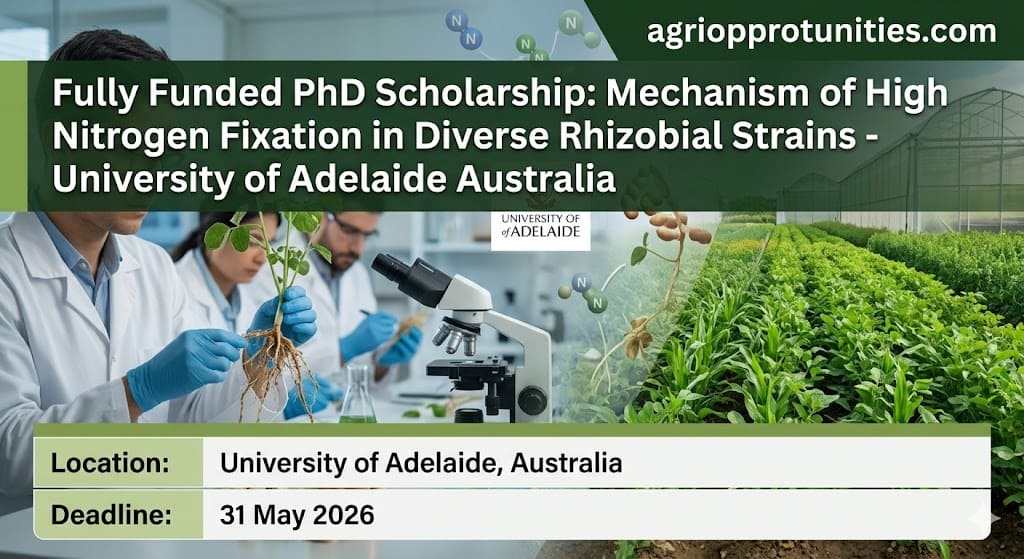
Fully Funded PhD Scholarship: Mechanism of High Nitrogen Fixation in Diverse Rhizobial Strains – University of Adelaide Australia

About the University of Adelaide
Applications are open for a PhD Nitrogen Fixation Rhizobia Australia position at the University of Adelaide. The project investigates diverse chickpea-nodulating rhizobial strains from Myanmar and Turkey with superior ability to fix nitrogen. The University of Adelaide is a leading research-intensive university in Australia. This project is part of the Food, Agriculture and Wine signature research theme. The research focuses on the legume-rhizobia symbiosis, which is responsible for fixing millions of tons of ‘free’ nitrogen into global cropping systems.
Scholarship Overview
Project Description
The legume-rhizobia symbiosis is responsible for fixing millions of tons of ‘free’ nitrogen into global cropping systems. Some rhizobial strains are highly efficient at fixing nitrogen compared to current commercial inoculant strains, but the mechanisms behind this are unclear.
This project will investigate diverse chickpea-nodulating rhizobial strains collected from soils in Myanmar and Turkey that have superior ability to fix nitrogen per unit nodule. Using qPCR and associated molecular techniques, we can determine key symbiosis and fixation genes expressed in fixing nodules, and the level of expression required for superior nitrogen fixation.
The project will involve development of microscopy protocols to observe bacteria in the developing and fixing nodules, and to determine bacteroid (nitrogen fixing bacteria) density in the nodule microsphere. These elite rhizobial strains will assist in understanding efficient nitrogen fixation and identification of new and better performing commercial rhizobial strains for pulses in Australia and the world.
Why This Scholarship Stands Out
This PhD is unique because it addresses a fundamental question in agricultural microbiology: why are some rhizobial strains more efficient at fixing nitrogen than others? Some rhizobial strains have superior ability to fix nitrogen per unit nodule compared to current commercial inoculant strains. Understanding the mechanisms behind high-efficiency nitrogen fixation could lead to better commercial inoculants for pulses (chickpeas, lentils, beans). The project involves field collections from Myanmar and Turkey, molecular techniques (qPCR, gene expression analysis), and microscopy protocol development (observing bacteroid density in nodules). For a student interested in plant-microbe interactions, molecular biology, and sustainable agriculture, this is an opportunity to contribute to reducing synthetic fertilizer dependence.
Key Responsibilities
- Investigate diverse chickpea-nodulating rhizobial strains with superior nitrogen-fixing ability
- Use qPCR and associated molecular techniques to determine key symbiosis and fixation genes expressed in fixing nodules
- Determine the level of expression required for superior nitrogen fixation
- Develop microscopy protocols to observe bacteria in developing and fixing nodules
- Determine bacteroid (nitrogen fixing bacteria) density in the nodule microsphere
Candidate Profile and Eligibility
| Requirement | Details |
|---|---|
| Education | Bachelor’s degree with honours or Master’s degree in Agricultural Sciences, Biological Sciences, Molecular Biology, or related field |
| Student Type | International and Domestic students welcome |
| Techniques | Experience or strong interest in qPCR, molecular techniques, and microscopy |
What They Offer
| Benefit | Details |
|---|---|
| Degree Options | Master of Philosophy or PhD |
| Location | University of Adelaide, Australia |
| Research Theme | Food, Agriculture and Wine |
| Supervision | Dr Judith Rathjen |
My Application Strategy
- Highlight your molecular biology experience – qPCR, gene expression analysis, and molecular techniques are core to this project
- Emphasize microscopy skills – Developing protocols to observe bacteria in nodules is a key component
- Show interest in plant-microbe interactions – Legume-rhizobia symbiosis is the focus
- Demonstrate understanding of nitrogen fixation – Biological nitrogen fixation is critical for sustainable agriculture
- Mention any experience with agricultural microbiology – Rhizobial strains or pulse crops (chickpeas, lentils, beans)
Who Should Apply
This research is perfect for a student with a background in agricultural sciences, biological sciences, or molecular biology who is fascinated by the symbiosis between legumes and rhizobia. If you are interested in how some bacterial strains fix more nitrogen than others, and want to use molecular techniques (qPCR) and microscopy to understand the mechanisms, this project offers training across molecular biology, microbiology, and plant science. Candidates with experience in rhizobia or nitrogen fixation research are especially encouraged.
How to Apply
Contact Dr Judith Rathjen for more information about the project and application process. at: judith.rathjen@adelaide.edu.au
Useful Links
Similar Posts
Fully Funded PhD Scholarship: Fusarium Wilt Resistance in Banana – Australia
Applications are open for a PhD Fusarium Wilt Resistance Banana Australia position at The University of Queensland’s School of Agriculture and Food Sustainability. The project investigates the genetic basis of Fusarium wilt resistance in banana using genomics and molecular marker approaches.
Fully Funded PhD Scholarship: Digital Agriculture and Computer Vision – South East Technological University
Applications are open for a PhD Digital Agriculture Computer Vision Ireland position at South East Technological University in Waterford. The VIP Ingredients project uses AI-driven image analysis and sensors to support quality-specific decision-making for plant-based ingredients.
Fully Funded PhD Scholarship: Development of Novel High Protein Products for Weight Management and Ageing Cohorts – Teagasc / University College Cork Ireland
Applications are open for a PhD High Protein Products Ageing Ireland position at Teagasc Moorepark in collaboration with University College Cork. The PRO-WIN project develops novel high-protein delivery systems for muscle maintenance in ageing and weight-management populations.
Fully Funded PhD Scholarship: Grain Science & Food Structure – University of Guelph – Canada
Applications are open for a PhD Grain Science Food Structure Canada position at the University of Guelph. The NSERC CREATE program investigates how grain architecture influences food quality using data science and AI.
Fully Funded Master’s Scholarship: Pasture Irrigation with Treated Wastewater – Ireland
The Fully Funded Master’s Scholarship is available to investigate pasture irrigation with treated wastewater in Ireland
Fully Funded PhD Scholarship: Veterinary Pathology (Cetacean Embolic Disease) – Universidad de Las Palmas de Gran Canaria – Spain
Applications are open for a PhD Cetacean Veterinary Pathology Spain position at the Universidad de Las Palmas de Gran Canaria. The research focuses on gas and fat embolism in marine mammals.