Fully Funded PhD Position: Soil–Plant Hydraulics and Drought | Forschungszentrum Jülich

Quick Overview
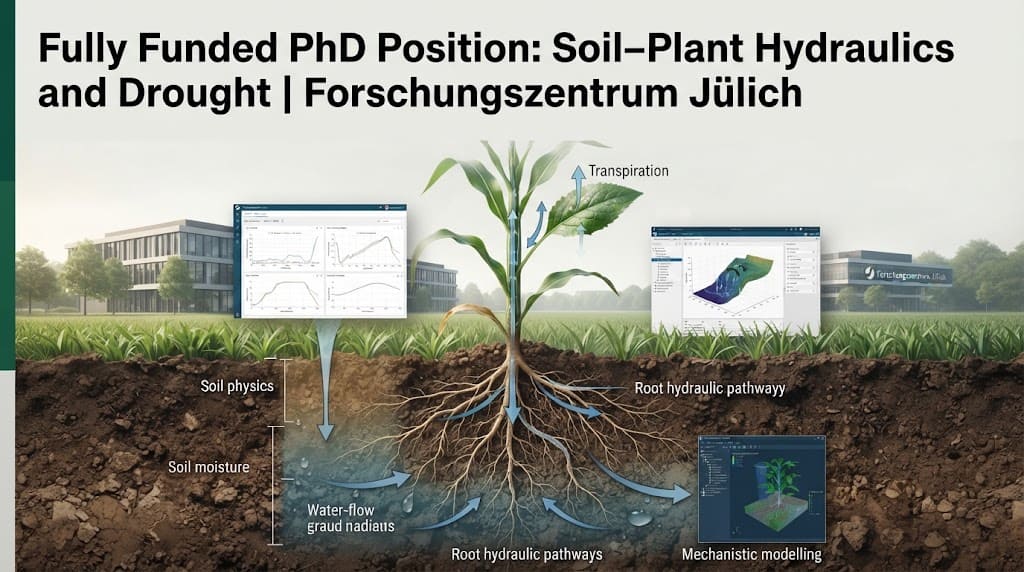
The Institute of Bio- and Geosciences – Agrosphere (IBG-3) at Forschungszentrum Jülich is offering a fully funded PhD position in Soil–Plant Hydraulics and Drought. This opportunity is part of one of the largest research institutions in Europe and focuses on understanding how climate change and land-use shifts affect terrestrial ecosystems, particularly agricultural and forest systems. The successful candidate will investigate the relationships between transpiration, effective soil water potential, and leaf water potential under contrasting soil and climatic conditions.
The PhD will combine mechanistic soil–root–plant modelling with experimental data, working with approaches implemented in CPlantBox and data from the TERENO SoilCan lysimeter network. This includes soil water status, evapotranspiration, sap flow, and leaf water potential measurements. The position offers a unique chance to contribute to solutions that safeguard ecosystem services through improved understanding of hydrological and biogeochemical processes. With a fixed term of 4 years, excellent research facilities, and a motivated international team, this is an ideal opportunity for candidates passionate about soil–plant water relations and drought research.
Key Details
| Position | PhD Position – Soil–Plant Hydraulics and Drought |
| Organization | Forschungszentrum Jülich (Institute of Bio- and Geosciences – Agrosphere, IBG-3) |
| Location | Jülich, Germany |
| Program | PhD |
| Qualification | MSc in bioscience engineering, soil science, hydrology, plant science, environmental science, physics, engineering, applied mathematics, or related field |
| Salary | Pay group 13 (65%) of TVöD-Bund + year-end bonus |
| Contract | Fixed term of 4 years |
| Research Focus | Soil–plant hydraulics, drought adaptation, root water uptake, stomatal regulation |
| Deadline | 30 September 2026 |
About the Institute and Research
The Institute of Bio- and Geosciences – Agrosphere (IBG-3) at Forschungszentrum Jülich develops solutions to safeguard ecosystem services based on an improved understanding of hydrological and biogeochemical processes in terrestrial systems. The institute’s focus is on agricultural and forest systems, which are coming under increasing pressure due to global change. Researchers combine innovative observation technologies with laboratory experiments and modeling to investigate and predict terrestrial processes across scales — from the pore scale through the field scale to the continental scale.
This PhD position is embedded within this broader mission, contributing to the sustainable use of natural resources: water, soil, and atmosphere. The research will specifically investigate how heterogeneous soil water potentials are integrated by root systems, how soil texture and root hydraulic properties control water uptake, hydraulic adaptation to drought, and the role of stomatal regulation in maintaining plant water status. The work integrates mechanistic modeling with real-world experimental data, offering a strong foundation for a research career in plant hydraulics, soil physics, or environmental modeling.
Forschungszentrum Jülich is one of the largest research institutions in Europe, with an international and interdisciplinary focus. The successful candidate will join a motivated team, access excellent scientific and technical facilities, and participate in international conferences and project meetings. The institute is committed to diversity, equal opportunities, and an inclusive working environment where everyone can realize their potential.
Key Responsibilities
Research and Modeling
- Investigate relationships between transpiration, effective soil water potential, and leaf water potential under contrasting soil and climatic conditions.
- Combine mechanistic soil–root–plant modelling with experimental data.
- Work with modelling approaches implemented in CPlantBox.
Data Analysis
- Analyze data from the TERENO SoilCan lysimeter network, including soil water status, evapotranspiration, sap flow, and leaf water potential.
- Determine how heterogeneous soil water potentials are integrated by root systems.
- Quantify how soil texture and root hydraulic properties control water uptake.
Drought Adaptation Research
- Investigate hydraulic adaptation to drought.
- Analyze the role of stomatal regulation in maintaining plant water status.
- Contribute to understanding how plants respond to water-limited conditions.
Collaboration and Dissemination
- Participate in international conferences and project meetings.
- Actively build your scientific network.
- Contribute to publications and research outputs.
Candidate Profile
Required:
- Master’s degree in bioscience engineering, soil science, hydrology, plant science, environmental science, physics, engineering, applied mathematics, or a related field.
- Strong quantitative skills.
- Interest in soil–plant water relations and drought.
- Motivation for modelling and data analysis.
- Programming experience or willingness to develop it.
- Good English communication skills (at least B2 level according to CEFR), ideally supported by a certificate.
Preferred:
- Experience in soil physics, plant hydraulics, or numerical modelling.
- Background in plant physiology or hydrology.
- Familiarity with programming languages (e.g., Python, C++).
- Interest in interdisciplinary research and international collaboration.
What They Offer
| Benefit | Details |
|---|---|
| Team & Environment | Motivated team with international and interdisciplinary focus at one of Europe’s largest research institutions |
| Research & Infrastructure | Access to excellent scientific and technical facilities |
| Networking & Exchange | Participation in international conferences and project meetings |
| Supervision & Support | Continuous expert guidance from academic supervisor |
| Work-life Balance | Flexible working hours and flexible working options |
| Annual Leave | 30 days of annual leave |
| Knowledge & Development | Professional development through training and networking (JuDocS) |
| Health & Well-being | Comprehensive health management programme, beach volleyball court, running groups, yoga classes, medical service, social counselling |
| Campus Experience | Research campus in the countryside, cafeteria with lake view |
| Successful Start | Welcome Days and Welcome Guide for structured onboarding |
| Support for International Employees | International Advisory Service |
| Fair Remuneration | Pay group 13 (65%) of TVöD-Bund + year-end bonus |
| Contract | Fixed term of 4 years |
Application Tips
- Highlight your quantitative skills – Strong quantitative skills are essential for this modelling and data analysis role.
- Show your interest in soil–plant water relations – Demonstrate genuine motivation for understanding drought adaptation and plant hydraulics.
- Mention programming experience – If you have experience with Python, C++, or other languages, highlight it. If not, express willingness to develop these skills.
- Provide English language certification – A certificate confirming at least B2 level (CEFR) strengthens your application.
- Emphasize relevant coursework – Courses in soil physics, plant hydraulics, hydrology, or numerical modelling are an advantage.
- Prepare for interdisciplinary collaboration – The project involves both modelling and experimental data, so show your ability to work across disciplines.
- Check language requirements – Visit the official language requirements page to ensure you meet the criteria before applying.
Why This PhD Matters (My Analysis)
Climate change and shifts in land use are placing unprecedented pressure on terrestrial ecosystems, particularly agricultural and forest systems that provide essential services like food, feed, fiber, and energy. Understanding how plants respond to drought and how soil–plant water relations function under contrasting conditions is critical for developing strategies to safeguard these ecosystem services. This PhD position at Forschungszentrum Jülich addresses these challenges directly by combining mechanistic modelling with real-world experimental data from the TERENO SoilCan lysimeter network.
The research has significant implications for sustainable agriculture and water resource management. By determining how root systems integrate heterogeneous soil water potentials and how soil texture and root hydraulic properties control water uptake, the findings could inform irrigation strategies, crop breeding programs, and land management practices. Investigating hydraulic adaptation to drought and the role of stomatal regulation contributes to our understanding of plant resilience under water-limited conditions — a growing concern in many regions worldwide.
For the successful candidate, this position offers exceptional benefits: a 4-year contract, fair remuneration under TVöD-Bund, 30 days of annual leave, and access to world-class research facilities. The international and interdisciplinary environment at Forschungszentrum Jülich provides an ideal setting for building a scientific network and developing a strong research career. The institute’s commitment to diversity, equal opportunities, and work-life balance makes it an attractive destination for researchers from diverse backgrounds. This is a rare opportunity to work at the forefront of soil–plant hydraulics research while contributing to solutions for one of the most pressing environmental challenges of our time.
Apply Now
Application: Through the official Forschungszentrum Jülich portal
Location: Jülich, Germany
Organization: Forschungszentrum Jülich (IBG-3)
Contract: Fixed term of 4 years
Salary: Pay group 13 (65%) of TVöD-Bund + year-end bonus
Language Requirements: https://go.fzj.de/languagerequirements
Benefits Information: https://go.fzj.de/benefits
Frequently Asked Questions
- What is the position? A PhD position in Soil–Plant Hydraulics and Drought at the Institute of Bio- and Geosciences – Agrosphere (IBG-3).
- Where is the position located? Jülich, Germany.
- What is the qualification requirement? A Master’s degree in bioscience engineering, soil science, hydrology, plant science, environmental science, physics, engineering, applied mathematics, or a related field.
- What is the salary? Pay group 13 (65%) of TVöD-Bund, plus an additional year-end bonus under the collective pay agreement.
- How long is the contract? Fixed term of 4 years.
- What are the language requirements? Good English communication skills at least B2 level according to CEFR, ideally supported by a certificate.
- Is programming experience required? Programming experience is preferred, or willingness to develop it.
- What research will I do? Investigate relationships between transpiration, soil water potential, and leaf water potential; combine modelling with experimental data; analyze drought adaptation and stomatal regulation.
- What benefits are offered? 30 days annual leave, flexible working hours, professional development, health management programme, international advisory service, and more.
- How do I apply? Through the official Forschungszentrum Jülich application portal.
Related Opportunities
- More PhD and Scholarship Opportunities
- PhD Research Assistantship in Water and Soil Quality | Southern Illinois University Carbondale
- Funded PhD (or MPhil) Scholarship – Wine Grape Aroma Research | Adelaide University
Add Agri Opportunities as a preferred source on Google to see latest agriculture Scholarship listings first.