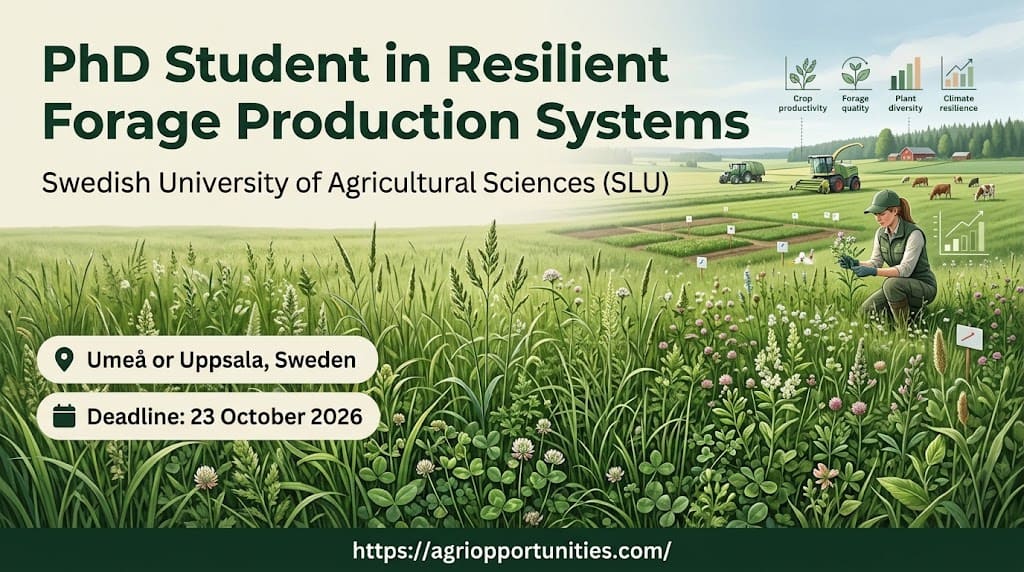
Fully Funded PhD: Resilient Forage Production Systems – Swedish University of Agricultural Sciences, Sweden

Quick Overview
The Swedish University of Agricultural Sciences (SLU) is offering a fully funded PhD position in Resilient Forage Production Systems within the Department of Crop Production Ecology. This four-year doctoral programme focuses on how the composition and management of forage crops influence their productivity, persistence, forage quality, and resilience, with particular emphasis on species-rich and functionally diverse leys. The research will be primarily based on farms and at field experimental sites in both northern and southern Sweden, providing a unique blend of controlled field experimentation and practical on-farm research.
Forage crops, particularly perennial leys, are central to ruminant production and agricultural systems in Sweden. Developing forage systems that maintain high and stable production while making efficient use of resources and providing wider environmental benefits is increasingly important under changing climatic and production conditions. The successful candidate will investigate how different plant species and functional groups contribute to forage production under contrasting environmental and management conditions, working with established and new experiments as well as forage systems under practical farm conditions. This is an exceptional opportunity for a motivated candidate with a strong interest in forage crops, crop production, and sustainable agricultural systems.
Key Details
| Position | PhD Student in Resilient Forage Production Systems |
| Organization | Swedish University of Agricultural Sciences (SLU) |
| Location | Umeå or Uppsala, Sweden |
| Program | PhD (4-year programme) |
| Qualification | MSc in agronomy, crop science, plant biology, agroecology, agricultural systems science, or closely related field |
| Salary | Doctoral student salary according to local collective agreement (fixed progression) |
| Employment | 4-year doctoral programme, 100% scope |
| Start Date | December 2026 or upon agreement |
| Deadline | 23 October 2026 |
| Apply Via | SLU application portal |
About the Department and Research
The Department of Crop Production Ecology at SLU develops knowledge about sustainable crop production systems to meet demands for food, animal feed, and bio-based raw materials in a changing world. The department’s research addresses challenges associated with climate change, environmental impacts, biodiversity, and the sustainable production of agricultural crops. With operations in both Uppsala and Umeå, the department is responsible for the Röbäcksdalen and Lövsta field research stations, providing excellent facilities for field-based research.
The forage research group in Umeå creates knowledge that promotes sustainable and competitive agricultural systems based on forages, including leys and pastures, and contributes to the sustainable production of food from ruminants. The group’s research includes agronomic field studies, crop modelling, and the use of remote sensing and spectral techniques for crop monitoring. The research environment includes expertise in forage production, crop ecology, plant diversity, crop modelling, remote sensing, and environmental measurements, with extensive collaboration within SLU and with agricultural organisations, farmers, and other research partners.
The doctoral project will investigate how the composition and management of forage crops influence their productivity, persistence, forage quality, and resilience. Particular emphasis will be placed on species-rich and functionally diverse leys and on understanding how different plant species and functional groups contribute to forage production under contrasting environmental and management conditions. The project may include studies of different legume and non-leguminous forb species and their contribution to productive and persistent forage systems.
Key Responsibilities
Field Experimentation
- Plan and conduct field experiments at farms and experimental sites across Sweden.
- Collect data on crop growth, botanical composition, yield, forage quality, and related plant and environmental variables.
- Work with established and new experiments investigating forage species, mixtures, and management.
- Travel to farms and experimental sites in different parts of Sweden, including Röbäcksdalen in Umeå.
Data Analysis and Methodology
- Process and statistically analyse experimental data.
- Contribute to the development and application of appropriate methods for assessing forage crops and plant mixtures.
- Use statistical software and quantitative approaches relevant to crop research.
Stakeholder Engagement
- Work with farmers and other agricultural stakeholders in connection with on-farm research.
- Collaborate with researchers and external partners within Sweden and internationally.
- Present research results at scientific meetings and to agricultural stakeholders.
Communication and Publication
- Write scientific papers and contribute to peer-reviewed publications.
- Present research findings at scientific meetings and stakeholder events.
- Collaborate within a multidisciplinary research environment.
Candidate Profile
Required:
- Second-cycle (MSc) degree in agronomy, crop science, plant biology, agroecology, agricultural systems science, or a closely related field.
- Knowledge of crop production or plant ecology relevant to agricultural systems.
- Experience of statistical analysis of experimental data.
- Interest in field-based agricultural research.
- Good written and spoken English.
- A driving licence valid for use in Sweden.
- Knowledge corresponding to at least 120 HEC in biological subjects, including a degree project and completed specialisation courses in crop production science or equivalent subjects.
- English language requirements equivalent to Swedish upper-secondary qualification Engelska B/6.
Preferred:
- Working knowledge of Swedish.
- Experience of field experiments involving crops or agricultural plants.
- Knowledge or experience of forage crops, grassland, or crop mixtures.
- Experience with statistical software.
- Experience with remote sensing, image analysis, crop modelling, or other quantitative approaches relevant to crop research.
- Experience of scientific writing and communication.
Personal Qualities:
- Ability to work both independently and collaboratively.
- Initiative and structured organisation of field and analytical work.
- Positive contribution to a research environment involving different disciplines and external partners.
What They Offer
| Benefit | Details |
|---|---|
| Position | PhD Student in Resilient Forage Production Systems |
| Organization | Swedish University of Agricultural Sciences (SLU) |
| Department | Crop Production Ecology |
| Location | Umeå or Uppsala, Sweden (or another location upon agreement) |
| Employment | 4-year doctoral programme |
| Scope | 100% |
| Salary | Doctoral student salary according to local collective agreement |
| Start Date | December 2026 or upon agreement |
| Research Environment | Forage research group with expertise in forage production, crop ecology, plant diversity, crop modelling, remote sensing |
| Collaboration | SLU researchers, agricultural organisations, farmers, international partners |
Application Tips
- Check your eligibility first – Ensure you meet both the general entry requirements (Master’s qualification or 240 credits with 60 in second-cycle) and specific entry requirements (120 HEC in biological subjects including degree project and specialisation courses in crop production science or equivalent).
- Prepare your application documents – Read about the required attachments at the SLU doctoral application page.
- Highlight relevant experience – Emphasize your experience with field experiments, statistical analysis, forage crops, or crop mixtures.
- Demonstrate statistical skills – Experience with statistical software and analysis of experimental data is required.
- Show your interest in field-based research – The role involves significant fieldwork during the growing season and travel across Sweden.
- Mention your driving licence – A driving licence valid for use in Sweden is required.
- Express willingness to travel – The position involves travel to farms and experimental sites in different parts of Sweden.
- Apply before 23 October 2026 – Submit your application through the SLU application portal.
Why This PhD Matters (My Analysis)
Forage crops, particularly perennial leys, are the backbone of ruminant production systems in Sweden and many other countries. They provide high-quality feed for dairy and beef cattle while also delivering environmental benefits such as carbon sequestration, biodiversity support, and reduced soil erosion. As climate change brings new challenges — including altered growing seasons, increased drought risk, and shifting pest pressures — developing forage systems that are both productive and resilient has become increasingly urgent. This PhD project addresses that need directly by investigating how plant diversity and management practices influence forage productivity, persistence, and quality.
The emphasis on species-rich and functionally diverse leys is particularly timely. Research increasingly shows that diverse plant communities can be more productive, more resistant to environmental stress, and more resilient than monocultures. By understanding how different grass, legume, and forb species contribute to forage production under contrasting conditions, this project could inform practical recommendations for farmers seeking to build more sustainable and resilient forage systems. The combination of controlled field experiments and on-farm research ensures that findings are both scientifically rigorous and practically relevant.
For the successful candidate, this position offers exceptional training in field-based agricultural research, statistical analysis, and stakeholder engagement. The opportunity to work across northern and southern Sweden provides exposure to diverse climatic and management conditions, while collaboration with farmers and agricultural organisations ensures real-world impact. SLU is a world-leading institution in agricultural and environmental sciences, and the Department of Crop Production Ecology offers a stimulating research environment with expertise spanning forage production, crop ecology, plant diversity, crop modelling, and remote sensing. With a four-year programme, competitive salary, and excellent facilities, this PhD represents an outstanding opportunity for a motivated candidate to build a research career in sustainable forage production.
Apply Now
Application: Through the SLU application portal
- Deadline: 23 October 2026
- Start Date: December 2026 or upon agreement
- Location: Umeå or Uppsala, Sweden
- Organization: Swedish University of Agricultural Sciences (SLU)
Application Information: https://www.slu.se/en/study/programmes-courses/doctoral-education/how-can-i-become-a-doctoral-student/application/
Department Information: Department of Crop Production Ecology | slu.se
Staff Benefits: https://www.slu.se/om-slu/jobba-pa-slu/
Frequently Asked Questions
- What is the position? A PhD student position in Resilient Forage Production Systems at SLU.
- Where is the position located? Umeå or Uppsala, Sweden (or another location upon agreement).
- What is the qualification requirement? A second-cycle (MSc) degree in agronomy, crop science, plant biology, agroecology, agricultural systems science, or a closely related field.
- What are the specific entry requirements? Knowledge corresponding to at least 120 HEC in biological subjects, including a degree project and completed specialisation courses in crop production science or equivalent subjects.
- What is the salary? Doctoral student salary according to local collective agreement with fixed salary progression.
- How long is the position? A 4-year doctoral programme, 100% scope.
- When does the position start? December 2026 or upon agreement.
- What is the application deadline? 23 October 2026.
- Is a driving licence required? Yes, a driving licence valid for use in Sweden is required.
- Is Swedish language proficiency required? No, but a working knowledge of Swedish is an advantage.
- What research will I do? Investigate how the composition and management of forage crops influence productivity, persistence, forage quality, and resilience, with emphasis on species-rich and functionally diverse leys.
- How do I apply? Through the SLU application portal. Read about required attachments at the SLU doctoral application page.
Related Opportunities
- PhD Position – Soil–Plant Hydraulics and Drought | Forschungszentrum Jülich
- PhD: Modelling Non-CO2 Greenhouse Gas Emissions from Agriculture | Wageningen University
- PhD Assistantship in Environmental Soil Physics | Penn State University
Add Agri Opportunities as a preferred source on Google to see latest agriculture Scholarship listings first.
Hello Dear Professor, i am Zain from Pakistan,
i have complete M.Sc Agriculture Agronomy, University of Agriculture Peshawar, Khyber pakhtonkhwa session 2024-2026
I am interested Germany fully funded PhD scholarship programs.