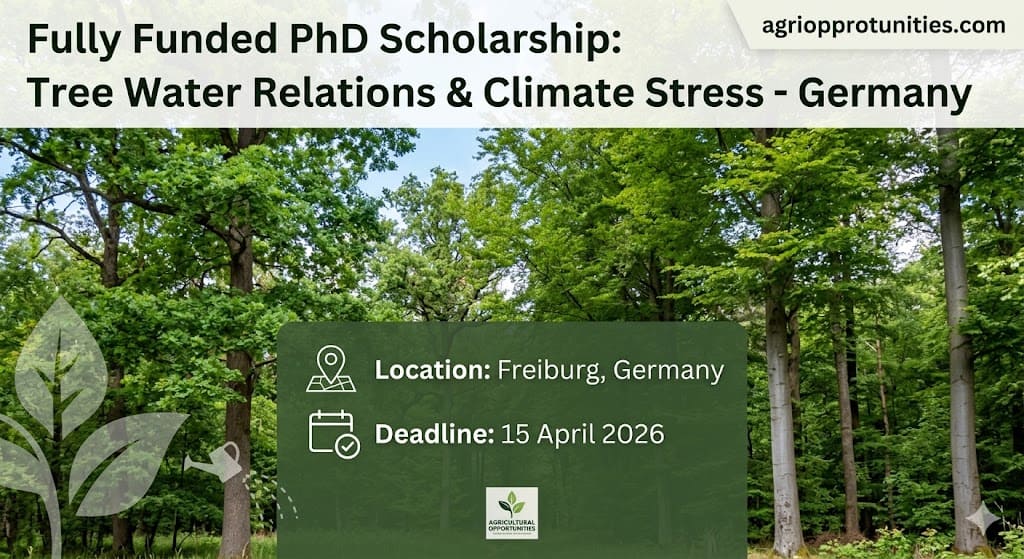
🎓Fully Funded PhD Scholarship: Tree Water Relations & Climate Stress – Germany

🏥 About University of Freiburg
Applications are open for a PhD Tree Water Relations Germany position at the University of Freiburg, Chair of Ecosystem Physiology, Faculty of Environment and Natural Resources. This fully funded doctoral position is part of Project B3.1 within Collaborative Research Center (CRC) 1537 – ECOSENSE, an interdisciplinary research initiative focused on developing innovative sensor technologies to understand ecosystem processes and climate stress impacts.
Start Date: July 2026 (second project phase)
🎯 Scholarship Overview
🔗 Research Project
The ECOSENSE initiative is redefining how scientists measure and understand ecosystems under climate stress. Hosted by the University of Freiburg, the project integrates environmental sciences and engineering to develop next-generation sensor systems capable of tracking ecological processes in real time.
This PhD Tree Water Relations Germany project centers on sensing water potentials from the leaf level to the forest stand scale. The goal is to understand how trees respond to extreme events such as droughts and heatwaves — events that are increasing in frequency due to climate change.
🔬 Research Infrastructure
A comprehensive forest research infrastructure has already been established near Freiburg, including:
- A dense sensor network
- Three canopy access towers
- Advanced measurement systems installed throughout the forest
📋 Research Focus
As a doctoral researcher, you will:
- Install and manage a sensor network on European beech and Douglas fir
- Measure continuous water potentials across the soil–plant–atmosphere continuum
- Investigate tree adaptation strategies under extreme climate conditions
- Analyze species interactions and the role of hydraulic capacitance
The research combines field measurements with laboratory and climate chamber experiments to calibrate and test novel sensors.
🔧 Technologies You Will Work With
- Optical dendrometers
- Microtensiometers
- Psychrometers
- Sap flow sensors
- Remote sensing integration tools
You will collaborate closely with remote sensing researchers to link tree-level water measurements to large-scale ecosystem monitoring systems.
✅ Qualifications
Required
| Requirement | Details |
|---|---|
| Education | Master’s degree in Environmental Sciences, Geoecology, or related field |
| Background | Strong background in plant physiology and ecosystem processes |
| Knowledge | Plant water fluxes and water potential dynamics |
| Fieldwork | Experience with fieldwork (forest research experience advantageous) |
| Language | Strong English proficiency |
| Personal | High level of autonomy, organization, and teamwork skills |
Desirable
| Requirement | Details |
|---|---|
| Sensors | Familiarity with sap flow, dendrometers, or water potential sensors |
| License | Valid driver’s license |
💼 What They Offer
| Benefit | Details |
|---|---|
| Duration | Initially 3 years (extension possible until June 2030) |
| Start Date | July 2026 |
| Location | Freiburg, Germany |
| Salary | TV-L E13 (75%) – German public sector pay scale |
| Facilities | Modern laboratory facilities |
| Team | Multicultural research team |
🎓 Academic Environment
The doctoral candidate will join the Chair of Ecosystem Physiology, a highly active and internationally connected research group.
Benefits include:
- Structured Research Training Group (RTG)
- Interdisciplinary workshops and seminars
- Professional development programs
- Close collaboration with early-career researchers
🌟 Why This PhD Matters
Climate change is reshaping forests across Europe and globally. Understanding how trees regulate water and survive extreme events is critical for:
- Sustainable forest management
- Climate adaptation policies
- Biodiversity protection
- Carbon cycle modeling
- Future ecosystem resilience strategies
📝 How to Apply
Required Documents:
- Letter of motivation
- Curriculum Vitae
- Academic transcripts
- Letter of recommendation
📧 Questions: Simon Haberstroh – simon.haberstroh@cep.uni-freiburg.de
Useful Links
Similar Posts
🎓Fully Funded PhD Scholarship: Agroecological Performance Assessment – Sweden
Applications are open for a Fully Funded PhD Agroecological Assessment Sweden position at the Department of Crop Production Ecology, Swedish University of Agricultural Sciences (SLU) in Uppsala. The PhD is embedded in the AGRITASC project, funded by the Agroecology Partnership/FORMAS.
🎓Fully Funded PhD Scholarship: VIRTUE – Phytoremediation, Pyrolysis and Biochar for PFAS removal – Norway
Applications are open for a Fully Funded PhD PFAS Environmental Sciences Norway position at the Faculty of Environmental Sciences and Natural Resource Management (MINA), Norwegian University of Life Sciences (NMBU). This 3-year PhD position is connected to the project VIRTUE.
🎓Fully Funded PhD in evolution and functional diversity of rubisco in extremophile photosynthetic organisms, Spain
A fully funded PhD position is available to investigate evolution and functional diversity of rubisco in extremophile photosynthetic organisms in Spain is now available at Chalmers University of Technology.
🎓Two Fully Funded Master’s Scholarships: Environmental Science – USA
Applications are open for Fully Funded MSc Environmental Science USA positions at Oklahoma State University (OSU) in Stillwater, Oklahoma. Two Graduate Research Assistantships (MS level) are available with a focus on Rangeland Ecology and Watershed Hydrology.
🎓Fully Funded PhD Scholarship: CRISPR Library Screening for AAV Production – Ireland
Applications are open for a PhD CRISPR AAV Production Ireland position at the National Institute for Bioprocessing Research and Training (NIBRT) in collaboration with University College Dublin (UCD). This position is part of the TRANS-AM research program focused on transforming advanced medicines manufacture.
🎓Fully Funded PhD in European Centre of Excellence for Sustainable Water Technology, The Netherlands
A Fully Funded PhD Scholarship Netherlands is now available at Wetsus, European Centre of Excellence for Sustainable Water Technology. This fully funded PhD scholarship Netherlands position focuses on linking soil microbiome with increased crop and food quality.